What Is Agent Orchestration?
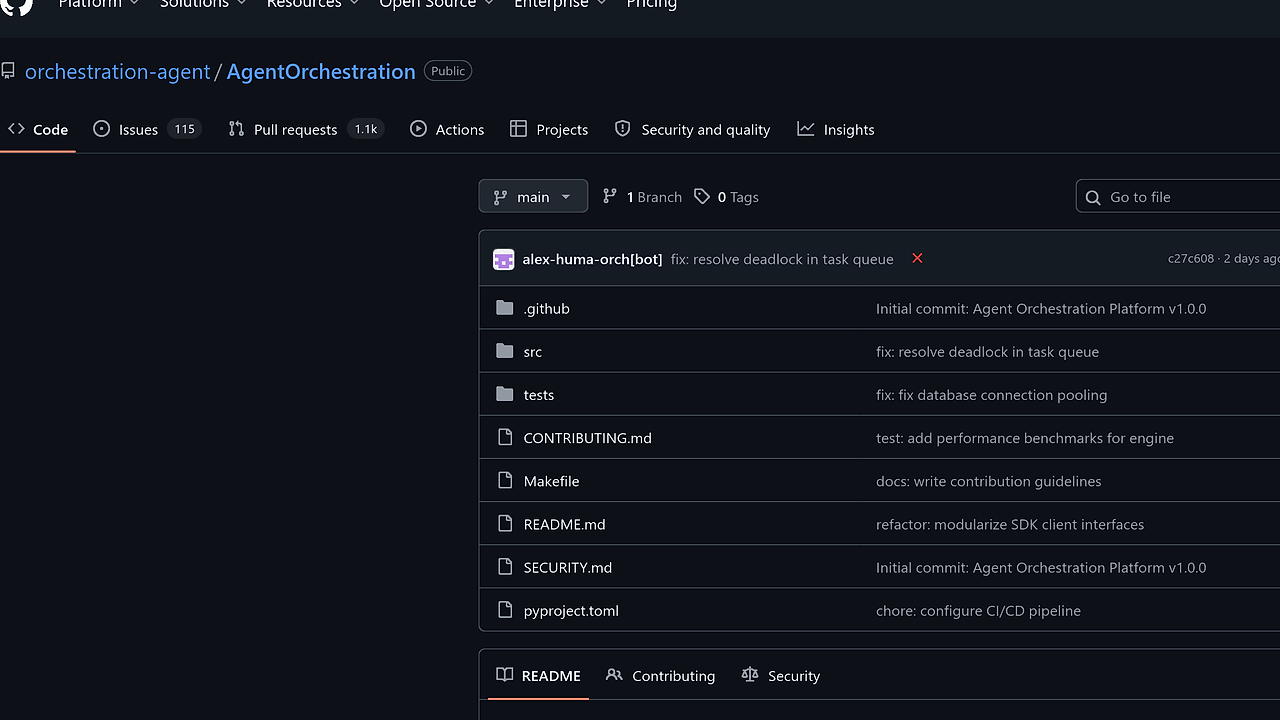
Agent Orchestration is one of the best AI Agent Orchestration Platforms tools for enterprise platform teams. Built by the orchestration-agent project, it coordinates autonomous AI agents across a registry, scheduler, resource manager, and monitoring layer, and the repo shows 40+ dated updates through Mar 21 2026. It is aimed at teams that need auditability, multi-cloud deployment, and predictable execution instead of ad hoc agent scripts.
Quick Overview
| Attribute | Details |
|---|---|
| Type | AI Agent Orchestration Platforms |
| Best For | enterprise platform teams, AI engineering leaders, and DevOps teams |
| Language/Stack | Python, TypeScript, Go, and Java SDKs; distributed orchestration engine |
| License | Enterprise License |
| GitHub Stars | N/A as of Mar 2026 |
| Pricing | Enterprise |
| Last Release | N/A — 2026-03-21 |
Who Should Use Agent Orchestration?
- Platform teams running multiple agents that need a shared registry, task queue, and resource policy instead of each service managing its own state.
- AI engineering leads who need deterministic scheduling, secure message passing, and traceable execution for regulated workflows.
- DevOps and SRE teams that want observability, alerts, and rollback-friendly operations for agent fleets across cloud and on-prem environments.
- Enterprise architects standardizing on a reusable control plane with SDK support for Python, TypeScript, Go, and Java.
Not ideal for:
- Solo builders shipping a weekend prototype that only needs a single local agent and no governance.
- Teams looking for a free open-source sandbox because Agent Orchestration is distributed under an Enterprise License.
- Use cases that do not require coordination such as a single LLM wrapper or a thin chat UI.
Key Features of Agent Orchestration
- Agent lifecycle management — Register, deploy, scale, and retire agents from a central control plane. That matters when you need consistent versioning, rollout controls, and cleanup for ephemeral workloads.
- Priority-based task scheduling — The scheduler allocates work using resource-aware rules, which helps prevent noisy-neighbor problems when multiple agents contend for CPU, memory, or external API budgets.
- Cross-agent communication with attestation — Messages are passed securely between agents with verification hooks. This is the right shape for workflows that need provenance, not just best-effort message passing.
- Enterprise security controls — RBAC, audit logging, and secrets management are built in. That reduces the amount of custom plumbing needed to pass security review in regulated environments.
- Multi-cloud and on-prem deployment — AWS, GCP, Azure, and private infrastructure are all first-class targets. That makes the system viable for hybrid estates where data residency matters.
- Observability stack — Distributed tracing, metrics, and structured logs give operators a way to debug agent latency, queue depth, and failure modes without guessing.
- Plugin architecture — Custom plugins and middleware let teams add policy checks, custom routing, or domain-specific orchestration logic without forking the core engine.
Agent Orchestration vs Alternatives
| Tool | Best For | Key Differentiator | Pricing |
|---|---|---|---|
| Agent Orchestration | Enterprise-grade agent fleets with governance | Distributed control plane with lifecycle management, attestation, and auditability | Enterprise |
| OpenSwarm | Collaborative agent swarms and lightweight coordination | Faster path for swarm-style experiments with less enterprise process overhead | Open-Source |
| Brainstorm MCP | Tool-using agents and MCP-driven workflows | Better fit when the primary problem is model-to-tool connectivity rather than fleet ops | Open-Source |
| OpenTrace | Tracing AI workflows and debugging execution paths | Best when you need deep visibility into spans, events, and failure analysis | Open-Source |
Pick OpenSwarm when you want to prototype multi-agent coordination without committing to enterprise governance. Pick Brainstorm MCP when your agents mostly need standardized tool access through MCP rather than a full orchestration layer.
Pick OpenTrace when your main pain is debugging and postmortem analysis. Agent Orchestration is the stronger choice when you need scheduling, RBAC, secrets handling, and fleet management in the same platform.
How Agent Orchestration Works
Agent Orchestration uses a distributed control-plane model. The core engine sits between the Agent Registry, Task Scheduler, Resource Manager, and Monitoring layer, so orchestration decisions are made centrally while execution stays distributed across agents and deployment targets. That architecture is a better fit than a single-process agent runner when you need stateful coordination, quota enforcement, and a paper trail for every task.
The design assumes that agents are long-lived resources with explicit lifecycle states. Registration, deployment, scaling, and retirement are separate operations, which makes it easier to manage canary releases, isolate failed workers, and keep audit logs aligned with the actual fleet state. The plugin system is the extension point for policy enforcement, middleware, and custom integrations, while the SDK layer keeps application code close to Python, TypeScript, Go, or Java instead of forcing one language runtime.
# getting started example
pip install agent-orchestrator-cli

ao init my-agents
ao deploy examples/hello-agent.yaml
ao status --watch
The first command installs the CLI, the second creates a new orchestration project, the third submits an example agent definition, and the fourth streams live status updates. In a real deployment, you would usually add cloud credentials, secrets configuration, and RBAC policy before pushing production agents.
Pros and Cons of Agent Orchestration
Pros:
- Built for fleet management — The platform handles registration, deployment, scaling, and retirement instead of treating agents as throwaway scripts.
- Security features are native — RBAC, audit logs, and secrets management are included, which saves time during enterprise security reviews.
- Works across environments — Multi-cloud and on-prem support makes it usable in hybrid infrastructure without separate orchestration stacks.
- Operational visibility is strong — Tracing, metrics, and structured logs help diagnose queue congestion, timeouts, and agent-to-agent failures.
- Extensible control plane — Plugins and middleware reduce the need for forks when teams need custom routing or compliance hooks.
Cons:
- Enterprise license only — Teams that want a permissive open-source license will need to look elsewhere.
- Operational overhead is non-trivial — A distributed scheduler, registry, and observability stack require real platform ownership.
- Likely overkill for single-agent apps — If you only need one model call and one tool call, the platform adds more ceremony than value.
- Unknown community scale — The scraped page does not expose star counts or release cadence beyond the update history, so external adoption is harder to gauge.
Getting Started with Agent Orchestration
pip install agent-orchestrator-cli

ao init my-agents
cd my-agents

ao deploy examples/hello-agent.yaml
ao status --watch
This quickstart creates a local project, deploys an example agent specification, and opens a live status view. After that, the next practical step is usually adding environment-specific configuration for cloud credentials, secrets, and policy rules so the same definition can run in staging and production.
If you are doing an Agent Orchestration tutorial for a team, start by modeling one task class and one failure mode. That gives you a clean baseline for testing scheduling behavior, audit output, and alert routing before you wire in a larger agent graph.
Verdict
Agent Orchestration is the strongest option for enterprises running coordinated AI agent fleets when governance and auditability matter more than speed of setup. Its main strength is the combination of scheduling, security, and observability in one distributed platform. The caveat is the enterprise-only licensing and operational overhead. Choose it when you need disciplined agent operations, not a lightweight prototype runner.