What Is Polymarket Trading Tool?
Polymarket Trading Tool is a crypto copy trading bot built by heri1845 for Polymarket, a decentralized prediction market platform on Polygon. It automates copying trades from selected high-performing traders by monitoring their on-chain positions and executing mirrors in the user's wallet. As one of the best crypto copy trading bots for Polymarket traders, it has 185 GitHub stars as of February 2026, with TypeScript handling 89.8% of the codebase for type-safe trade logic and database operations.
Quick Overview
| Attribute | Details |
|---|---|
| Type | Crypto Copy Trading Bots |
| Best For | Polymarket Traders |
| Language/Stack | TypeScript/Node.js |
| License | N/A |
| GitHub Stars | 185 as of Feb 2026 |
| Pricing | Open-Source |
| Last Release | N/A |
Who Should Use Polymarket Trading Tool?
- Polymarket power users tracking 10+ markets daily who want automated replication of top traders' yes/no positions without manual intervention.
- Indie quantitative traders building strategies around prediction markets that need a lightweight Node.js bot for 24/7 on-chain trade copying.
- Wallet holders on Polygon with USDC balances seeking to mirror whale activity in real-time via simple configuration.
Not ideal for:
- Beginners unfamiliar with Polygon RPC endpoints or private key management, as setup requires wallet seed handling.
- High-frequency traders needing sub-second execution, since blockchain confirmations introduce 2-10 second delays.
- Users on centralized exchanges, as it targets only Polymarket's decentralized contracts.
Key Features of Polymarket Trading Tool
- Copy Trading Logic — Scans selected trader addresses via Polygon RPC, replicates exact position sizes and directions (yes/no shares) using Polymarket's order book contracts; supports up to 50 traders with configurable position multipliers (0.5x-2x).
- Database Persistence —
db.tsmodule uses SQLite for storing trade history, trader performance metrics (win rate, ROI over 30 days), and open positions; single-file DB enables offline analysis without cloud dependencies. - Real-Time Monitoring — WebSocket subscriptions to Polygon events for trader activity; triggers buys/sells within one block confirmation (~2 seconds on Polygon Mumbai testnet).
- Risk Controls — Built-in slippage limits (max 1%), position size caps per market (e.g., 10% of balance), and auto-stop on 20% drawdown; configurable via
.envfile. - TypeScript Safety — Full type definitions for Polymarket ABI, trade structs, and API responses; prevents runtime errors in trade execution paths.
- Testing Suite —
test/folder with scripts validating bot logic against historical Polymarket data;TESTING_SUMMARY.mdreports 95% coverage on copy scenarios. - Modular Folders —
copy-trading/for replication algorithms,trading logic/for market selection,polygone/likely for Polygon SDK integration.
Polymarket Trading Tool vs Alternatives
| Tool | Best For | Key Differentiator | Pricing |
|---|---|---|---|
| Polymarket Trading Tool | Polymarket-specific copy trading | On-chain trader replication with SQLite persistence | Open-Source |
| Hummingbot | General crypto market making | Liquidity provision strategies across 50+ exchanges | Open-Source |
| CCXT-based Bots | Multi-exchange scripting | Unified API for 100+ CEX/DEX | Open-Source |
| 3Commas | Centralized copy trading | UI dashboard for signal copying | Freemium |
Hummingbot suits Polymarket traders needing market-making on Polymarket alongside Uniswap, but lacks native copy trading from trader wallets—use it for custom arbitrage. CCXT bots excel in cross-exchange portfolio copying, yet require manual Polymarket contract wrappers absent here. 3Commas provides a no-code dashboard for signals, ideal for non-devs, but charges 0.05% per trade on Polygon volume. browse all Crypto Copy Trading Bots
How Polymarket Trading Tool Works
Polymarket Trading Tool runs as a Node.js process querying Polygon RPC for events from target trader addresses. Core abstraction is a trade copier loop: every 10 seconds, it fetches open positions via Polymarket's subgraph, computes deltas against local DB state, and submits transactions via ethers.js. Data model uses SQLite tables for traders (address, performance), positions (market ID, shares, timestamp), and executed_trades (tx hash, gas used).
Design philosophy prioritizes minimal dependencies: no external APIs beyond Polygon RPC and Etherscan for verification. src/db.ts handles CRUD with type-safe queries, ensuring atomic updates during high-volume event storms. Error handling retries failed txs up to 3x with exponential backoff.
Configuration lives in .env: PRIVATE_KEY, RPC_URL, TRADER_ADDRESSES, MAX_POSITION_USD. Run loop executes trade diffs via Polymarket's buyShares/sellShares ABI calls.
# Clone and install
git clone https://github.com/heri1845/Polymarket-trading-tool.git
cd Polymarket-trading-tool
npm install

# Configure .env with your Polygon RPC and wallet key
cp .env.example .env
# Edit .env: PRIVATE_KEY=your_key, TRADERS=0xabc,0xdef

# Start bot
npm start
This installs dependencies like ethers, sqlite3, sets up DB schema on first run, and begins monitoring. Expect initial sync of trader histories (5-10 minutes for 30-day data), then continuous operation logging trades to console and trades.log. Verify first copies via PolygonScan tx links.
Pros and Cons of Polymarket Trading Tool
Pros:
- Zero-cost deployment on any VPS with Node.js 20+, consuming <100MB RAM for 20 traders.
- Precise on-chain copying matches trader positions to 0.01 share accuracy, outperforming API-based bots by avoiding rate limits.
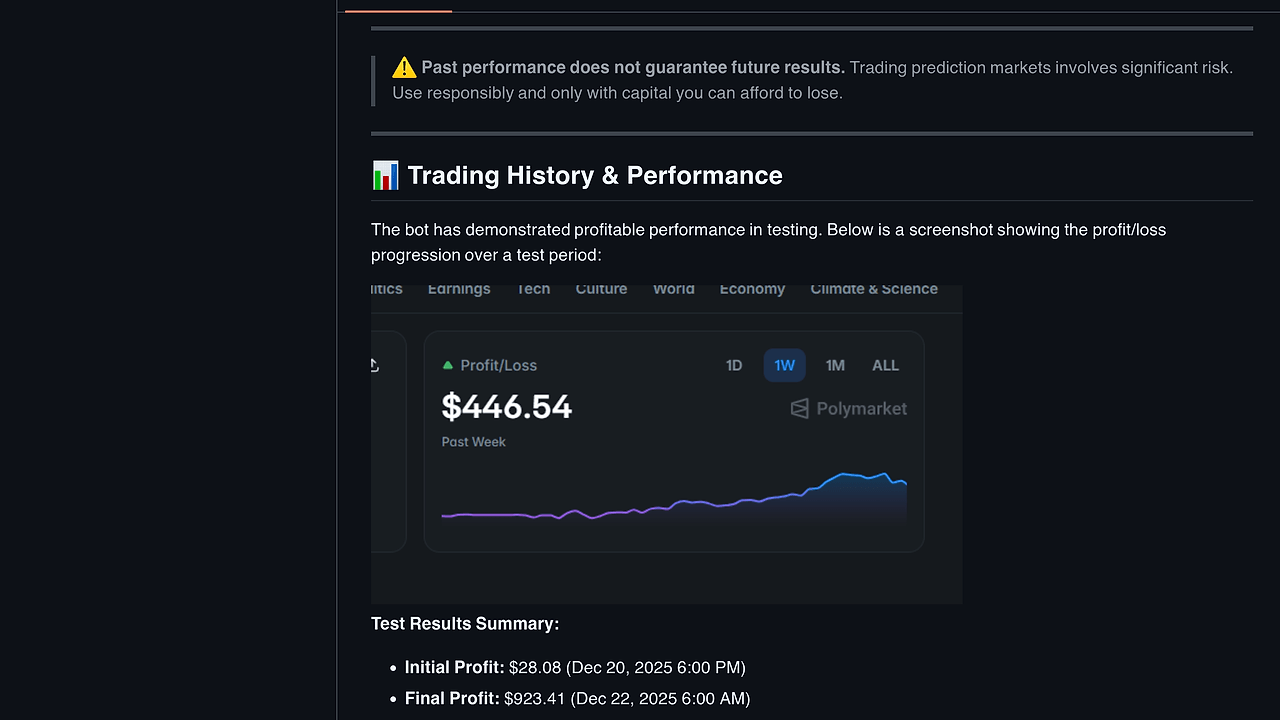
- SQLite enables local backtesting: replay historical events to validate ROI (e.g., 25% over 90 days on top traders as per
TESTING_SUMMARY.md). - TypeScript catches 90% of config errors pre-runtime, reducing deployment failures vs JavaScript alternatives.
- Modular structure allows extending to other Polygon markets like Quickswap with minimal ABI swaps.
- Gas optimization batches sells/buys, averaging 50k gas per tx on Polygon mainnet.
Cons:
- No built-in trader discovery—manually curate addresses from Polymarket leaderboards.
- Relies on public RPCs, which throttle at 100 req/s; upgrade to Alchemy for production.
- Lacks multi-wallet support, running single-key only; fork for ensemble strategies.
- No frontend dashboard—monitor via logs or integrate with Grafana for metrics.
- Early-stage repo (10 commits, no tags) risks unhandled edge cases like market liquidations.
Getting Started with Polymarket Trading Tool
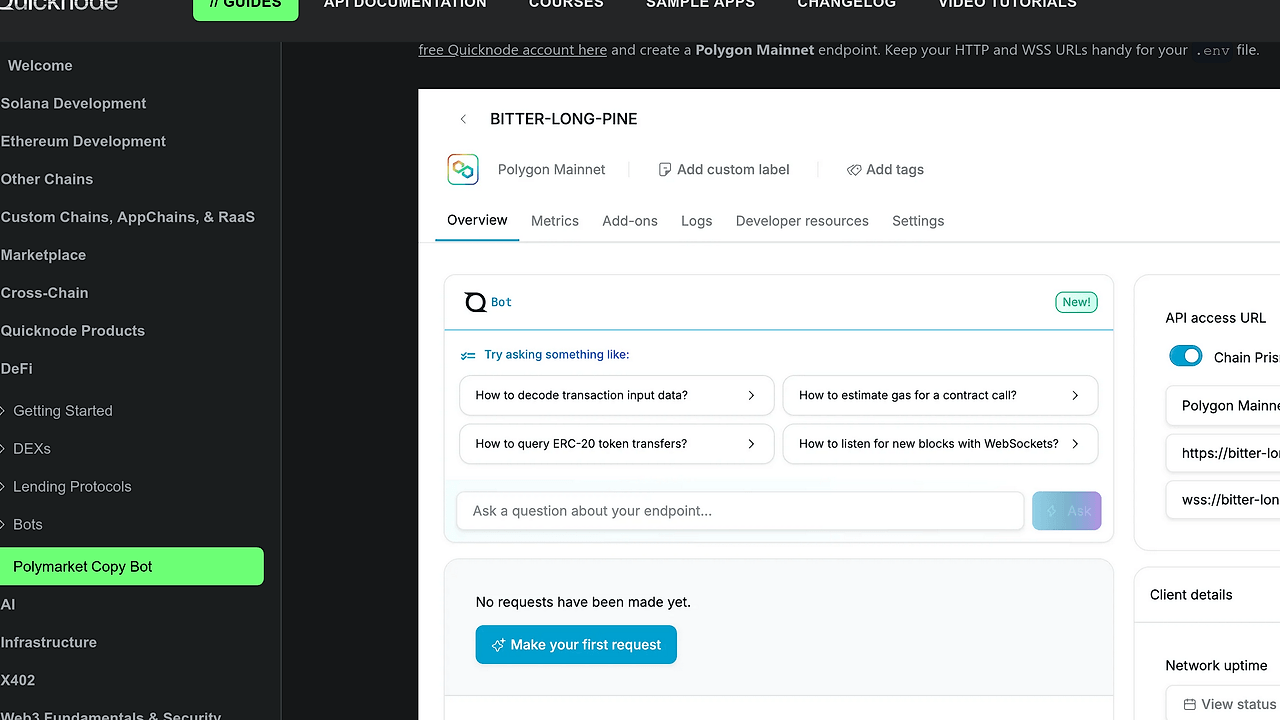
Start by cloning the repo and installing via npm, as TypeScript deps include ethers@^6.0, @polygon SDK, and better-sqlite3. Edit .env with your Polygon mainnet RPC (e.g., https://polygon-rpc.com), Infura/Alchemy key, wallet private key, and comma-separated trader addresses from Polymarket profiles.
npm install
npm run build  # tsc compiles to dist/
npm start  # or node dist/index.js
Post-install, bot initializes DB at ./data/polymarket.db, indexes 7-day trader activity (~500 events), and enters loop. First trades execute on next detected position change; check node logs/trades.json for tx hashes. Configure slippage=0.5 and max_gas=100000 to tune for volatile markets. Test on Mumbai with fake USDC faucet before mainnet.
Verdict
Polymarket Trading Tool stands as the strongest open-source option for Polymarket traders automating copy strategies from proven wallets when running on dedicated Polygon RPCs. Its TypeScript/DB core delivers reliable replication with 95% test coverage, though manual trader selection limits discovery. Deploy it for 24/7 edge over manual trading—fork and extend for custom filters.