What Is Pump.fun bundler CLI?
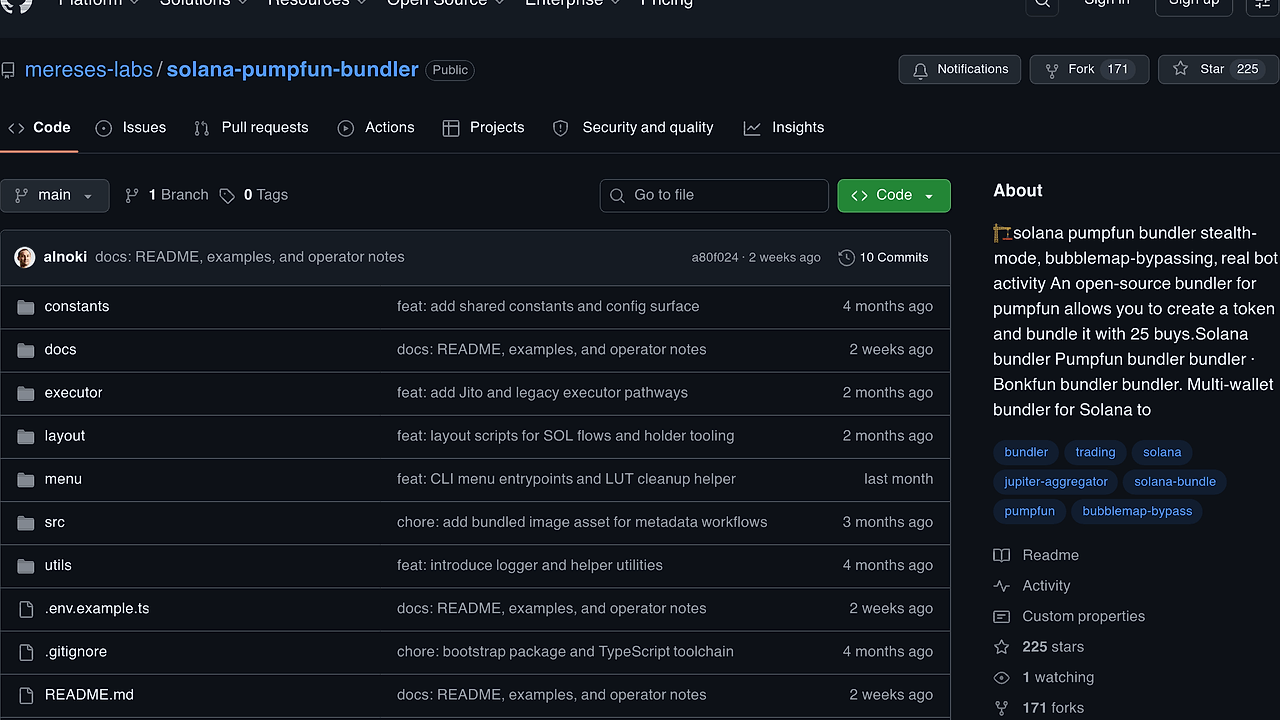
Pump.fun bundler CLI is a TypeScript CLI built by mereses-labs for Solana token launch operators; it orchestrates Pump.fun metadata upload, mint creation, multi-wallet bundle buys, SOL routing, and holder workflows from one local menu. Pump.fun bundler CLI is one of the best Solana Trading CLI Tools for Solana token launch operators, and the repo exposes 4 main workflows plus a smoke test that prints the menu and exits on option 5. It wraps @solana/web3.js, Anchor, a bundled Pump.fun IDL client, and Jito bundle submission so the operator owns the full transaction graph.
Quick Overview
| Attribute | Details |
|---|---|
| Type | Solana Trading CLI Tools |
| Best For | Solana token launch operators and bot builders |
| Language/Stack | TypeScript, @solana/web3.js, Anchor, Pump.fun IDL, Jito bundles |
| License | ISC |
| GitHub Stars | N/A as of Feb 2026 |
| Pricing | Open-Source |
| Last Release | N/A — no tagged release in the scraped page |
Who Should Use Pump.fun bundler CLI?
- Launch teams running Pump.fun drops who need the metadata upload, mint creation, and bundled buys in one operator flow instead of stitching together ad hoc scripts.
- Solana bot builders who already understand wallets, RPC endpoints, and priority fees, and want a repeatable command-line workflow with fewer moving parts.
- Small execution desks that need to fan out buys or sweeps across multiple wallets, then gather SOL back into a control wallet after the launch window closes.
- Security-conscious operators who prefer local config files, gitignored secrets, and explicit bundle submission over a browser UI with hidden state.
Not ideal for:
- Teams that want a GUI with minimal setup and no wallet handling.
- Users who do not have a disciplined hot-wallet process, since the tool expects real keys and live RPC access.
- Projects that need a general-purpose DEX trader instead of Pump.fun-specific launch automation.
Key Features of Pump.fun bundler CLI
- Pump.fun metadata upload — The tool prepares the token metadata object with
name,symbol,description, socials, and animagepath, then uploads the payload during the create flow. On Node.js 18+, it can rely on globalBlobandfetch, which keeps the upload path simple and avoids extra runtime shims. - Mint creation and launch orchestration — The creator wallet in
LP_wallet_*signs the on-chain create instruction, and the repo stores the mint secret atwallets/mint_secret.bs58after launch. That makes the mint lifecycle explicit and easier to audit than a hidden in-memory flow. - Multi-wallet bundle buys — The CLI builds buy transactions across several bundler wallets and submits them through Jito with
sendBundle. That is the right shape when you want synchronized execution instead of sequential RPC broadcasts that can be reordered or partially filled. - Address lookup table support — The bundle path uses an ALT so the transaction can carry more accounts without exploding the message size. This matters when create, funding, tips, and multiple buy instructions need to fit into one coordinated package.
- SOL routing and wallet refills — The
solDistributeandsolGatherpaths move SOL across bundler wallets and sweep funds back after use. That gives operators a clean way to stage capital for launches and then consolidate balances without manual transfers. - Pre-simulation before broadcast — The
presimulateflow checks the create metadata and create transaction path before live submission. In practice, that is the cheapest way to catch bad account state, malformed metadata, or missing config before a bundle hits the block engine. - Audit-friendly workflow separation — The repo splits behavior into focused modules like
createTokenBuy,presimulate, andsolDistribute, with logs written undersrc/logs/<date>.txt. That structure is easier to reason about than a single monolithic bot file, especially when you need to debug a failed launch under time pressure.
Pump.fun bundler CLI vs Alternatives
| Tool | Best For | Key Differentiator | Pricing |
|---|---|---|---|
| Pump.fun bundler CLI | Local Pump.fun launch operations | Menu-driven TypeScript app with bundled Pump.fun client, ALT flow, and Jito bundle submission | Open-Source |
| PumpPortal | Hosted launch or trading workflows | Less local state and faster onboarding, but less control over exact wallet and bundle construction | Freemium / Paid |
Raw @solana/web3.js scripts | Teams building custom Solana systems | Maximum flexibility, but you write transaction assembly, retries, logging, and wallet orchestration yourself | Open-Source |
| Jito bundle SDK or custom relay code | Teams that only need bundle transport | Lowest-level bundle submission primitive with no Pump.fun-specific launch logic | Open-Source |
Pick PumpPortal if you want an API or web front end and do not care about owning every wallet and instruction in the flow. Pick Pump.fun bundler CLI when the launch graph matters and you want local control over metadata, bundle buys, and SOL routing.
Use raw @solana/web3.js scripts if your team wants total control and is comfortable building a bot platform from scratch. For broader command-line automation outside Solana launch flows, start with browse all CLI tools. For post-launch transaction tracing, pair this workflow with OpenTrace to correlate bundle submissions and confirmations.
If bundle transport is the only problem you need to solve, the Jito SDK is enough and keeps the abstraction layer small. Pump.fun bundler CLI is the better fit when you need launch-specific orchestration, wallet funding, and holder actions in one operator shell instead of a pile of glue code.
How Pump.fun bundler CLI Works
Pump.fun bundler CLI is a local operator shell that reads .env for RPC and bundle endpoints and settings.ts for wallet and token state. The design centers on explicit config files, so the tool does not hide state behind a server process or remote dashboard. @solana/web3.js handles account inspection, transaction building, and confirmations, while Anchor and the bundled Pump.fun IDL drive the on-chain instructions.
The codebase splits operations into focused layout modules, including createTokenBuy, presimulate, solDistribute, and solGather, with bundle dispatch delegated to executor/lilJito.ts. That separation is useful because create flows, bundle flows, and fund-sweep flows fail for different reasons and need different recovery paths. The CLI creates an ALT when the account set becomes too large, then sends the result through the Jito block engine endpoint configured in .env.
npm install
cp settings.example.ts settings.ts
printf '5\n' | npm start
That smoke test loads dependencies, boots the interactive menu, and exits immediately without changing chain state. After that, fill in the creator wallet, bundler wallets, and token metadata in settings.ts, then point RPC_ENDPOINT, RPC_WEBSOCKET_ENDPOINT, and the Jito block engine variables at infrastructure you actually control.
Pros and Cons of Pump.fun bundler CLI
Pros:
- Deterministic launch flow — The CLI keeps metadata upload, mint creation, bundling, and funding in one explicit path, which reduces operator ambiguity.
- Jito-native bundle submission —
sendBundleis built into the workflow, so the tool is designed for coordinated execution rather than naive broadcast. - ALT-aware transaction packing — Address lookup tables make larger bundle payloads practical when you add extra wallet and funding instructions.
- Pre-simulation support — The repo includes a presimulate path that catches bad state before live submission.
- Clear config boundary — Secrets live in
settings.ts,.env, andwallets/, which is easier to audit than scattered inline constants. - Operational logging — Timestamped logs under
src/logs/help you reconstruct what happened during a launch or sweep.
Cons:
- High key-management burden — The tool expects hot wallets, secret handling, and disciplined rotation, which is not friendly to casual users.
- Pump.fun-specific scope — It is useful for Pump.fun flows, but it is not a general Solana trading framework.
- Dependency risk — The repo notes transitive vulnerabilities from older Anchor and Raydium-related packages, so production use needs review.
- No GUI layer — Operators must be comfortable with a terminal, config files, and logs.
- Operational and compliance risk — Coordinated trading, misleading launches, or market manipulation can trigger platform, RPC, or legal issues, so the tool requires responsible use.
Getting Started with Pump.fun bundler CLI
git clone https://github.com/mereses-labs/solana-pumpfun-bundler.git
cd solana-pumpfun-bundler
npm install
cp settings.example.ts settings.ts
npm start
The first run opens the menu, but it will only be useful after settings.ts and .env are populated with valid wallets, RPC endpoints, and token metadata. Use Node.js 18+ so the metadata upload path has native Blob and fetch, then run npm run typecheck once the config file exists to catch type errors before you touch mainnet.
The token.image path must resolve locally, and the creator wallet plus bundler provider wallets need enough SOL to cover fees, tips, and any launch-side funding. If you want a non-destructive smoke test before a real launch, run printf '5\n' | npm start after configuration to verify the menu boots and exits cleanly.
Verdict
Pump.fun bundler CLI is the strongest option for local Pump.fun launch automation when you need deterministic wallet control and Jito bundle submission in one TypeScript workspace. Its best strength is the tight coupling between metadata upload, ALT-backed bundle buys, and SOL routing. The caveat is operational risk and heavy key management. Use it if you can run hot wallets safely and want full transaction ownership.