What Is Polymarket Copy-Trading Bot?
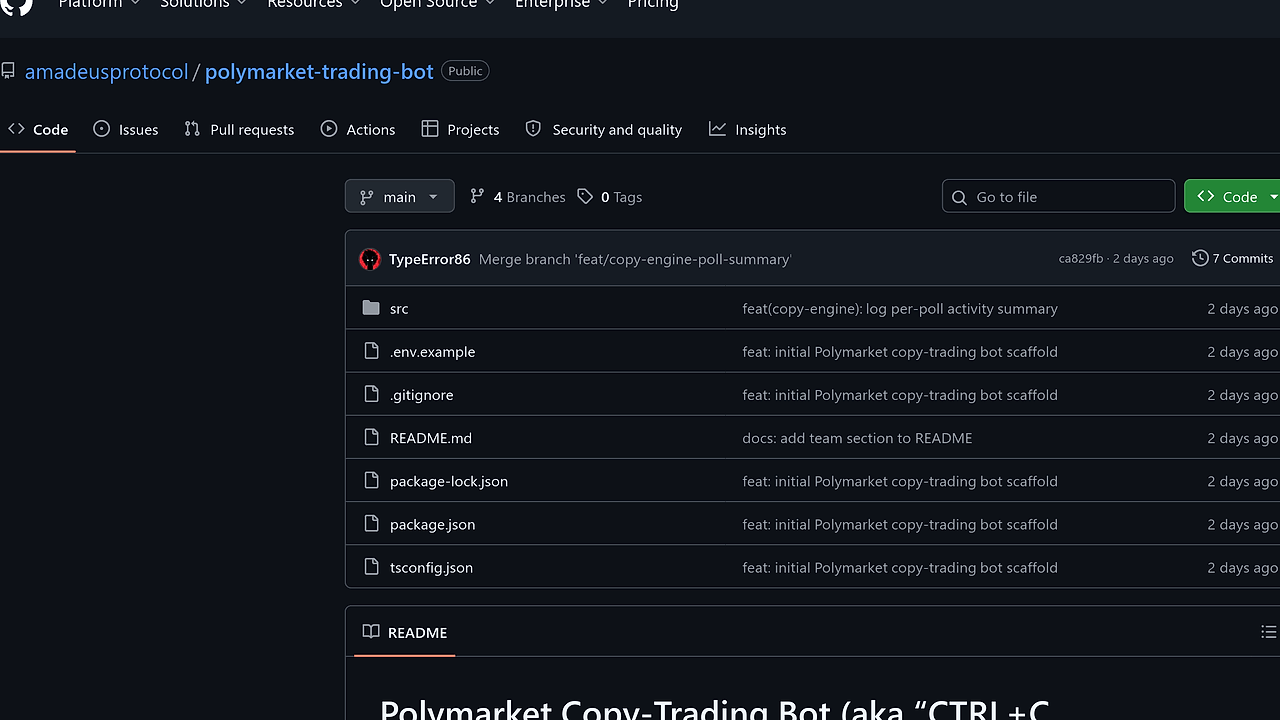
Polymarket Copy-Trading Bot is a TypeScript/Node copy-trading bot built by the amadeusprotocol contributors for Polymarket developers and quant-minded traders who want to mirror a target wallet from their own account. It is one of the best Prediction Market Bots tools for Polymarket developers, and the README documents a five-minute setup path plus risk controls like a size multiplier and per-order USD caps.
The bot watches a target user, polls for recent activity, and places similar orders through your own Polymarket account. It is designed for people who want deterministic automation around the Polymarket CLOB instead of hand-copying trades in the UI.
Quick Overview
| Attribute | Details |
|---|---|
| Type | Prediction Market Bots |
| Best For | Polymarket developers, automation engineers, and copy-traders |
| Language/Stack | TypeScript, Node.js 20, Polymarket CLOB, Polygon |
| License | N/A |
| GitHub Stars | N/A |
| Pricing | Open-Source |
| Last Release | N/A |
Who Should Use Polymarket Copy-Trading Bot?
- Solo traders who want to mirror one high-conviction Polymarket wallet without writing a full execution engine.
- Automation engineers who need a small, inspectable TypeScript codebase with environment-variable configuration and clear guardrails.
- Indie hackers testing copy-trading UX, wallet-following products, or a signal-to-execution pipeline before building a larger platform.
- Risk-aware operators who prefer caps, multipliers, and explicit polling intervals over opaque bot defaults.
Not ideal for:
- Low-latency desks that need event streaming, sub-second reaction times, or market-making style execution.
- Users expecting arbitrage without building their own routing, pricing, and execution logic.
- Teams unwilling to manage keys or fund a dedicated wallet for testing.
Key Features of Polymarket Copy-Trading Bot
- Target resolution by proxy or username —
COPY_TARGET_USERaccepts either a0x...proxy address or a username. The bot tries to resolve the username to a proxy, which keeps setup flexible when you know the trader but not their exact on-chain address. - Poll-based activity ingestion —
COPY_POLL_INTERVAL_MSandCOPY_ACTIVITY_LIMITdefine how often the bot checks for new activity and how much history it scans per pass. That keeps the runtime easy to reason about, but it also means execution is intentionally interval-based rather than streaming. - Trade sizing guardrails —
COPY_SIZE_MULTIPLIERscales copied order size, andCOPY_MAX_ORDER_USDhard-caps the order value. Those two knobs are the difference between controlled mirroring and accidentally matching a whale-sized position. - Trades-only mode —
COPY_TRADES_ONLY=truenarrows copying to actual trade activity instead of every wallet action. That reduces noise when the target wallet has unrelated activity or when you want to exclude non-execution events from the mirror. - Node 20 TypeScript runtime — the repo uses a plain
npm install,npm run dev, andnpm startworkflow. There is no custom runtime to bootstrap, which keeps local inspection and code changes straightforward. - Private-key plus proxy-based execution — the bot signs with
POLYMARKET_PRIVATE_KEYand routes throughPOLYMARKET_ADDRESS, which is the proxy or funder address shown in the Polymarket UI. That separation matters because the bot mirrors orders from your account, not from the target’s wallet. - Safety-first defaults — the README recommends a fresh wallet, a low
COPY_SIZE_MULTIPLIER, and a smallCOPY_MAX_ORDER_USDwhile testing. That is the correct posture for copy trading because the failure mode is usually over-sizing, not under-sizing.
Polymarket Copy-Trading Bot vs Alternatives
| Tool | Best For | Key Differentiator | Pricing |
|---|---|---|---|
| Polymarket Copy-Trading Bot | Copying a specific Polymarket trader | Username/proxy targeting plus order mirroring on the Polymarket CLOB | Open-Source |
| Hummingbot | Market making and exchange arbitrage | Many exchange connectors and strategy templates | Open-Source |
| Freqtrade | Systematic crypto strategy research | Backtesting, hyperopt, and indicator-driven bots | Open-Source |
| CCXT | Building custom exchange integrations | Unified API layer rather than a ready-made bot | Open-Source |
Pick Hummingbot if your job is cross-exchange routing, liquidity provision, or market making across multiple venues. It is a broader execution framework than Polymarket Copy-Trading Bot, but it is not built around mirroring one trader’s wallet.
Pick Freqtrade if you care more about strategy research, backtests, and parameter sweeps than social trading. Freqtrade is better when your edge comes from indicators or portfolio rules, not from following a single Polymarket account.
Pick CCXT if you want raw exchange adapters and you are comfortable writing the rest yourself. If you plan to wrap this into a larger agent workflow, OpenSwarm fits the coordination layer well, and OpenTrace is useful when you need to inspect failed execution paths and rate-limit behavior.
How Polymarket Copy-Trading Bot Works
The core architecture is simple: a target activity poller, a trade filter, a sizing layer, and an execution path that submits mirrored orders through your own Polymarket account. The bot reads COPY_TARGET_USER, fetches the latest target activity on a schedule, filters it according to COPY_TRADES_ONLY, and translates the result into orders scaled by COPY_SIZE_MULTIPLIER and bounded by COPY_MAX_ORDER_USD.
That design choice matters because it keeps the state model small. The bot only needs your configuration, the target identity, recent activity history, and the outcome of the last execution pass, which makes debugging much easier than with a black-box service.
The protocol choice is also deliberate. Polling is less elegant than a websocket stream, but it is easier to recover from process restarts, network hiccups, and API errors, and it avoids the complexity of maintaining a long-lived subscription just to mirror another wallet.
COPY_TARGET_USER=0xTargetProxyAddressHere
COPY_POLL_INTERVAL_MS=15000
COPY_SIZE_MULTIPLIER=0.25
COPY_MAX_ORDER_USD=20
COPY_TRADES_ONLY=true
npm run dev
The example above starts the bot in a conservative mode that checks every 15 seconds, copies only trade activity, and limits each mirrored order to a small dollar amount. Expect a short delay between the target trade and your own order, because the bot is intentionally poll-based instead of event-driven.
Pros and Cons of Polymarket Copy-Trading Bot
Pros:
- Clear execution model — the bot mirrors activity with explicit polling, so you know exactly when it checks and what it can miss.
- Strong risk controls — sizing multipliers and hard USD caps reduce the chance of blindly matching oversized positions.
- Low operational overhead — the TypeScript and Node.js setup is familiar to most developers and easy to modify.
- Username-to-proxy support — target discovery is friendlier than forcing every operator to track addresses manually.
- Simple local debugging — environment variables and a standard npm workflow make it easy to inspect and patch.
Cons:
- Polling adds latency — the bot cannot match a target in real time, so it will always trail the source trader by at least one interval.
- No arbitrage engine — it copies trades, but it does not scan markets for price differences or route around slippage.
- Key management is on you — the README assumes you understand private keys, proxy addresses, and wallet hygiene.
- Limited strategy scope — this is not a general quant platform with backtesting, portfolio analytics, or exchange coverage.
- Operational risk remains — if the target trader is wrong, Polymarket Copy-Trading Bot will faithfully copy the mistake.
Getting Started with Polymarket Copy-Trading Bot
git clone https://github.com/amadeusprotocol/polymarket-trading-bot.git
cd polymarket-trading-bot
npm install
cp .env.example .env
npm run dev
After the first run, the bot reads your .env, resolves the target trader, and begins polling for activity at the configured interval. If username resolution fails, switch COPY_TARGET_USER to the target proxy address directly, then lower your multiplier and cap before you let it run unattended.
Verdict
Polymarket Copy-Trading Bot is the strongest option for Polymarket wallet mirroring when you want a small TypeScript codebase instead of a generic trading framework. Its main strength is explicit control over sizing and polling; its main caveat is latency, because polling will always lag the source trader. Use it if you want practical copy trading on Polymarket and can tolerate that delay.