What Is WeatherBet?
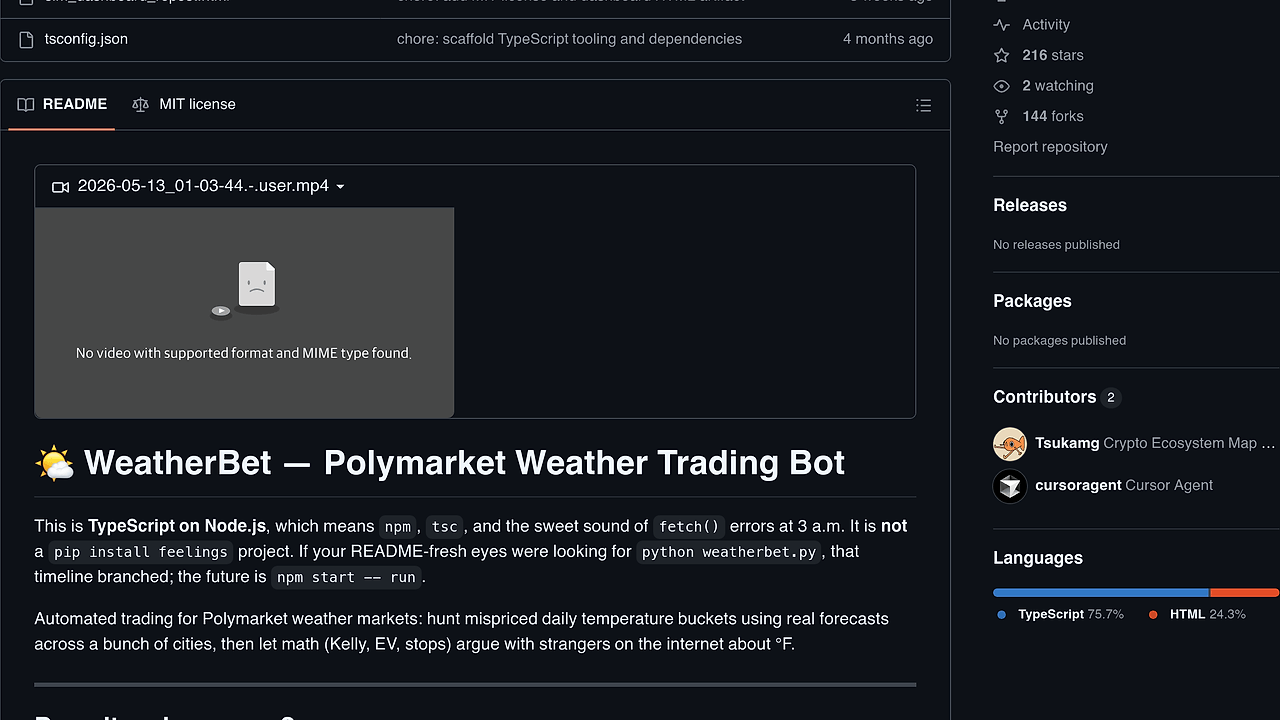
WeatherBet is an open-source TypeScript on Node.js bot built by Tsukamg that scans Polymarket weather markets, compares forecast sources, and decides whether a temperature bucket has positive edge. WeatherBet is one of the best Prediction Market Bots tools for quant traders, and the scope is deliberately narrow: 20 cities, 3 forecast sources, airport-based resolution, and optional live execution when you want automation instead of spreadsheet theater.
The design is built around weather-market mechanics rather than generic trading abstractions. It runs in paper mode by default, uses Gamma quotes and a simulated balance when live CLOB access is disabled, and persists every decision so you can audit why a trade happened or why it was skipped.
Quick Overview
| Attribute | Details |
|---|---|
| Type | Prediction Market Bots |
| Best For | quant traders |
| Language/Stack | TypeScript on Node.js |
| License | N/A |
| GitHub Stars | N/A |
| Pricing | Open-Source |
| Last Release | N/A |
Who Should Use WeatherBet?
- Quant traders building weather-market strategies who want a rule-based entry engine instead of manual clicking. WeatherBet handles the forecast ingestion, EV check, and position sizing loop so you can focus on edge quality.
- Indie hackers testing automation ideas on Polymarket without writing a full trading stack from scratch. WeatherBet already includes market lookup, ledger persistence, and a paper trading path.
- Ops-minded developers who want a Node.js service they can run on a VPS with
npm start -- runand inspect after the fact. The JSON market history makes debugging much easier than opaque SaaS automation. - Research-heavy builders comparing model forecasts against observed station data. WeatherBet gives you a concrete pipeline for testing whether ECMWF, HRRR, GFS, and METAR data agree enough to justify a trade.
Not ideal for:
- High-frequency traders who need sub-second execution, exchange colocation, or order-book microstructure analysis. WeatherBet is a forecast-driven bot, not an HFT stack.
- People who want a GUI-only product with no environment variables, no terminal, and no code review. WeatherBet expects you to edit
.env, run commands, and understand what each key does. - Teams that refuse third-party data dependencies. WeatherBet depends on weather APIs, Gamma metadata, and, in live mode, Polymarket credentials.
Key Features of WeatherBet
- Multi-source weather ingestion — WeatherBet pulls from Open-Meteo for ECMWF and HRRR/GFS coverage, plus Aviation Weather METAR for station observations. That gives it both forecast inputs and reality checks before it risks capital.
- Airport-first market mapping — Polymarket weather markets resolve against airport stations like KLGA, KORD, KSEA, and KDAL, not downtown coordinates. WeatherBet maps the city to the correct station so a narrow bucket does not get misread by a few degrees of geography.
- EV gate and fractional Kelly sizing — Trades are blocked unless the expected value clears the threshold, then sized with Kelly rather than a fixed wager. That means edge drives position size, not the size of the lunch break.
- Explicit downside controls — The bot uses a 20% stop-loss, a breakeven trailing stop after +20%, and a slippage filter that skips markets with spreads above $0.03. Those rules keep the bot from paying up in thin books.
- Paper and live execution paths — Paper mode uses Gamma quotes and a simulated balance, while live mode switches to
@polymarket/clob-clientwhenWEATHERBOT_CLOB_LIVE=1is set. You can test the whole workflow before putting real funds at risk. - JSON market ledger — Every forecast snapshot, price update, open position, and resolution lands under
data/markets/as JSON. That gives you an audit trail that pairs well with OpenTrace for decision tracing and DataHaven for long-term archival. - Interval-based monitor loop — The bot scans markets, waits, and rechecks open positions on a fixed cadence. That is a sane design for weather markets, where signal changes happen on forecast refreshes, not every millisecond.
WeatherBet vs Alternatives
| Tool | Best For | Key Differentiator | Pricing |
|---|---|---|---|
| WeatherBet | Polymarket weather markets | Forecast-driven execution with airport mapping, EV checks, and Kelly sizing | Open-Source |
| Hummingbot | Crypto exchange market making | Broad connector ecosystem for exchanges, not weather settlement logic | Open-Source |
| Freqtrade | Crypto strategy research and automation | Strong backtesting and indicator workflow on OHLCV data | Open-Source |
| 3Commas | Hosted crypto trading automation | Fast setup with a UI, but it is exchange-first and not forecast-native | Paid |
Pick Hummingbot if your edge depends on exchange liquidity provision, arbitrage, or connector coverage. Pick Freqtrade if your workflow starts with candle data, technical indicators, and Python strategy research. Pick 3Commas if you want a hosted dashboard and do not care about weather settlement mechanics. WeatherBet wins when the market primitive is a forecast, not a chart.
How WeatherBet Works
WeatherBet uses a simple pipeline: fetch weather, map the market to the correct airport station, compute expected value, size the position, then place or simulate the order. The core abstraction is a per-market JSON record under data/markets/, which stores enough state to explain why a trade was taken, held, or rejected.
The design favors explicit data flow over hidden magic. WeatherBet reads Polymarket metadata from Gamma, fetches weather inputs from Open-Meteo, cross-checks station reality through Aviation Weather METAR, and uses Visual Crossing for historical and resolution helpers. The result is a deterministic service that is easy to replay, inspect, and debug.
export WEATHERBOT_VC_KEY=your_visual_crossing_key
export WEATHERBOT_CLOB_LIVE=0
npm start -- run
That command starts the main loop in paper mode, so WeatherBet will scan markets, evaluate edge, and update its ledger without sending live orders. If you want to trace each decision, pipe the logs into OpenTrace; if you want repeatable deployment on a VPS, pair the repo with djevops.
The execution layer is intentionally thin. When live trading is enabled, the bot uses Polymarket CLOB credentials and a proxy wallet; when it is disabled, the same strategy code runs against Gamma quotes and a simulated balance. That split makes the WeatherBet tutorial path practical because you can validate the math before you wire up keys.
Pros and Cons of WeatherBet
Pros:
- Forecast-native workflow — WeatherBet is built for weather markets, so the city-to-airport mapping and forecast ingestion are already in the right shape.
- Clear risk logic — EV gating, Kelly sizing, stop-loss, trailing stop, and slippage checks are explicit and easy to reason about.
- Paper mode first — You can run the full strategy without live orders, which is the right default for a market with noisy data and thin liquidity.
- Audit-friendly storage — JSON files under
data/markets/make it easy to inspect state, replay decisions, or build your own analytics. - Node.js operational model — Anyone comfortable with
npm,tsc, and environment variables can run it without learning a separate runtime.
Cons:
- Weather-data dependence — WeatherBet is only as good as the upstream forecast and station feeds. If those APIs rate-limit, drift, or change schemas, you own the breakage.
- No graphical dashboard — The bot is terminal-first, so non-technical users will feel friction immediately.
- Manual configuration required — You need a
.envfile, weather keys, and, for live trading, Polymarket credentials. - Narrow market scope — WeatherBet is specialized for weather markets, so it is not the right answer for generic crypto bots or equity execution.
- Operational vigilance still matters — Stops, filters, and Kelly sizing reduce bad trades, but they do not remove market risk or bad forecast regimes.
Getting Started with WeatherBet
The fastest way to learn how to use WeatherBet is to run it in paper mode, inspect the output, and only then decide whether live trading is worth enabling. The install path is standard Node.js tooling, and the repo expects Node.js 20.10+ so fetch() and AbortSignal behavior match the runtime assumptions.
git clone https://github.com/Tsukamg/polymarket-weather-trading-engine
cd polymarket-weather-trading-engine
npm install
cp env.example .env
npm run build
npm start -- status
npm start -- run
After the first run, WeatherBet will create or update files under data/markets/ and print its current balance or paper balance state. Set WEATHERBOT_VC_KEY before you expect good historical resolution data, and only set WEATHERBOT_CLOB_LIVE=1 after you have added WEATHERBOT_POLY_PRIVATE_KEY and WEATHERBOT_POLY_PROXY_WALLET.
If you are on Windows, the repo also supports copy env.example .env instead of cp. If you want a more durable archive of market snapshots, send the JSON output to DataHaven so you are not relying only on local disk.
Verdict
WeatherBet is the strongest option for automated Polymarket weather trading when you want forecast-driven entries and hard risk rules. Its biggest strength is the EV-plus-Kelly pipeline backed by airport-aware market mapping; its main caveat is the setup overhead around API keys, market-specific data, and live trading credentials. Use it if you want serious experiment tooling, not casual betting.