Cellarium: What It Kills / Replaces
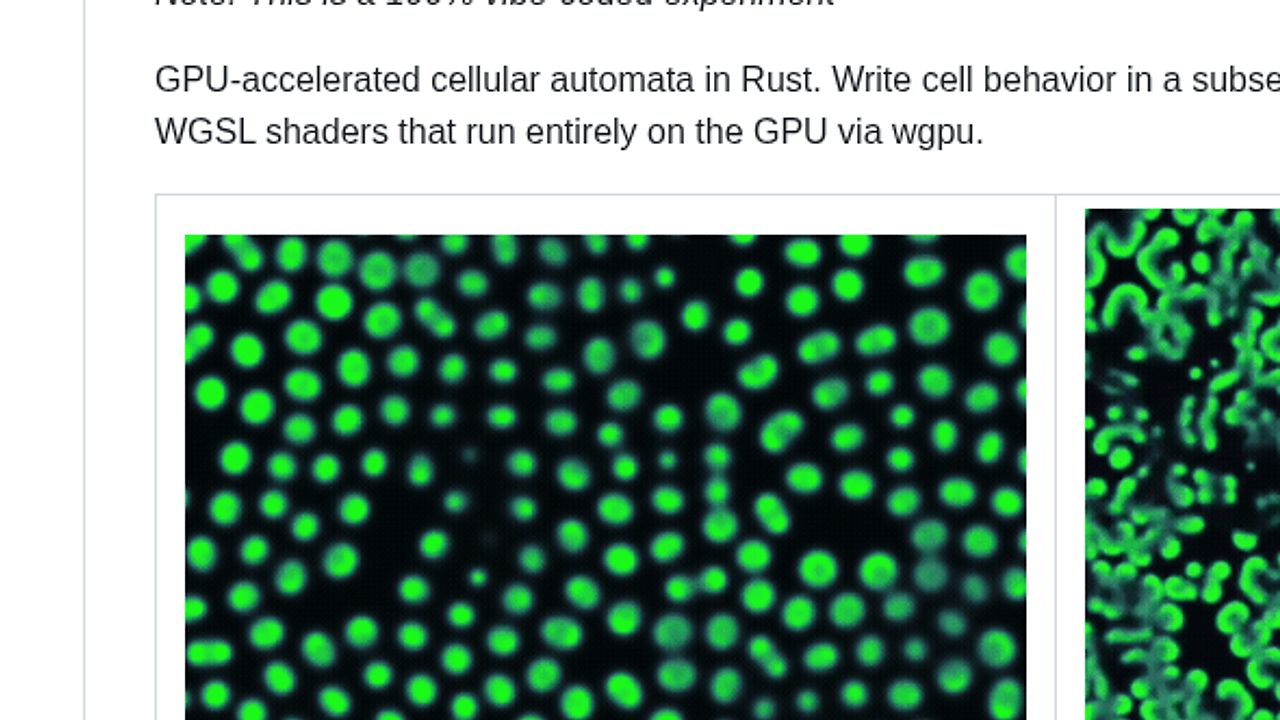
Cellarium aims to replace traditional CPU-bound cellular automata frameworks with a GPU-accelerated approach. It disrupts libraries that rely on slower, more cumbersome methods in favor of more performant graphics pipeline integration.
Under the Hood: Architecture
At its core, Cellarium utilizes Rust to define cellular behaviors while leveraging WGSL shaders for execution on the GPU via wgpu. The data model revolves around GPU textures, allowing for efficient representation and manipulation of cell states.
The Good & The Bad
Pros:
- Directly write conditions in Rust, reducing context-switching.
- Parallel processing speeds up simulations significantly.
- Compact, efficient state representation using textures minimizes memory usage.
- Provides real-time feedback with adjustable constants over a TUI interface.
Cons:
- Higher learning curve for developers unfamiliar with GPU programming.
- Overhead of GPU context setup may negate benefits for smaller simulations.
- Limited to the performance bounds of wgpu, which might not suit all GPUs.
Quickstart
To get started quickly with Cellarium, simply set up your project and run the example:
cargo run --example game_of_life