What Is NVIDIA NemoClaw?
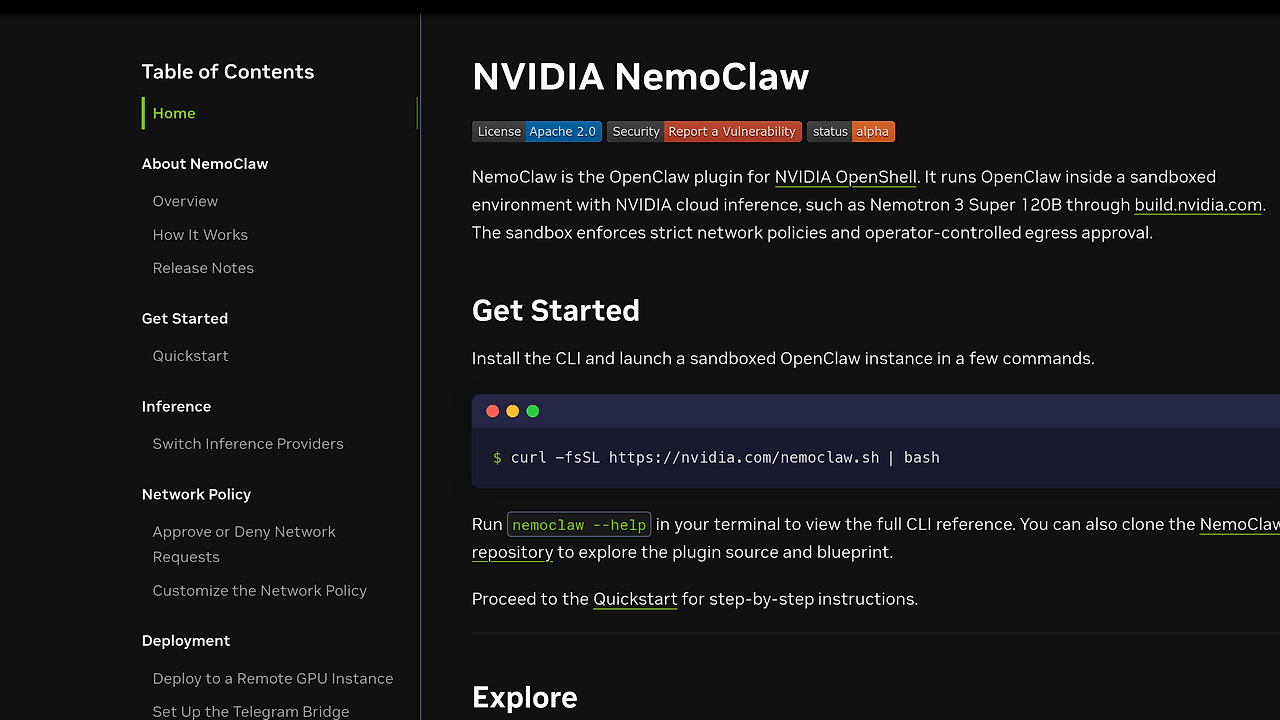
NVIDIA NemoClaw is an open-source AI agent runtime built by NVIDIA as an OpenClaw plugin for the OpenShell framework within the NVIDIA Agent Toolkit. It provisions secure, sandboxed environments for always-on OpenClaw assistants, handling inference routing through NVIDIA cloud endpoints while isolating agent execution via Docker containers and k3s clusters. NVIDIA NemoClaw targets developers experimenting with autonomous agents, boasting 8.1k GitHub stars and 845 forks as of October 2024. As one of the best AI agent runtimes for developers building autonomous agents, it emphasizes production-grade isolation from day one despite its alpha status.
Quick Overview
| Attribute | Details |
|---|---|
| Type | AI Agent Runtimes |
| Best For | developers building autonomous agents |
| Language/Stack | Docker, k3s, NVIDIA OpenShell |
| License | Apache-2.0 |
| GitHub Stars | 8.1k as of Oct 2024 |
| Pricing | Open-Source |
| Last Release | main (1897b90) — Oct 2024 |
Who Should Use NVIDIA NemoClaw?
- AI researchers prototyping agent swarms: Need isolated sandboxes for OpenClaw models without host contamination, supporting multi-vCPU inference workloads.
- Indie hackers integrating NVIDIA agents: Want one-command k3s deployment for OpenShell gateways, bypassing manual Kubernetes YAML authoring.
- DevOps teams securing agent pipelines: Require Docker-based isolation with cloud-routed inference, fitting CI/CD via non-interactive install.sh modes.
- Platform engineers scaling agent fleets: Handle 4+ vCPU nodes pushing 2.4 GB sandbox images without OOM failures on 16 GB RAM setups.
Not ideal for:
- Production deployments demanding SLAs, as alpha APIs change frequently.
- Low-spec laptops under 8 GB RAM, where image decompression triggers OOM without swap.
- Non-NVIDIA inference users, locked to cloud routing.
Key Features of NVIDIA NemoClaw
- Sandbox Orchestration: Deploys k3s clusters per agent, using parameterized setup.sh for custom names; isolates OpenClaw execution in 2.4 GB Docker images compressed.
- OpenShell Integration: Routes agent inference via NVIDIA Agent Toolkit gateways, supporting always-on assistants with secure token handling in openclaw.json.
- Non-Interactive CI/CD Mode: install.sh and uninstall.sh flags enable automated onboarding; detects sandbox context in status commands to avoid false negatives.
- Hardware-Aware Provisioning: Enforces 4 vCPU/8 GB RAM minimums; recommends 16 GB/40 GB disk for parallel Docker daemon, k3s, and image export pipelines.
- Documentation Automation: .agents/skills/update-docs handles CONTRIBUTING.md and README.md updates; sphinx_llm.txt groups for uv-managed Python docs.
- Code Quality Hardening: .editorconfig enforces linting/formatting; .coderabbit.yaml for PR reviews; DCO in LICENSE for contributions.
- GitHub Actions CI: Workflows for docs builds on PRs (#334); fixes 403 errors on github.com/npmjs.org via access: full in nemoclaw-blueprint.
NVIDIA NemoClaw vs Alternatives
| Tool | Best For | Key Differentiator | Pricing |
|---|---|---|---|
| NVIDIA NemoClaw | developers building autonomous agents | k3s sandboxes with NVIDIA cloud inference | Open-Source |
| OpenSwarm | Swarm agent coordination | Peer-to-peer agent meshing without cloud | Open-Source |
| Brainstorm MCP | Multi-cloud agent planning | Protocol-agnostic MCP for hybrid deploys | Open-Source |
| OpenTrace | Agent observability | Distributed tracing for agent calls | Open-Source |
OpenSwarm suits decentralized setups where cloud dependency is a non-starter, offering native P2P for agent swarms at the cost of NVIDIA-specific optimizations. Brainstorm MCP excels in multi-provider environments, abstracting inference backends unlike NemoClaw's NVIDIA lock-in. OpenTrace pairs well for monitoring NemoClaw agents, adding span collection absent in the base runtime.
How NVIDIA NemoClaw Works
NVIDIA NemoClaw abstracts agent deployment into a sandbox model using Docker for isolation and k3s for lightweight Kubernetes orchestration. Core components include the OpenShell runtime gateway, which proxies OpenClaw assistant calls to NVIDIA cloud inference endpoints via secure APIs. The nemoclaw directory houses the main CLI, with bin/setup.sh parameterizing sandbox names to enable multi-agent contexts; pyproject.toml and package.json manage Python/Node.js dependencies via uv and npm.
At runtime, install.sh pulls the 2.4 GB sandbox image, spins up k3s, and configures openclaw.json without hardcoding NVIDIA_API_KEY exposure. Status commands query sandbox health, fixing false negatives by detecting k3s contexts. Inference flows: agent prompt → OpenShell gateway → NVIDIA cloud → response, all within container boundaries to prevent host escapes.
# Clone and install
curl -sSL https://raw.githubusercontent.com/NVIDIA/NemoClaw/main/install.sh | bash

# Start sandboxed OpenClaw agent
nemoclaw status
nemoclaw sandbox create my-agent --non-interactive
These commands provision a fresh k3s cluster, deploy the OpenShell gateway, and verify sandbox readiness. Expect 2-5 minutes on recommended hardware, with logs in ~/.nemoclaw detailing image pulls and pod schedules. Initial config auto-generates openclaw.json; edit for custom skills in .agents/skills.
Pros and Cons of NVIDIA NemoClaw
Pros:
- Zero-config k3s deployment cuts setup from hours to minutes for OpenClaw sandboxes.
- Docker isolation blocks agent escapes, with 2.4 GB images supporting offline caching post-pull.
- Non-interactive modes integrate directly into GitHub Actions or Jenkins pipelines (#318).
- Active community: 141 PRs, 83 issues, recent fixes like #340 for sandbox naming.
- uv-managed Python deps ensure reproducible builds across pyproject.toml.
- Hardware scaling: Handles 4 vCPU loads without tuning, OOM-resistant on 16 GB RAM.
Cons:
- Alpha status means API breaks: e.g., JensenClaw easter egg removed for security (# recent).
- NVIDIA cloud lock-in prevents local GPU inference routing.
- High resource floor: 8 GB RAM minimum, swap kludge for lower specs slows exports.
- No built-in observability; pair with OpenTrace for traces.
- Docs workflow young: sphinx_llm.txt experimental, manual CONTRIBUTING.md updates needed.
Getting Started with NVIDIA NemoClaw
NVIDIA NemoClaw requires a fresh OpenClaw install and NVIDIA account for cloud inference. Verify prerequisites: 4 vCPU, 8 GB RAM, 20 GB disk; add swap if marginal.
# Prerequisites: Docker, curl
curl -sSL https://raw.githubusercontent.com/NVIDIA/NemoClaw/main/install.sh | bash -s -- --non-interactive

# Verify and create sandbox
nemoclaw status
nemoclaw sandbox create test-agent
nemoclaw agent run --sandbox test-agent
Running install.sh fetches dependencies, starts k3s, and builds the sandbox image; output shows pod IPs and gateway endpoints. First agent run proxies a sample OpenClaw prompt to NVIDIA cloud, logging response latency under 2s. Configure ~/.nemoclaw/openclaw.json for API keys and skills; uninstall.sh cleans k3s without residue.
Verdict
NVIDIA NemoClaw stands as the strongest AI agent runtime for developers building autonomous OpenClaw assistants when NVIDIA cloud inference fits your stack. Its k3s sandboxes deliver true isolation with one-liner deploys, hitting 8.1k stars for good reason. Caveat alpha volatility—pin commits for stability. Deploy it today for secure agent experimentation.