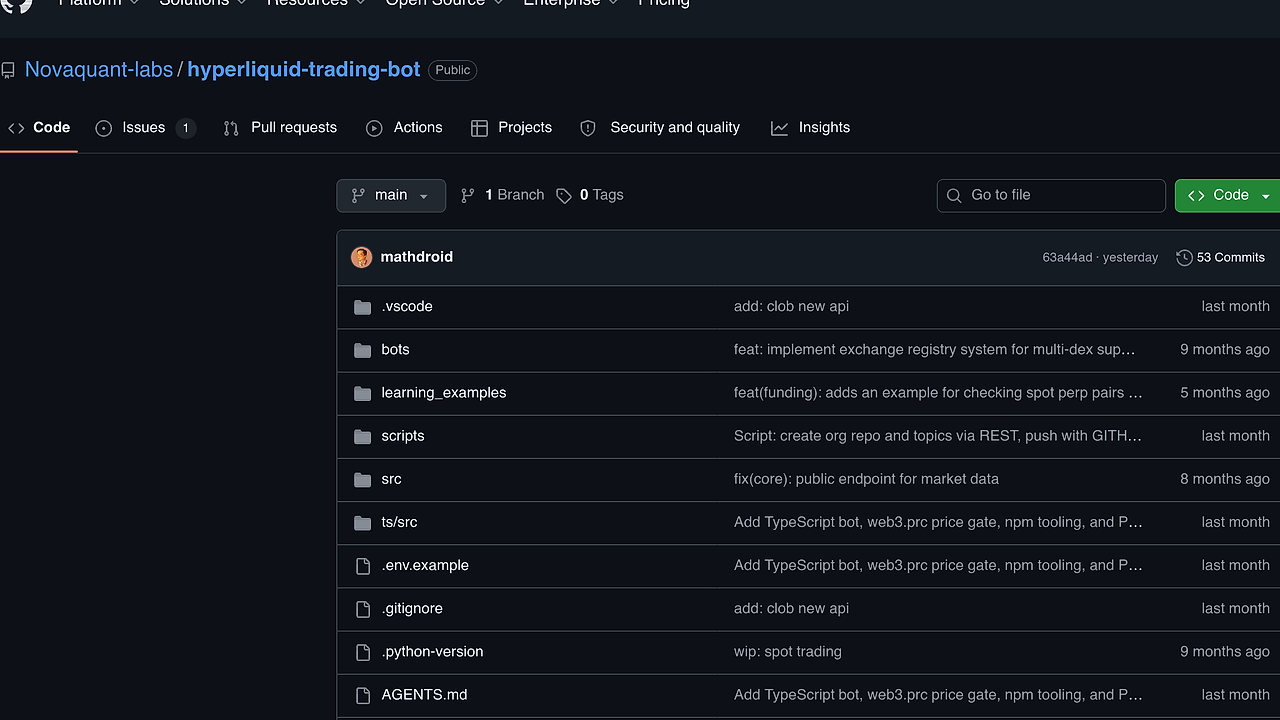
What Is Hyperliquid Grid Trading Bot?
Hyperliquid Grid Trading Bot is a Node.js and TypeScript grid-strategy runner from Novaquant-labs for Hyperliquid, and Hyperliquid Grid Trading Bot is one of the best Crypto Trading Bots tools for algo traders. It automates layered limit orders, rebalances as price moves, and enforces risk limits for traders who want hands-off execution on testnet or mainnet. The repo’s quick start targets a 5-minute setup and ships with a conservative BTC config for controlled first runs.
Quick Overview
| Attribute | Details |
|---|---|
| Type | Crypto Trading Bots |
| Best For | algo traders, quants, and Hyperliquid users who want automated grid execution |
| Language/Stack | Node.js 20.19+, TypeScript, YAML, Hyperliquid API |
| License | MIT |
| GitHub Stars | N/A |
| Pricing | Open-Source |
| Last Release | N/A |
Who Should Use Hyperliquid Grid Trading Bot?
- Hyperliquid-focused traders who want a deterministic grid engine instead of manually babysitting orders in the terminal.
- Indie quants validating range-trading ideas who need a config-driven runner, not a full research stack.
- Small prop or personal trading desks that need testnet-first deployment, drawdown gates, and explicit allocation caps.
- Node.js developers who prefer a codebase they can inspect, fork, and wire into their own monitoring or execution workflow.
Not ideal for:
- High-frequency traders who need sub-second market-making logic, order book microstructure analysis, or colocation.
- People looking for a no-risk passive income app; the bot still trades derivatives and can lose principal.
- Teams that need deep backtesting, portfolio analytics, or ML signal generation out of the box.
Key Features of Hyperliquid Grid Trading Bot
- YAML-driven strategy config — Every important setting lives in a single YAML file under
bots/, which keeps strategy parameters versionable and easy to diff in Git. That structure is ideal for repeatable deployments because the bot can be started from a known config rather than hidden UI state. - Testnet and mainnet switching — The environment supports
HYPERLIQUID_TESTNET=truefor rehearsal runs and a mainnet mode for live capital. That separation is the right default for exchange automation because it forces you to validate behavior before sending real orders. - Layered grid placement — The runner places buy orders below and sell orders above a configured center price, then keeps the ladder active as fills happen. This is the core grid-trading mechanic: buy lower, sell higher, repeat, and keep inventory bounded by the configured limits.
- Risk management gates — The sample config includes
max_allocation_pct,stop_loss_enabled,take_profit_enabled,max_drawdown_pct, and rebalance thresholds. Those controls matter more than the entry strategy because grid bots fail when they over-allocate into a one-way trend. - Operational logging and validation —
npm run validatecatches config mistakes before the bot starts, andnpm run debugincreases log detail for execution tracing. That makes failure modes easier to inspect because you can see order placement, rebalances, and shutdown behavior in the logs. - Simple Node runtime footprint — The repository targets Node.js 20.19+ and runs as a command-line process, which makes it straightforward to deploy on a VPS, a container, or a long-lived shell session. There is no browser session, no heavy backend, and no extra platform lock-in.
- Graceful stop behavior — Pressing
Ctrl+Ccancels open orders, which is a small detail but a critical one for live trading. A bot that does not clean up stale orders on exit creates orphaned exposure and makes operator error expensive.
Hyperliquid Grid Trading Bot vs Alternatives
| Tool | Best For | Key Differentiator | Pricing |
|---|---|---|---|
| Hyperliquid Grid Trading Bot | Hyperliquid-only grid execution with clear risk controls | Minimal, inspectable Node.js runner tuned for one exchange | Open-Source |
| Hummingbot | Multi-exchange market making and more advanced bots | Broader exchange coverage and a larger execution framework | Open-Source |
| Freqtrade | Strategy research, backtesting, and automated crypto trading | Stronger quant workflow with backtesting and indicator pipelines | Open-Source |
| Jesse | Systematic crypto strategy development and research | Research-first architecture with more emphasis on strategy development | Open-Source |
If you want exchange-level observability around live fills and stops, pair a bot like this with OpenTrace so execution history stays inspectable. If you want to archive fills, PnL, and run metadata outside the process, DataHaven is a cleaner fit than trying to overload the trading runner with storage concerns.
Pick OpenSwarm only if you are orchestrating multiple autonomous workers around the bot, not for the trading loop itself. For most users, Hyperliquid Grid Trading Bot beats Hummingbot when the only exchange you care about is Hyperliquid and you want fewer moving parts.
How Hyperliquid Grid Trading Bot Works
Hyperliquid Grid Trading Bot uses a simple execution model: read secrets from .env, load a YAML strategy file, place a ladder of limit orders around a center price, and keep scanning for fills, risk breaches, and rebalance triggers. The design choice here is deliberate. Instead of a sprawling service with a database, queue, and dashboard, the bot keeps state small and explicit so you can reason about every order that reaches Hyperliquid.
The core abstraction is the grid: a set of buy levels below the current price and sell levels above it. That means the bot is not trying to predict direction; it is trying to monetize oscillation while staying inside guardrails like allocation caps, drawdown thresholds, and optional stop-loss or take-profit rules. The practical result is a process you can run on a VPS, inspect from logs, and shut down without leaving chaos behind.
npm install
cp .env.example .env
npm run validate
npm start
The first command installs dependencies, the second creates your local secret file, the third validates your YAML before live execution, and the last starts the runner with the first active strategy. In a real deployment, you would set testnet mode first, confirm that the grid levels and allocation limits match your risk tolerance, and only then flip the environment to mainnet.
Pros and Cons of Hyperliquid Grid Trading Bot
Pros:
- Clear execution path — The bot is a single-purpose runner, so you can understand the order lifecycle without digging through a multi-service architecture.
- Testnet-first workflow — The repository makes it easy to rehearse before risking capital, which is the correct default for derivative automation.
- Explicit risk controls — Allocation caps, drawdown thresholds, and stop-loss or take-profit settings are present in the config, not hidden in code.
- Git-friendly configuration — YAML files make strategy changes diffable, reviewable, and easy to roll back.
- Command-line operability — You can install, validate, debug, and run everything from the shell with standard Node tooling.
- Easy to fork — TypeScript plus a small surface area makes custom extensions less painful than in a larger trading framework.
Cons:
- Only one exchange focus — Hyperliquid support is the point, but that also means no broad multi-exchange abstraction layer.
- No built-in research suite — You do not get serious backtesting, walk-forward analysis, or portfolio analytics from the repo alone.
- Derivatives risk is real — Grid trading can get trapped in trending markets if sizing and drawdown limits are not tuned aggressively enough.
- Requires secret handling discipline — Private keys live in
.env, so operator mistakes can be expensive if you ignore basic key management. - Operational monitoring is minimal — You get logs, but you still need external tools if you want dashboards, alerts, or long-term run archives.
Getting Started with Hyperliquid Grid Trading Bot
The fastest way to start is to clone the repo, install dependencies, copy the example environment file, and run validation before you expose any live keys. The bot expects a .env file for private-key configuration and a YAML file under bots/ that defines the grid, allocation cap, and risk thresholds.
git clone https://github.com/Novaquant-labs/hyperliquid-trading-bot.git
cd hyperliquid-trading-bot
npm install
cp .env.example .env
npm run validate
npm start
After validation passes, the bot will load the first active config and begin placing grid orders. Start on testnet, keep max_allocation_pct low, and use a conservative range_pct until you have verified how the bot behaves when price moves sharply or fills cluster on one side.
Verdict
Hyperliquid Grid Trading Bot is the strongest option for Hyperliquid-native grid automation when you want a small, inspectable Node.js runner and clear risk controls. Its main strength is operational simplicity; its main caveat is that it is still a live derivatives bot with no built-in research stack. Use it if you want direct execution control and can manage risk like an adult.