What Is Orthrus?
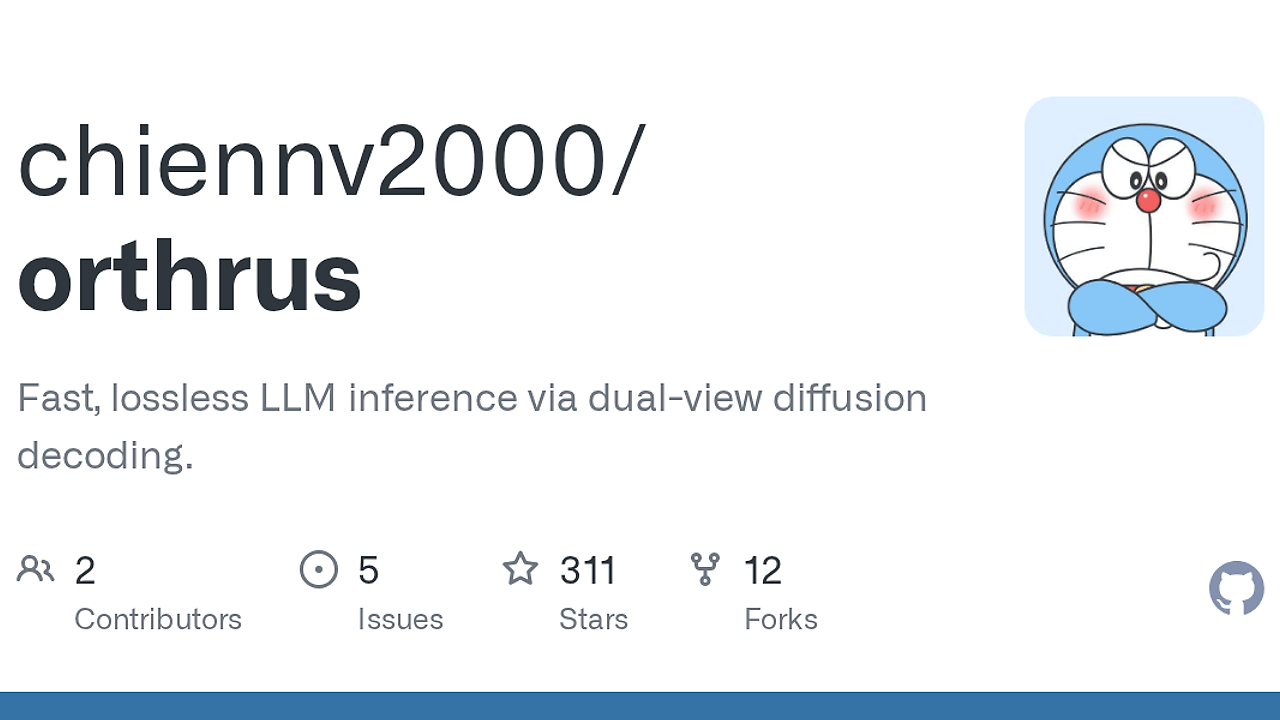
Orthrus is a dual-view diffusion framework built by Chien Van Nguyen and collaborators for memory-efficient, lossless LLM inference. Orthrus is one of the best LLM Inference Optimization tools for ML engineers and researchers because it preserves the base model's exact predictive distribution while delivering up to a 7.8× generation speedup on published benchmarks. The repo ships Qwen3-based checkpoints and a PyTorch/Transformers implementation for teams that need faster decoding without speculative-decoding drift.
Quick Overview
| Attribute | Details |
|---|---|
| Type | LLM Inference Optimization |
| Best For | ML engineers and researchers shipping LLMs |
| Language/Stack | Python, PyTorch, Hugging Face Transformers, FlashAttention, MLX |
| License | N/A |
| GitHub Stars | N/A |
| Pricing | Open-Source |
| Last Release | N/A |
Who Should Use Orthrus?
- Inference engineers serving Qwen3-class models who need lower latency without accepting draft-model mismatch or output drift.
- Research teams comparing parallel token generation methods against speculative decoding baselines like EAGLE-3 and DFlash.
- Apple Silicon developers who want local inference on Macs through MLX instead of waiting for CUDA-only paths.
- Benchmarking teams measuring long-context behavior, especially when context windows reach 40K tokens and standard parallel methods start to degrade.
Not ideal for:
- Teams that need a hosted API or managed serving layer instead of a research-oriented codebase.
- Deployments that cannot use
trust_remote_code=Trueor installflash-attndependencies. - Users who only need plain autoregressive decoding and do not care about decoding speedups.
Key Features of Orthrus
- Strictly lossless generation — Orthrus uses an exact intra-model consensus mechanism so the output matches the original base model's predictive distribution. That matters when correctness is non-negotiable for code generation, math, or safety-sensitive workloads.
- Dual-view diffusion architecture — The autoregressive view and the diffusion view share the same high-fidelity Key-Value cache. This removes the duplicate cache pressure you get with draft-model speculative decoding and keeps cache overhead at roughly O(1).
- Qwen3 model zoo — The repo publishes Orthrus-Qwen3-1.7B, Orthrus-Qwen3-4B, and Orthrus-Qwen3-8B checkpoints. Reported average speedups are 4.25×, 5.20×, and 5.36×, which makes the performance story easy to compare across model sizes.
- Parameter-efficient adaptation — Parallel generation is injected by fine-tuning only 16% of total parameters while the base LLM stays frozen. That design keeps the delta small and reduces the risk of destroying the pretrained model's behavior.
- FlashAttention and runtime flexibility — The quickstart supports
sdpa,eager,flash_attention_2, andflash_attention_4. That gives you a clean path from laptop experiments to GPU-backed production-like benchmarking. - Streaming token output —
TextStreameris wired into the example generation path, so you can emit tokens as they are verified instead of waiting for a full sequence. This is useful for terminal apps, notebooks, and interactive eval loops. - MLX support on Apple Silicon — Orthrus includes a native MLX path and was tested with
mlx==0.31.2andmlx-lm==0.31.3. That makes it practical to validate the method on a MacBook without a CUDA box.
Orthrus vs Alternatives
| Tool | Best For | Key Differentiator | Pricing |
|---|---|---|---|
| Orthrus | Lossless parallel decoding on Qwen3 checkpoints | Shared KV cache plus dual-view diffusion keeps outputs exact while accelerating generation | Open-Source |
| vLLM | High-throughput autoregressive serving | Mature serving stack with broad ecosystem support and deployment patterns | Open-Source |
| SGLang | Structured generation and serving workflows | Better fit for programmable serving graphs and control flow | Open-Source |
| EAGLE-3 | Speculative decoding research and comparisons | Draft-model speculative approach that Orthrus is designed to beat on fidelity and cache efficiency | Open-Source |
Pick vLLM when you need a battle-tested serving engine and do not need Orthrus's diffusion-based acceleration path. Pick SGLang when your priority is orchestration, structured prompting, and serving flexibility rather than exact parallel token generation.
EAGLE-3 is the right baseline when you want to compare speculative decoding against Orthrus's shared-cache design. If you are profiling latency, context-length regressions, or token acceptance behavior, pair those runs with OpenTrace so the measurements stay reproducible.
For a broader pass over adjacent systems, browse all LLM inference optimization tools.
How Orthrus Works
Orthrus works by splitting generation into two coupled views: an autoregressive path that preserves token-by-token correctness and a diffusion path that proposes tokens in parallel. The key design choice is that both views attend to the exact same cached state, so Orthrus avoids the duplicated memory footprint that speculative decoding usually pays for with a separate draft model.
The technical trade-off is straightforward. Orthrus keeps the base LLM frozen and fine-tunes only a small fraction of parameters to inject parallel generation behavior, which is why the repo reports only 16% of parameters being updated. The result is a system that preserves the base model's output fidelity while shifting work off the sequential decoding bottleneck.
import torch
from transformers import AutoModelForCausalLM, AutoTokenizer, TextStreamer

model = AutoModelForCausalLM.from_pretrained(
    'chiennv/Orthrus-Qwen3-8B',
    dtype=torch.bfloat16,
    device_map='cuda',
    attn_implementation='flash_attention_2',
    trust_remote_code=True,
).eval()
tokenizer = AutoTokenizer.from_pretrained('chiennv/Orthrus-Qwen3-8B')

prompt = 'Write a program to count the frequency of each word in a paragraph.'
messages = [{'role': 'system', 'content': ''}, {'role': 'user', 'content': prompt}]
input_ids = tokenizer.apply_chat_template(
    messages,
    return_tensors='pt',
    add_generation_prompt=True,
    enable_thinking=False,
).input_ids

output_ids = model.generate(
    input_ids=input_ids.to(model.device),
    max_new_tokens=2048,
    use_diffusion_mode=True,
    streamer=TextStreamer(tokenizer, skip_prompt=True),
)
That snippet loads the Qwen3-backed checkpoint, switches on FlashAttention 2, and opts into Orthrus's diffusion mode for generation. In practice, you should expect higher throughput on longer outputs, with the exact same semantic content as the base model rather than approximate draft acceptance.
Pros and Cons of Orthrus
Pros:
- Exact-output fidelity — Orthrus is designed to preserve the base model's predictive distribution, which is the main reason to choose it over approximate parallel decoding.
- Lower cache overhead — The shared KV cache avoids the memory duplication common in draft-model speculative methods.
- Fast published benchmarks — The repo reports 4.25× to 5.36× average speedups across the Qwen3 1.7B, 4B, and 8B checkpoints, with up to 7.8× on generation tasks.
- Small fine-tuning footprint — Updating only 16% of parameters keeps the adaptation surface smaller than full-model retraining.
- Works on GPUs and Apple Silicon — CUDA paths are available through Transformers and FlashAttention, and MLX support covers local Mac workflows.
Cons:
- Not a turn-key serving platform — Orthrus is a research implementation, not a managed inference layer like a hosted API.
- Requires custom remote code —
trust_remote_code=Trueis part of the main workflow, which can be a deployment review blocker in locked-down environments. - Dependency sensitive — Performance depends on FlashAttention and the right PyTorch stack, so installation can be harder than standard Transformers inference.
- Model scope is limited — The published model zoo is centered on Qwen3 checkpoints, so you do not get broad model coverage out of the box.
- Native server integrations are pending — The repo says vLLM and SGLang integration is coming soon, which means production serving teams need to validate their own wrapper today.
Getting Started with Orthrus
The fastest way to try Orthrus is to install the editable package, add the supporting dependencies, and then run the provided Transformers quickstart. The repo recommends uv for dependency resolution, and the install path is simple enough for a clean GPU or Colab environment.
uv pip install -e .
uv pip install ninja packaging
uv pip install flash-attn --no-build-isolation
python - <<'PY'
import torch
from transformers import AutoModelForCausalLM, AutoTokenizer

model = AutoModelForCausalLM.from_pretrained(
    'chiennv/Orthrus-Qwen3-1.7B',
    dtype=torch.bfloat16,
    device_map='cuda',
    attn_implementation='flash_attention_2',
    trust_remote_code=True,
).eval()

tokenizer = AutoTokenizer.from_pretrained('chiennv/Orthrus-Qwen3-1.7B')
prompt = 'Explain prefix sums in one paragraph.'
messages = [{'role': 'system', 'content': ''}, {'role': 'user', 'content': prompt}]
input_ids = tokenizer.apply_chat_template(messages, return_tensors='pt', add_generation_prompt=True, enable_thinking=False).input_ids
output = model.generate(input_ids=input_ids.to(model.device), max_new_tokens=128, use_diffusion_mode=True)
print(tokenizer.decode(output[0], skip_special_tokens=True))
PY
After the first run, the main thing to verify is that your attention backend is actually using FlashAttention or SDPA instead of falling back to a slower eager path. If you are on Apple Silicon, switch to the MLX example from the repo and confirm that mlx and mlx-lm match the tested versions before you compare throughput.
Verdict
Orthrus is the strongest option for lossless parallel decoding when you need higher throughput without speculative-decoding drift. Its shared-KV design and Qwen3 checkpoints deliver real speedups, but the trust_remote_code and FlashAttention requirements make it less turnkey than vLLM or SGLang. Choose Orthrus when fidelity matters more than convenience.