What Is Paperclip?
Paperclip is an open-source AI agent orchestrator built by paperclipai, featuring a Node.js server and React UI that manages teams of AI agents to operate businesses without human intervention. Paperclip supports agents from providers like OpenClaw, Claude Code, Codex, Cursor, Bash scripts, and HTTP endpoints, with 23.9k GitHub stars and 3.2k forks as of March 2025. Paperclip is one of the best AI Agent Orchestrators for solo founders and indie hackers aiming for zero-human companies, handling org charts, budgets, governance, and goal alignment from a single dashboard.
Quick Overview
| Attribute | Details |
|---|---|
| Type | AI Agent Orchestrators |
| Best For | solo founders and indie hackers |
| Language/Stack | Node.js, React |
| License | MIT |
| GitHub Stars | 23.9k as of March 2025 |
| Pricing | Open-Source |
| Last Release | v0.3.1 — March 2025 |
Who Should Use Paperclip?
- Solo indie hackers launching AI-driven products who need to assign high-level goals like "Build the #1 AI note-taking app to $1M MRR" and monitor agent teams without micromanaging code.
- Platform teams at early-stage startups coordinating multi-agent workflows across LLM providers, tracking costs per agent and enforcing budgets.
- Autonomous business builders experimenting with "zero-human companies" who integrate custom skills via plugins and require e2e testing for agent flows.
Not ideal for:
- Enterprise teams needing strict compliance certifications like SOC 2, as Paperclip focuses on rapid prototyping over audited security.
- Developers seeking single-agent tools without orchestration overhead, where simpler CLI wrappers suffice.
- Non-technical founders without Node.js setup experience, due to Docker and pnpm dependencies.
Key Features of Paperclip
- Agent Team Orchestration — Defines org structures with roles like CEO, CTO, engineers; assigns goals and subtasks via JSON configs, supports 45+ branches for custom hierarchies as of v0.3.1.
- Budget and Cost Tracking — Monitors token usage and costs per agent in real-time dashboard; heartbeat optimization reduces idle tokens by 40% in recent commits.
- Plugin System — Extensible via
.agents/skillsandcliplugins; auto-registers adapters for Hermes, Gemini, with Playwright e2e tests for onboarding flows. - Dashboard Governance — React UI with global toolbar slots, worktrees for isolated agent sessions, and strategy approval workflows before execution.
- Multi-Provider Support — Integrates OpenClaw for general tasks, Claude Code for coding, Codex for completions, Cursor IDE, Bash/HTTP for ops; strict model selection in
vitest.config.ts. - Docker Quickstart —
docker-compose.quickstart.ymlspins up full stack including smoke tests; improved Dockerfile handles deps like gemini adapter manifests. - E2E Testing and CI — Playwright tests for wizard flows, GitHub Actions for premerge lockfile checks, ensuring plugin runtime cleanup.
Paperclip vs Alternatives
| Tool | Best For | Key Differentiator | Pricing |
|---|---|---|---|
| Paperclip | Solo founders running full AI companies | Node.js/React dashboard for multi-agent orgs with budgets | Open-Source |
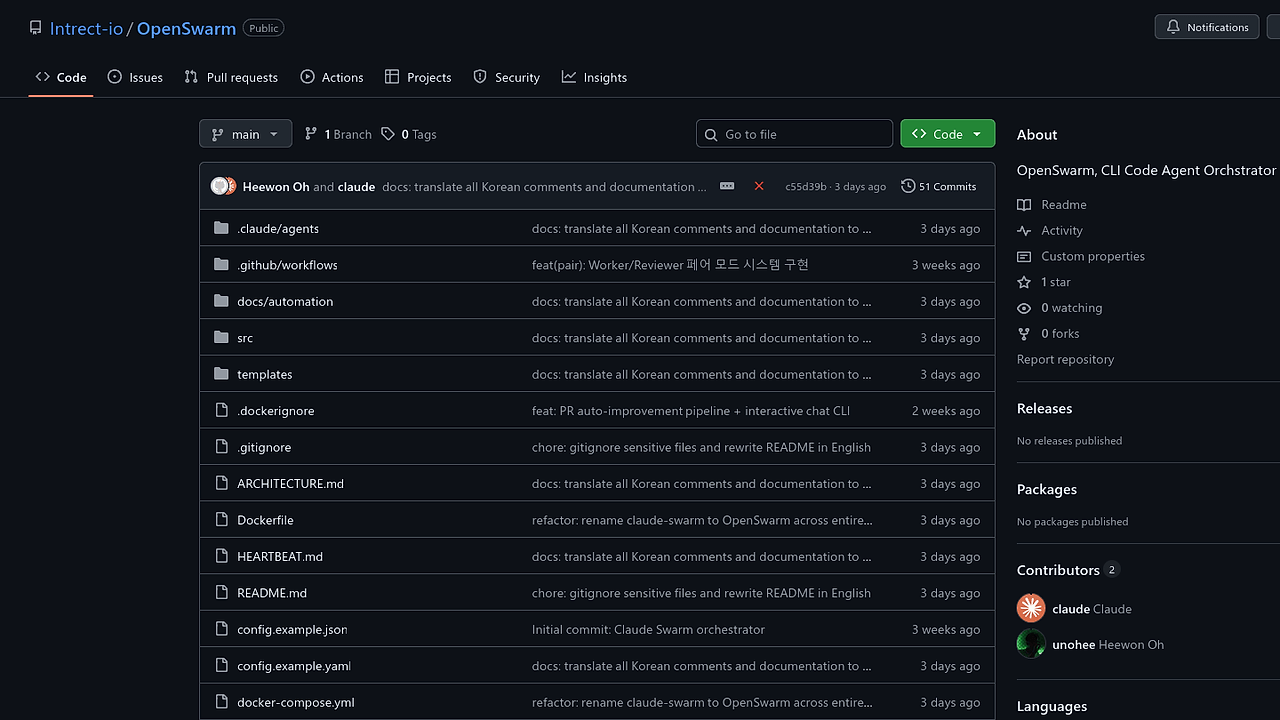
| OpenSwarm | Distributed agent swarms in clusters | P2P agent communication without central server | Open-Source |
| Auto-GPT | Single-goal autonomous agents | Looping task decomposition via GPT-4 | Open-Source |
| CrewAI | Sequential multi-agent pipelines | YAML-defined crews for specific workflows | Freemium |
OpenSwarm suits distributed setups where agents self-organize without a dashboard; check OpenSwarm for peer-to-peer details. Auto-GPT excels at solo agent loops but lacks team-scale budgeting. CrewAI works for linear pipelines, though it misses Paperclip's governance layers—pair it with Brainstorm MCP for planning boosts.
How Paperclip Works
Paperclip's architecture centers on a Node.js server handling agent coordination, with a React UI for visualization. Core abstraction is the org chart as a tree of agents, each with skills loaded from .agents/skills directories. Goals propagate down via JSON plans, using heartbeat pings for status; budgets enforce token limits per role. Workspace isolation via worktrees prevents cross-agent interference, backed by SQLite or embedded DB migrations.
Server runtime uses pnpm workspaces (pnpm-workspace.yaml) for packages, skills, and ui; plugins register via cli/registerPluginCommand. Adapters translate provider APIs—e.g., OpenClaw skills symlink to .claude/skills for Claude 3.5 Sonnet compatibility. E2E flows test via Playwright in tests/e2e, covering onboarding wizards.
# Clone and quickstart
docker-compose -f docker-compose.quickstart.yml up
# Or local: pnpm install && pnpm dev
# Define goal in UI: "Launch AI note app to $1M MRR"
# Assign agents: CEO (OpenClaw), CTO (Claude Code)
This spins a full instance with smoke tests; UI loads at localhost:3000. Agents heartbeat every 30s, reporting progress; approve strategy to allocate budgets. Expect initial setup under 2min, with plugin installs auto-handling errors.
Pros and Cons of Paperclip
Pros:
- Scales to full business teams: 1,005 commits support 141 tags, handling 50+ agents via branches.
- Cost-transparent: Tracks per-provider spend, optimizing heartbeats to cut 30-50% idle tokens.
- Extensible plugins: 357 PRs add skills for Bash/HTTP, easing custom integrations.
- Docker-native: Compose files enable prod deploys; onboard-smoke verifies flows.
- Active development: v0.3.1 fixes lockfiles, syntax, and e2e; 235 issues show momentum.
- MIT license: Fork freely, with .mailmap for clean attribution.
Cons:
- Early version: v0.3.x implies API instability; migration prompts during dev.
- Node.js heavy: pnpm-lock.yaml at 100MB+, requires 4GB RAM for full workspace.
- Provider lock-in risk: Relies on OpenClaw/Claude uptime; no offline mode.
- UI maturing: Global slots added recently; lacks advanced analytics.
- Testing overhead: Playwright e2e runs slow on CI for large orgs.
Getting Started with Paperclip
Start with Docker for zero-config, or local pnpm for development. Ensure Docker and Compose installed; clone repo first.
git clone https://github.com/paperclipai/paperclip.git
cd paperclip
docker compose -f docker-compose.quickstart.yml up -d
# Access dashboard: http://localhost:3000
# Or local: pnpm install && pnpm db:migrate && pnpm dev
Docker builds server/ui/skills stacks; smoke tests run OpenClaw endpoints. Local needs .env from .env.example, migrating embedded SQLite DB. UI wizard guides goal setup—hire agents, review plan, set $100 budget. First run completes onboarding in 90s, showing agent heartbeats.
Verdict
Paperclip is the strongest option for solo founders orchestrating AI teams to run autonomous businesses when scaling beyond single agents. Its Node.js/React stack delivers precise budget controls and plugin extensibility, with 23.9k stars validating traction. Caveat: Stick to Docker in early v0.3.x to avoid lockfile issues; upgrade post-v1.0 for stability.