What Is PomClaw?
PomClaw is an enterprise distributed AI Agent platform built by the PomClaw project on GitHub for platform engineers, CTOs, and enterprise AI teams that need centralized control over many agents. PomClaw is one of the best AI Agent Platforms tools for enterprise teams. The stack is Go 1.24+, PostgreSQL or Oracle, and SSH sandboxes, and the repo badge shows version 1.0.0 with an MIT license. The design targets shared infrastructure and claims up to 90% lower infra cost by replacing one-VM-per-agent deployments.
Quick Overview
| Attribute | Details |
|---|---|
| Type | AI Agent Platforms |
| Best For | Enterprise AI teams, platform engineers, and CTOs |
| Language/Stack | Go 1.24+, PostgreSQL/Oracle, SSH sandbox, TypeScript/React, WebSocket/HTTP |
| License | MIT |
| GitHub Stars | N/A as of Feb 2026 |
| Pricing | Open-Source |
| Last Release | v1.0.0 — N/A |
Who Should Use PomClaw?
- Platform teams running dozens or hundreds of agents that need one control plane, shared auth, and centralized lifecycle management instead of per-agent VM sprawl.
- Enterprise AI operations teams that need RBAC, audit logs, TLS, SSH key management, and a database-backed record of every session and state transition.
- Backend engineers building on Go services who want a direct HTTP/WebSocket integration point and a deployment model that fits existing Linux and Unix servers.
- Data and automation teams that need durable SQL-backed memory with semantic retrieval through pgvector rather than ephemeral local files.
Not ideal for:
- Solo developers shipping a small proof of concept that only needs a single local agent and does not justify Postgres, SSH nodes, or a central gateway.
- Teams that refuse operational overhead around database schema management, SSH credential rotation, and sandbox node provisioning.
- Projects that want fully container-native or serverless execution with no dependency on existing Linux hosts.
Key Features of PomClaw
- Distributed memory store — PomClaw keeps agent memory, conversation history, state, and metadata in a database instead of on local disk. It supports PostgreSQL, Oracle, and any SQL-backed backend that can hold tenant-scoped records, with pgvector for semantic retrieval.
- SSH sandbox execution — PomClaw runs code in isolated SSH-connected sandboxes rather than allocating a VM per agent. That cuts idle compute waste and makes it possible to attach existing Linux or Unix hosts as execution nodes.
- Central Gateway control plane — The Gateway API coordinates agent lifecycle, UI delivery, task routing, and WebSocket sessions from a single service. This is the part you run once, while workers scale by adding more sandbox nodes.
- Multi-tenant RBAC and audit logging — PomClaw separates organization-level and agent-level access control, then records actions in audit logs. That matters for regulated environments where you need to answer who ran what, when, and from which tenant.
- Real-time observability — The platform exposes streaming logs, execution timing, CPU and memory metrics, and distributed tracing hooks. If you need longer-term retention or log warehousing, pair PomClaw with DataHaven for downstream storage and analysis.
- Go backend and React UI — PomClaw ships as a Go service with a TypeScript and React frontend. The
make buildworkflow compiles both halves intodist/control-ui/, so the Gateway can serve the UI without a separate frontend deployment. - Horizontal scaling by nodes, not agents — The architecture is built so compute grows with the number of SSH sandbox nodes rather than the number of agents. That is the part that makes PomClaw practical for fleets in the hundreds or thousands.
PomClaw vs Alternatives
| Tool | Best For | Key Differentiator | Pricing |
|---|---|---|---|
| PomClaw | Enterprise multi-agent fleets with shared infra | SQL-backed memory plus SSH sandbox execution under one Gateway | Open-Source |
| OpenSwarm | Lighter agent orchestration and swarm-style coordination | Less infrastructure-heavy, better if you do not need enterprise tenancy controls | Open-Source |
| Brainstorm MCP | MCP-first planning and prompt workflows | Better fit when the workflow is centered on model context servers rather than long-lived infra | Open-Source |
| OpenTrace | Debugging and tracing agent systems | Observability first, not an execution or memory platform | Open-Source |
Pick PomClaw when the problem is not just orchestration but tenancy, persistence, and execution isolation at scale. Pick OpenSwarm when you want a simpler orchestration layer and can tolerate looser infra assumptions.
Pick Brainstorm MCP when your agents mostly interact through MCP-compatible tooling and you care more about model workflow design than fleet management. Pick OpenTrace when you already have an agent runtime and only need tracing, debugging, and end-to-end execution visibility.
How PomClaw Works
PomClaw uses a control-plane plus sandbox-node architecture. The Gateway owns the API, WebSocket sessions, and UI, while the database stores the durable model for agents, sessions, memory records, tenant boundaries, and audit events. That means the platform is designed around persistence first, not ephemeral worker state, which is why it can keep long-running agent histories without forcing each agent to own a VM.
The execution path is simple: a request enters the Gateway, the Gateway resolves tenant and agent context from the SQL store, and work is dispatched to one of the registered SSH sandboxes using a load-balancing strategy such as round robin. The sandbox nodes provide an isolated command environment with timeout and resource controls, so the platform gets practical separation without paying the full cost of per-agent virtual machines.
A typical PomClaw tutorial starts with building the repo, loading the schema, and launching the Gateway. The commands below show the shortest path to a working local install.
git clone https://github.com/pomclaw/pomclaw.git
cd pomclaw
make build
./build/pomclaw setup-database
./build/pomclaw gateway
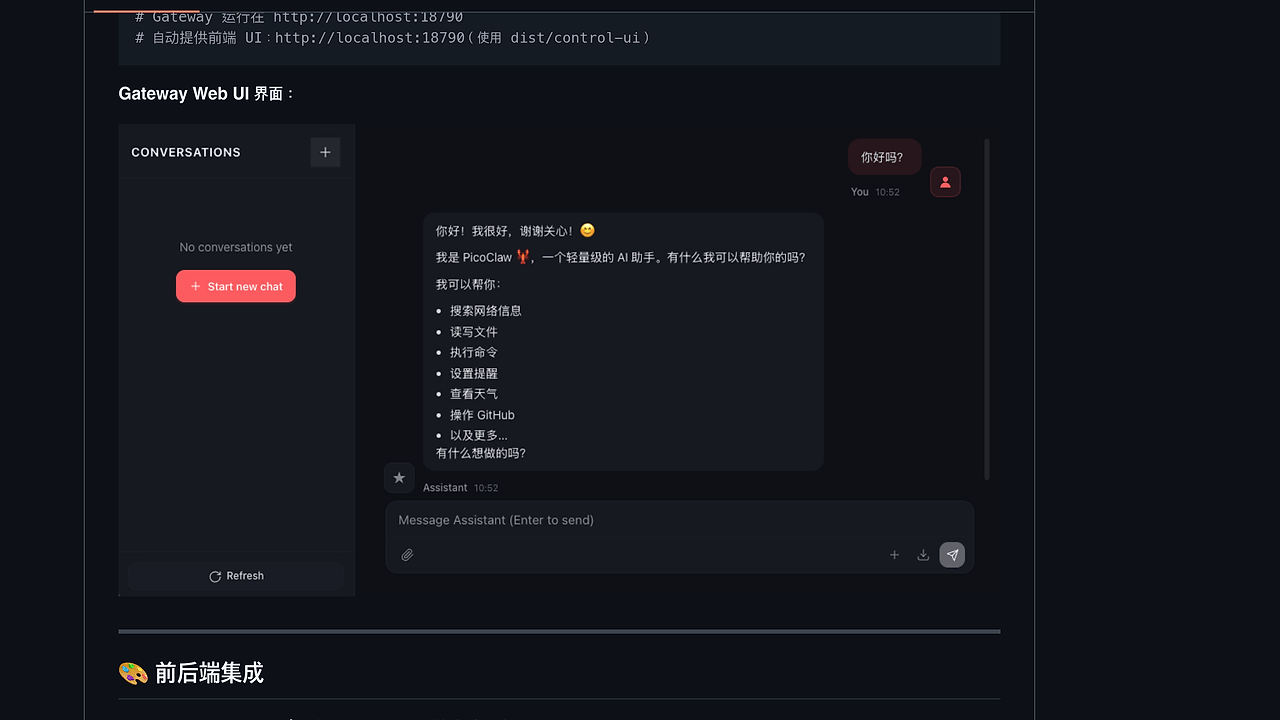
This build path compiles the Go backend and the React UI, then starts the Gateway on http://localhost:18790. After that, you connect one or more SSH nodes through config or environment variables, and the Gateway begins routing agent work into the sandbox pool.
Pros and Cons of PomClaw
Pros:
- Shared infrastructure model reduces the compute tax of running one VM per agent and makes large fleets economically viable.
- SQL-backed persistence keeps memory, conversation history, and state durable across restarts, which is a better fit than local files for production systems.
- SSH sandbox support lets you reuse existing Linux or Unix hosts instead of standing up a separate VM estate.
- Strong enterprise controls cover tenant isolation, RBAC, audit logging, TLS, and network separation.
- Built-in observability exposes logs and metrics from the same control plane, which shortens incident response time.
- Full-stack delivery ships a backend, frontend, and build pipeline in one repo, which simplifies local development and self-hosting.
Cons:
- Operational complexity is real because you must run a database, manage SSH keys, and maintain sandbox nodes.
- The SSH model is not cloud-native by default if your team wants container schedulers or serverless functions instead of host-level sandboxes.
- The repo text does not show public star counts or release notes, so production maturity has to be validated from your own testing.
- Oracle and Postgres support increases configuration surface area, which can help enterprise fit but also adds more moving parts.
Getting Started with PomClaw
The fastest PomClaw setup is to build the repo, point it at PostgreSQL, initialize the schema, and start the Gateway. The example below matches the repository quickstart and is the cleanest path for a first run.
git clone https://github.com/pomclaw/pomclaw.git
cd pomclaw
make build
export POM_STORAGE_TYPE=postgres
export POM_POSTGRES_HOST=localhost
export POM_POSTGRES_PORT=5432
export POM_POSTGRES_DATABASE=pomclaw
export POM_POSTGRES_USER=postgres
export POM_POSTGRES_PASSWORD=yourpassword
./build/pomclaw setup-database
./build/pomclaw gateway
After the Gateway starts, open http://localhost:18790 to reach the UI and register at least one SSH sandbox node. From there, PomClaw can begin routing agent work, persisting sessions, and streaming logs through the central control plane.
Verdict
PomClaw is the strongest option for enterprise AI agent fleets when you need shared infrastructure, SQL-backed memory, and SSH-isolated execution. Its biggest strength is lowering cost and centralizing governance; its main caveat is the extra operational work compared with lighter orchestration frameworks. Choose PomClaw if you already run PostgreSQL or Oracle and want one control plane for many agents.