What Is Solana On-Chain Arbitrage Bot?
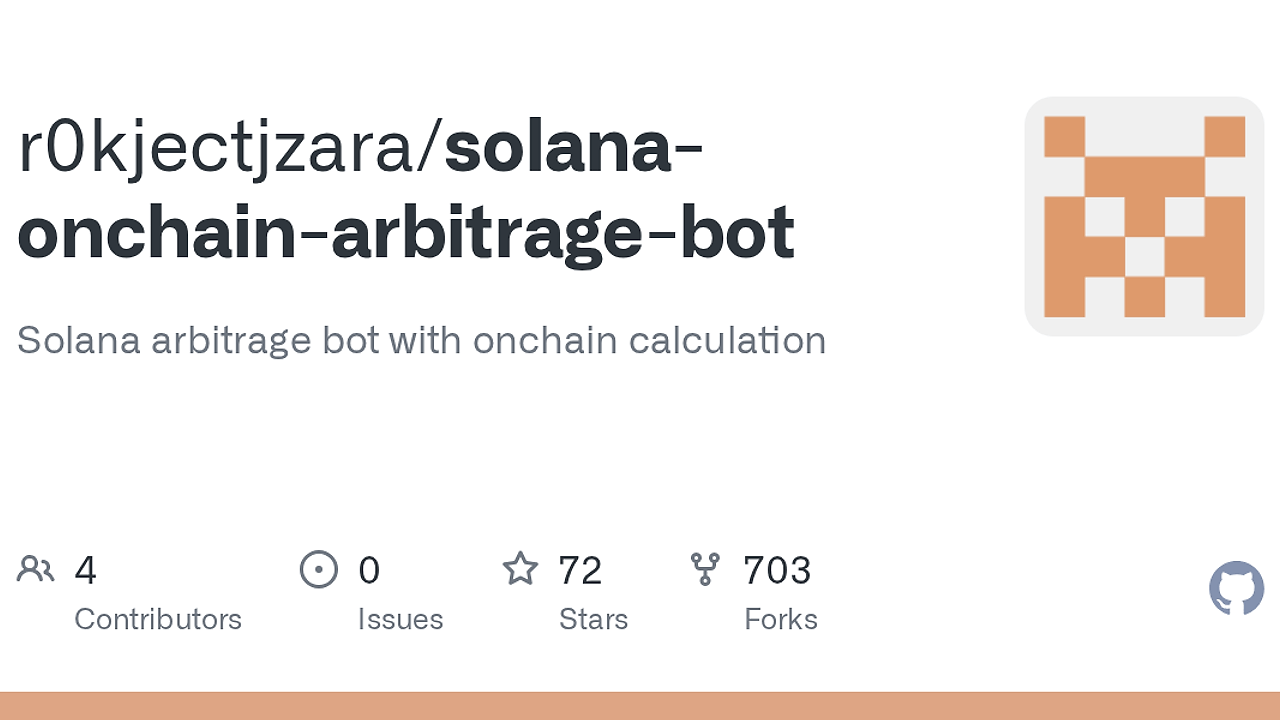
Solana On-Chain Arbitrage Bot is a reference Arbitrage Bot repository maintained by r0kjectjzara that parses Solana liquidity pools, builds arbitrage routes, and invokes an on-chain arbitrage program. Solana On-Chain Arbitrage Bot is one of the best Arbitrage Bots tools for pro Solana traders and MEV developers who need to study Rust-based pool parsing across 13 supported DEX families, but it is explicitly not production-ready.
This repo is a technical reference, not a beginner-friendly trading system. It focuses on account parsing, route grouping, and transaction submission mechanics, which makes it useful when you need to understand how a Solana arbitrage workflow is assembled from raw pool accounts instead of relying on a black-box service.
Quick Overview
| Attribute | Details |
|---|---|
| Type | Arbitrage Bots |
| Best For | Pro Solana traders and MEV developers |
| Language/Stack | Rust, Cargo, Solana RPC, TOML config, ATAs, flash loans |
| License | MIT |
| GitHub Stars | N/A as of Feb 2026 |
| Pricing | Open-Source |
| Last Release | N/A |
Who Should Use Solana On-Chain Arbitrage Bot?
- Solana protocol engineers who need a concrete Rust example for parsing pools, detecting DEX ownership, and wiring transactions into an on-chain program.
- MEV researchers who want to inspect how route construction works across AMM variants such as Raydium, Orca Whirlpool, and Meteora without reverse-engineering a closed system.
- Indie quant builders testing arbitrage logic on devnet or low-capital mainnet setups where the priority is learning the plumbing, not maximizing fill quality.
- Backend developers who already understand Solana accounts,
ATAcreation, and compute budget instructions, and only need a reference implementation to adapt.
Not ideal for:
- Beginners who want a turnkey bot with guarded defaults, monitoring, and safe wallet handling.
- Teams that need deterministic production execution, retry hardening, and full observability out of the box.
- Users who expect a managed SaaS workflow instead of editing
config.tomland running a Rust binary themselves.
Key Features of Solana On-Chain Arbitrage Bot
- TOML-driven configuration — The bot reads runtime settings from
config.toml, including wallet keys, RPC URLs, routing markets, and spam settings. That keeps deployment simple for operators who prefer file-based config over environment-only wiring. - Automatic ATA creation — It can create associated token accounts when they are missing, which removes a common first-run failure mode in Solana token flows. This matters when a route touches a mint the wallet has never interacted with before.
- Multi-RPC transaction sending — The spam mode can broadcast transactions through multiple RPC endpoints. That gives you a basic fallback path for unreliable providers, although it also raises the risk of duplicated traffic if you misconfigure retries.
- Flashloan integration — The repo includes a flashloan path, which is useful for capital-efficient arbitrage experiments. In practice, this means you can validate route economics without requiring a large idle balance in the hot wallet.
- Auto-detected DEX type — DEX identification happens through the pool account owner, so you do not need to manually label each pool address. This reduces config friction when you are feeding the bot a mixed list of Raydium, Orca, Meteora, or newer venue accounts.
- Mint-based route grouping — Pools are grouped by mint to help build arbitrage routes around shared assets. That is the correct abstraction for cross-pool price discovery on Solana, where route quality depends on matching the same base and quote assets across venues.
- Broad AMM coverage — The reference implementation lists Pump AMM, Raydium V4, Raydium CPMM, Raydium CLMM, Meteora DLMM, Meteora Dynamic AMM, Meteora DAMM V2, Orca Whirlpool, Vertigo, Heaven, Futarchy, Humidifi, PancakeSwap, and Byreal. That breadth is why Solana On-Chain Arbitrage Bot is useful as a parser reference even if you never deploy it unchanged.
Solana On-Chain Arbitrage Bot vs Alternatives
| Tool | Best For | Key Differentiator | Pricing |
|---|---|---|---|
| Solana On-Chain Arbitrage Bot | Reference implementation and pool parsing research | Transparent Rust code path for parsing pools, routing by mint, and calling the on-chain arbitrage program | Open-Source |
| solana-mev-bot | Production bot deployment | Full-featured bot repo recommended by the project itself for users who need a production path | Open-Source |
| Jupiter Aggregator | Swap routing and best-price execution | Aggregation layer optimized for swap execution, not a custom on-chain arbitrage reference | Free |
| Custom Rust Bot | Teams with internal infra | Maximum control over strategy, risk checks, and execution policy, but no starter scaffolding | N/A |
Pick solana-mev-bot when you want the production implementation the repo points to and you do not want to assemble the rest of the trading stack yourself. Pick Jupiter Aggregator when the goal is reliable route execution across Solana liquidity sources rather than studying how a dedicated arbitrage program is wired.
Pick a Custom Rust Bot when your team already has risk controls, telemetry, and RPC infrastructure in place. For a broader ecosystem scan, compare this project with other browse all DeFi Automation tools and, if you need shell-based orchestration around Solana jobs, browse all CLI Tools.
How Solana On-Chain Arbitrage Bot Works
Solana On-Chain Arbitrage Bot is built around a simple but practical architecture: load config, inspect pool accounts, classify the DEX, group markets by mint, and then build an arbitrage transaction that can be sent through one or more RPC endpoints. The important design choice is that the bot treats the pool account itself as the source of truth, using account owner detection to infer the venue rather than forcing you to hardcode every pool type.
That approach is useful on Solana because AMM programs evolve quickly, and a static mapping layer becomes stale fast. The repo also exposes the operational pieces that matter in real trading systems: ATA creation, compute unit limits, optional lookup table accounts, and flashloan toggles. The result is a reference implementation that shows the transaction lifecycle end to end, even though it does not try to hide complexity behind a polished abstraction.
# getting started example
cargo run --release --bin solana-onchain-arbitrage-bot -- --config config.toml
The command above launches the Rust binary in release mode and points it at your TOML config file. Expect the bot to read your wallet, RPC endpoints, and market list, then iterate through configured pools, classify them, and assemble a transaction path if route conditions are met. If spam.enabled = true, the sender fans out to multiple RPC URLs, which can help in unreliable network conditions but also demands careful retry tuning.
Pros and Cons of Solana On-Chain Arbitrage Bot
Pros:
- Clear reference architecture — The repo shows the exact pieces you need for Solana arbitrage: pool parsing, route grouping, program invocation, and config loading.
- Broad AMM coverage — Support for multiple DEX families makes it valuable for protocol research and parser validation.
- Low-friction onboarding — A single
config.tomlplus a release build is enough to start testing, which is easier than wiring a full custom stack. - ATA auto-creation — Missing token accounts are handled automatically, reducing first-run failures.
- Flashloan support — The strategy layer can be tested with borrowed capital, which is useful for route validation.
- Multi-RPC sending — Basic distribution across RPC providers gives you a simple resilience option for mainnet testing.
Cons:
- Not production-ready — The repo explicitly says it is a demo/reference implementation, so you should not treat it as a hardened trading bot.
- Not optimized — The code path is not tuned for best execution latency or maximal fill quality.
- Manual operations remain — You still have to maintain config, wallet security, and RPC hygiene yourself.
- Beginner-unfriendly — The target user already understands Solana accounts, Rust builds, and transaction structure.
- Execution risk is on you — Spam mode, flashloans, and pool routing can create real losses if route validation is weak.
Getting Started with Solana On-Chain Arbitrage Bot
Start by cloning the repository, copying the sample config, and installing the Rust toolchain if you do not already have it. You need a funded Solana wallet and at least one RPC endpoint before the bot can submit anything useful.
git clone https://github.com/r0kjectjzara/solana-onchain-arbitrage-bot.git
cd solana-onchain-arbitrage-bot
cp config.toml.example config.toml
cargo run --release --bin solana-onchain-arbitrage-bot -- --config config.toml
After the first run, edit config.toml with your wallet key, RPC URLs, and the pool addresses you want scanned. You can also tune compute_unit_limit, process_delay, and the optional spam settings if you are testing against multiple RPC providers. For a cleaner deployment workflow, keep the bot isolated from hot keys and rotate RPC credentials separately.
Verdict
Solana On-Chain Arbitrage Bot is the strongest option for Solana protocol research and route-parsing work when you need a Rust reference that mirrors real on-chain mechanics. Its biggest strength is transparent pool classification across many AMMs, but the caveat is equally clear: it is a demo, not a hardened execution engine. Use it to learn, prototype, and validate, then graduate to a production bot before risking serious capital.