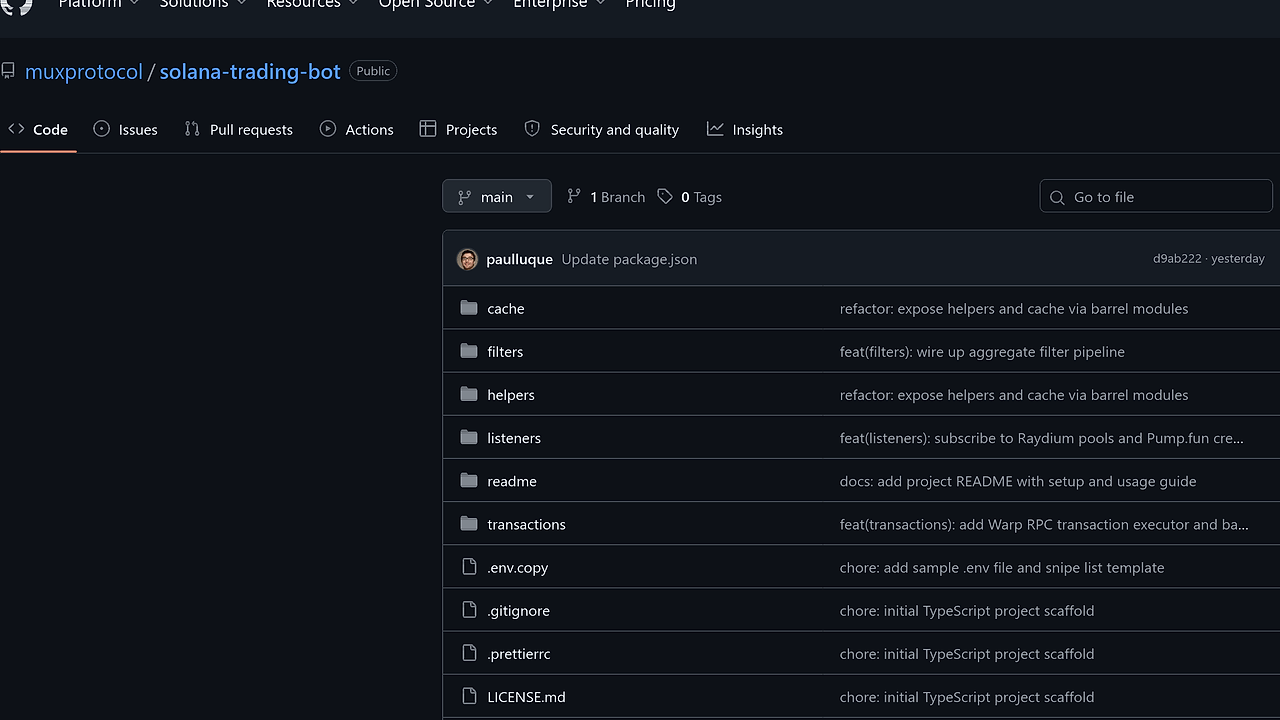
What Is Solana Trading Bot?
Solana Trading Bot is one of the best Solana Trading Bots for traders. Built by muxprotocol, it watches Raydium AMM v4 pools and pump.fun bonding curves in real time, then sends buys and auto-sells through three executors (default, warp, jito) for users who want event-driven entries instead of manual chart watching. The repo is organized around listeners, caches, filters, and a transaction layer, so the control surface is mostly .env values and on-chain heuristics rather than a GUI.
Quick Overview
| Attribute | Details |
|---|---|
| Type | Solana Trading Bots |
| Best For | traders |
| Language/Stack | Node.js 18+, TypeScript, Solana WebSocket RPC, Raydium AMM v4, pump.fun, warp.id, Jito |
| License | N/A |
| GitHub Stars | N/A |
| Pricing | Open-Source |
| Last Release | N/A |
Who Should Use Solana Trading Bot?
- Solana memecoin traders who want block-speed entries on Raydium and pump.fun without hand-placing orders.
- Quant-style indie hackers who are comfortable editing
.env, runningnpm start, and managing RPC and keypair hygiene. - CTOs and platform engineers testing an internal Solana market-making or sniping workflow in a controlled wallet.
- Power users who want route selection across
default,warp, andjitoexecutors rather than a fixed execution path.
Not ideal for:
- People who want a polished hosted UI or Telegram workflow.
- Anyone who cannot afford RPC fees, priority fees, and possible total loss.
- Teams that need audited custody, formal compliance, or exchange-grade controls.
Key Features of Solana Trading Bot
- Raydium AMM v4 sniping — listens for newly opened liquidity pools and tries to buy inside the same block window. The bot filters on pool state, quote mint, and liquidity size before it commits capital.
- pump.fun bonding-curve support — detects new token creations, buys with native SOL, and routes selling until graduation to Raydium. That path uses the bonding-curve program directly, so WSOL and Raydium-specific filters do not apply.
- Three transaction executors —
defaultuses standard RPC,warpuses warp.id relay, andjitofans out bundles to five block-engine regions. That gives you a practical latency and inclusion trade-off instead of a single hard-coded send path. - Safety filters — burn checks, renounced mint authority, freeze authority, mutable metadata, social links, and pool-size windows. These filters are designed to block obvious rugs and low-quality launches before a buy is signed.
- Snipe list mode —
USE_SNIPE_LIST=truebypasses broad filters and buys only mint addresses listed insnipe-list.txt. That is useful when you already curate entries elsewhere and want the bot to act as a fast execution layer. - Auto-sell with TP/SL — polls live pool state every
PRICE_CHECK_INTERVALms and exits onTAKE_PROFITorSTOP_LOSS. The sell path works for both Raydium and pump.fun positions once the wallet balance changes. - Concurrency guard and retries —
ONE_TOKEN_AT_A_TIMEprevents the bot from fighting itself across fresh pools, and buy and sell retries can be tuned independently. That matters when your RPC is flaky or when multiple launch events hit at once.
Solana Trading Bot vs Alternatives
If you want adjacent automation tooling around this kind of self-hosted workflow, browse all DevOps Automation tools or CLI Tools. The real trade-off here is source-level control versus packaged trading UX.
| Tool | Best For | Key Differentiator | Pricing |
|---|---|---|---|
| Solana Trading Bot | Self-hosted Solana sniping | Source-level control over filters, executors, and RPC | Open-Source |
| Trojan | Telegram-first trading | Polished UX and faster onboarding | Paid |
| BonkBot | Fast meme-coin swaps | Minimal setup inside Telegram | Freemium |
| Photon | Chart-driven active trading | UI, charting, and fast swap flow | Freemium |
Pick Trojan if you want a maintained Telegram trading stack and do not care about source access. Pick BonkBot if you want the lowest-friction mobile workflow and are fine with fewer knobs. Pick Photon if your decision process depends on charting and visual order entry. Pick Solana Trading Bot if you want to own the code, tune the filters, and choose your execution rail.
How Solana Trading Bot Works
Solana Trading Bot runs as an event-driven listener pipeline. It subscribes to OpenBook markets, Raydium pools, pump.fun logs, and wallet SPL balance changes through WebSocket RPC, then stores market and curve state in memory so the bot can make a buy or sell decision without rescanning chain history on every event. The design choice is simple: keep the hot path in process memory and let the RPC provider handle chain observation.
The filtering layer sits between the listeners and the buy logic. For Raydium, the bot checks pool status, quote mint, burn state, mint authority, freeze authority, metadata mutability, socials, and pool size before it sends a transaction. For pump.fun, the bot skips Raydium-only checks and uses the bonding-curve state plus PUMP_FUN_MAX_CURVE_PROGRESS, because the token has not yet migrated to a normal pool.
Execution is intentionally pluggable. The same bot can send via standard RPC, warp.id relay, or Jito bundles, which lets you trade off inclusion probability, fee cost, and operational complexity. That matters because the fastest entry is not always the best entry, especially when the launch environment is crowded and slippage moves faster than your UI.
TRANSACTION_EXECUTOR=jito ONE_TOKEN_AT_A_TIME=true npm start
That command starts the bot with bundle-based execution and a mutex so only one token is processed at a time. Expect it to load .env, open subscriptions, and then react to new pool or curve events as they appear. You still need valid PRIVATE_KEY, RPC endpoints, and a funded quote token account for Raydium before the first live trade can succeed.
Pros and Cons of Solana Trading Bot
Pros:
- Direct control over execution — you choose
default,warp, orjitoinstead of accepting a fixed route. - Real-time event model — WebSocket listeners let the bot react to new pools and curve creations quickly.
- Configurable risk gates — burn, freeze, mint authority, socials, and pool-size checks are all explicit.
- Native pump.fun path — it handles bonding curves without forcing everything through Raydium abstractions.
- Simple operational model — one repo, one
.env, one wallet, one process. - Auto-sell automation — TP/SL polling reduces the need to watch every position manually.
Cons:
- No hosted UI — the workflow is code and config, not a productized dashboard.
- RPC dependency is hard — public endpoints will throttle, and bad providers will miss events.
- High false-negative and false-positive risk — filters help, but they cannot prove a token is safe.
- Memecoin execution is hostile — rugs, honeypots, sandwiching, and bad fills are still common.
- Cache state is in memory — restarts can lose transient market context.
Getting Started with Solana Trading Bot
The fastest path is to clone the repo, install dependencies, copy the sample environment file, and start the process. Before you run it live, configure a dedicated wallet, paid RPC and WebSocket endpoints, and the buy or sell settings you actually want.
git clone https://github.com/muxprotocol/solana-trading-bot.git
cd solana-trading-bot
npm install
cp .env.copy .env
npm start
After startup, Solana Trading Bot reads PRIVATE_KEY, RPC_ENDPOINT, RPC_WEBSOCKET_ENDPOINT, QUOTE_MINT, QUOTE_AMOUNT, and the filter flags that define what it is allowed to buy. If you are using Raydium, make sure the quote token account already exists; if you are using pump.fun, switch on ENABLE_PUMP_FUN and remember that native SOL is used directly on the bonding curve.
Verdict
Solana Trading Bot is the strongest option for self-hosted Solana sniping when you need direct control over filters and execution rails. Its main advantage is the clean separation between listeners, filters, and transaction executors, but the caveat is operational risk: paid RPC, key management, and memecoin losses are still on you. Recommended for experienced traders who want source-level control.