What Is AI Trading Agent?
AI Trading Agent is an open-source AI Trading Agents project built by endless-sky-team that connects OpenRouter models, Lighter accounts, Prisma, PostgreSQL, and Bun into a scheduled crypto execution loop for developers and quant builders. AI Trading Agent is one of the best AI Trading Agents tools for crypto developers and quant builders. It runs every 5 minutes, persists invocations and tool calls, and is meant for observable experimentation rather than blind autopilot trading.
Quick Overview
| Attribute | Details |
|---|---|
| Type | AI Trading Agents |
| Best For | crypto developers and quant builders |
| Language/Stack | Bun, TypeScript, Prisma, PostgreSQL, Express, React, Vite, Vercel AI SDK, OpenRouter, and Lighter |
| License | N/A |
| GitHub Stars | N/A as of Feb 2026 |
| Pricing | Open-Source |
| Last Release | N/A |
Who Should Use AI Trading Agent?
AI Trading Agent fits teams that want a thin orchestration layer around trading decisions instead of a full proprietary trading platform.
- Crypto protocol engineers who need an LLM-driven execution loop around spot or perpetuals without building scheduling, persistence, and tool wiring from scratch.
- Indie hackers testing trading prompts who want SQL-backed history, repeatable runs, and a small codebase they can modify in one sitting.
- Quant teams comparing models on the same market snapshot, because each
Modelsrow can route a different OpenRouter model and Lighter account. - CTOs and internal tooling owners who care about narrow tool surfaces, auditability, and predictable failure modes more than fancy agent autonomy.
Not ideal for:
- People looking for passive income or a set-and-forget bot.
- Teams that need formal exchange certification, a hardened OMS/EMS, or institution-grade risk controls before a live deployment.
- Beginners who do not have a test wallet, API key hygiene, or a position-sizing policy.
Key Features of AI Trading Agent
- 5-minute execution cadence — The agent wakes on a fixed interval and loads every configured trader row before calling
invokeAgent. That cadence is simple, deterministic, and easier to reason about than a fleet of event-driven workers. - Multi-horizon signal assembly — Each cycle combines short-term and medium-term candles, including indicators such as EMA20 and MACD. The model sees both recent momentum and broader trend context in a single prompt.
- Prisma-backed history —
InvocationsandToolCallsare written to PostgreSQL, which gives you queryable audit trails instead of ephemeral console output. That is the right shape for debugging model behavior and reconstructing decisions later. - Constrained tool calling — The model cannot execute arbitrary code or reach arbitrary endpoints. It only gets the trading tools that the repository wires in, which keeps the blast radius smaller than a general-purpose autonomous agent.
- Per-account model routing — Each row in
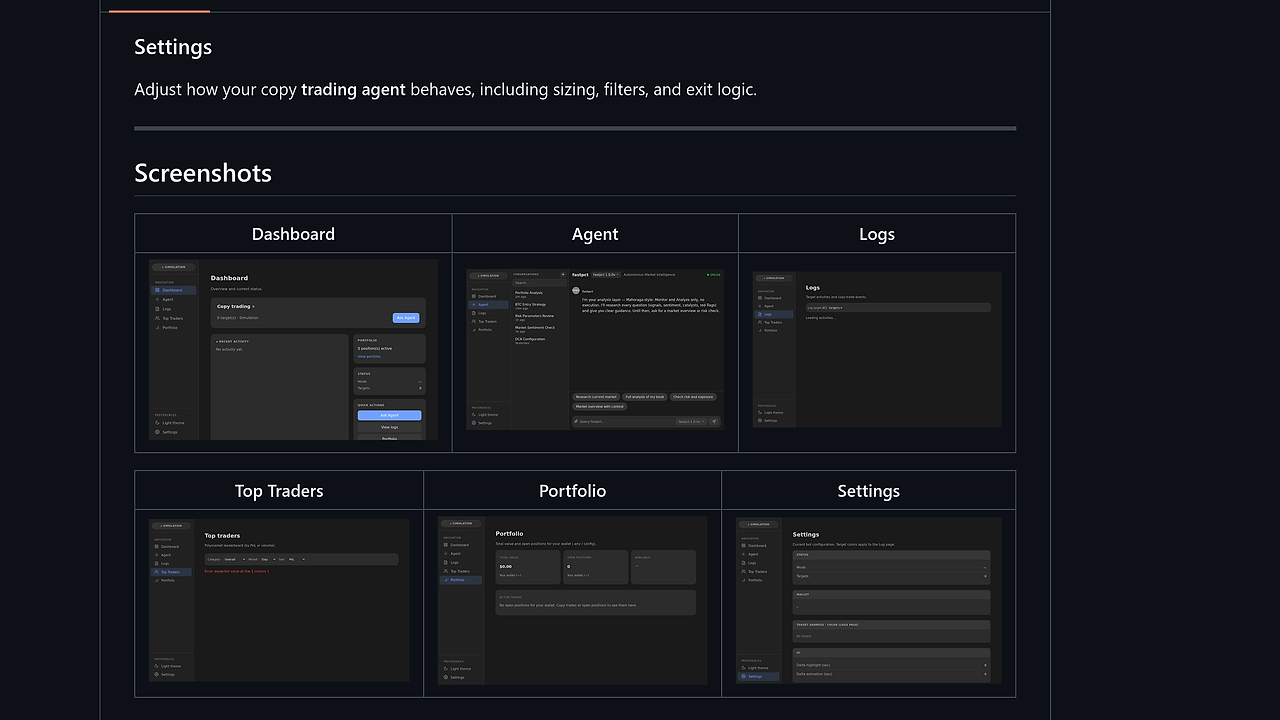
Modelscan hold its ownopenRoutermodelName, API key, andaccountIndex. That makes model A/B tests and segmented account management straightforward without duplicating the runner. - Optional review surface — The backend API and React/Vite frontend provide a place to inspect positions, invocations, and telemetry without opening a SQL console. If you want deeper run-level tracing, pair the repo with OpenTrace.
- Bun-first developer loop — Scripts, runtime, and package management are built around Bun, so startup and iteration are faster than a heavier Node stack. For teams already standardizing on Bun, the repo fits the rest of the toolchain cleanly.
AI Trading Agent vs Alternatives
| Tool | Best For | Key Differentiator | Pricing |
|---|---|---|---|
| AI Trading Agent | LLM-assisted crypto execution with audit logs | Prompt assembly plus constrained tool calling | Open-Source |
| Freqtrade | Rule-based strategy backtesting and live trading | Mature deterministic trading engine | Open-Source |
| Hummingbot | Market making and liquidity operations | Deep exchange connectivity and connector ecosystem | Open-Source |
| OpenSwarm | Multi-agent orchestration around shared workflows | Agent coordination rather than trading-specific execution | Open-Source |
Pick Freqtrade when you want a conventional strategy engine with backtesting, parameter sweeps, and a more traditional quant workflow. AI Trading Agent wins when the experiment is about model behavior, prompt design, and action tracing rather than pure signal rules.
Pick Hummingbot when market making, connector breadth, and exchange-specific liquidity operations matter more than prompt engineering. AI Trading Agent is narrower and easier to audit, which makes it a better fit for prototype capital or research accounts.
Pick OpenSwarm when you want multiple agents to inspect, review, or coordinate around the trading loop instead of putting every responsibility in one process. That pairing works well when one agent drafts the signal summary and another agent validates risk before the final execution step.
How AI Trading Agent Works
AI Trading Agent uses a narrow-loop architecture: a scheduler loads configured models, fetches market snapshots, builds a prompt, calls an OpenRouter model through the Vercel AI SDK, and exposes only a fixed set of trading tools. The design keeps the model in a policy role while the code keeps authority over execution, sizing, and persistence.
The persistence model is intentionally boring. Prisma writes records into PostgreSQL tables such as Models, Invocations, and ToolCalls, so every decision can be queried after the fact without scraping logs or replaying stdout. That makes the repo suitable for post-trade analysis, prompt iteration, and lightweight model comparisons.
Position handling is the main place where deterministic code matters more than model creativity. Long, short, and flat states need to map to the correct exchange-side action, and that logic should stay in code because a wrong side on a leveraged trade is an expensive bug, not a cosmetic issue.
bun install
bunx prisma migrate deploy
bun run index.ts
The commands above install dependencies, apply the database schema, and start the agent loop. After startup, the process loads each configured trader, constructs the enriched prompt, and then waits for the next five-minute cycle. If you use the dashboard API, you can inspect state in parallel and keep the trading loop separate from the review surface.
Pros and Cons of AI Trading Agent
Pros:
- Clear audit trail in PostgreSQL, which makes it easy to inspect what the model asked for and what the exchange layer did.
- Narrow tool surface, so the agent cannot wander into arbitrary network calls or shell commands.
- Multi-model support, which is useful when you want to compare OpenRouter models against the same market data.
- Bun, TypeScript, and Prisma keep the repository compact and easy to modify for research work.
- The optional frontend and backend make human review possible without custom admin tooling.
- Fixed cadence reduces operational complexity compared with always-on websocket-driven bots.
Cons:
- The repo text emphasizes live experimentation, not a full historical backtesting stack.
- You must manage API keys, secrets, and capital at risk yourself; the code does not replace risk management.
- The architecture is coupled to Lighter and OpenRouter, so porting to another venue means writing adapters.
- Logs and prompt bodies can expose sensitive strategy details if you run them verbosely in production.
- The system is only as safe as your position-sizing rules and exchange configuration.
Getting Started with AI Trading Agent
A minimal setup is straightforward if you already have Bun, PostgreSQL, OpenRouter, and Lighter credentials. The repo expects a DATABASE_URL, an OPENROUTER_API_KEY, and at least one populated Models row before the loop can do any useful work.
bun install
bunx prisma migrate dev
bunx prisma studio
bun run index.ts
After the install and migration step, use Prisma Studio to confirm that Models contains the accounts and model names you want to automate. When you start the process, AI Trading Agent will load those rows, build the trading prompt, and begin cycling every five minutes without further intervention.
Verdict
AI Trading Agent is the strongest option for crypto teams testing LLM-driven execution when they want auditable runs and narrow tool boundaries instead of a generic bot. Its biggest strength is the Prisma-backed history of prompts and tool calls, and its main caveat is that live trading still depends on your own risk controls and exchange setup. Use it for experiments first, capital second.