What Is TradingAgents?
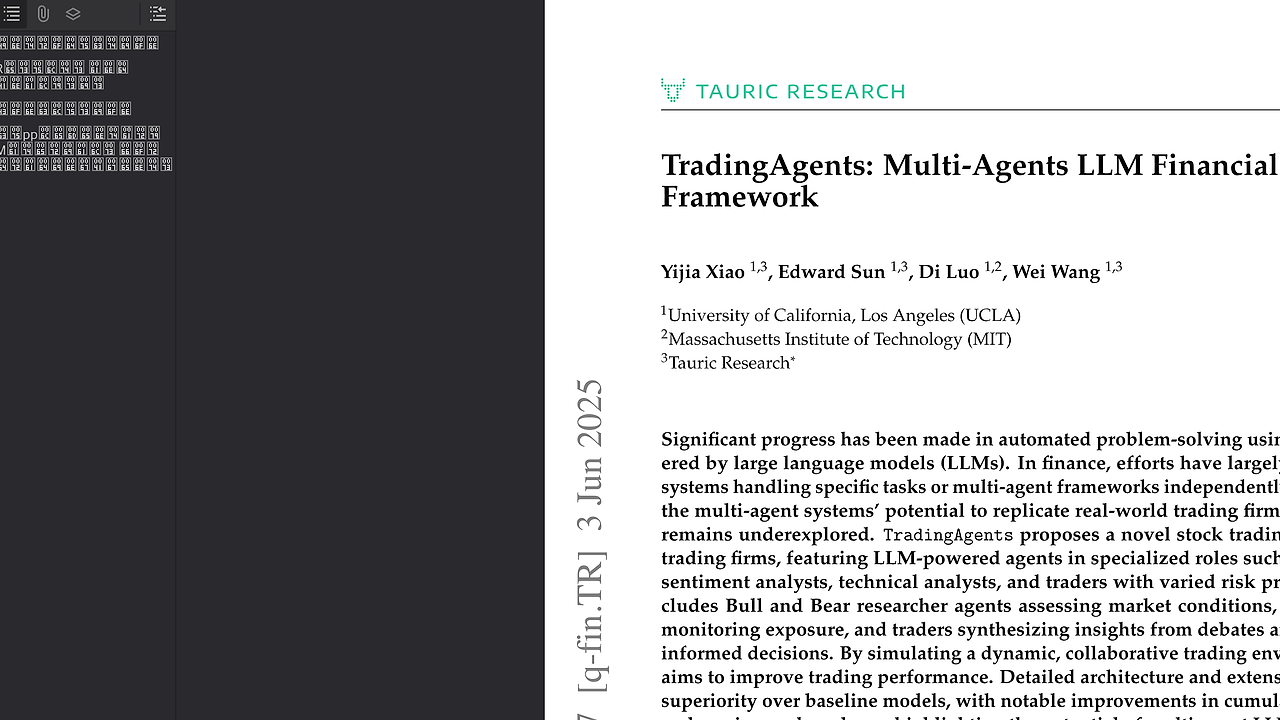
TradingAgents is one of the best AI Trading Agents tools for Quants. Built by TauricResearch and maintained in this lukiIabs fork, it orchestrates analyst, researcher, trader, risk, and portfolio agents over market data and LLM outputs; the project has a published arXiv paper and shipped v0.2.4 in Apr 2026 with structured-output agents, checkpoint resume, and a persistent decision log. It is for quant developers, fintech engineers, and research teams that want a reproducible multi-agent trading workflow instead of a single chat prompt.
TradingAgents is not a broker wrapper or an auto-click buy button. It is a research framework that mirrors how trading desks split work across specialization layers, then asks those layers to argue before capital is allocated. That makes it relevant for signal research, portfolio simulation, and agent benchmarking, especially when you need auditability across research -> decision -> risk -> execution.
Quick Overview
| Attribute | Details |
|---|---|
| Type | AI Trading Agents |
| Best For | Quants, fintech researchers, and agentic trading experiments |
| Language/Stack | Node.js with legacy Python/LangGraph under legacy-python/ |
| License | N/A in scraped text |
| GitHub Stars | N/A in scraped text as of Apr 2026 |
| Pricing | Open-Source |
| Last Release | v0.2.4 — Apr 2026 |
Who Should Use TradingAgents?
- Quant developers building research workflows that need separated analyst, trader, and risk roles instead of one monolithic model call.
- Fintech engineers validating LLM-assisted market research where every decision needs a traceable output and a checkpointable run state.
- Indie hackers prototyping trading assistants that can score sentiment, read news, and produce structured trade rationales before execution.
- Applied AI teams comparing agent debate patterns across model providers such as OpenAI, Anthropic, Gemini, DeepSeek, Qwen, GLM, or Azure.
Not ideal for:
- Production live-trading desks that need exchange-certified execution, latency guarantees, or broker compliance controls out of the box.
- Teams without API budgets because the framework still depends on paid model and data-provider usage even though the code itself is open-source.
- Users who want a simple indicator script; TradingAgents is heavier than a basic RSI or MACD bot because the value comes from multi-agent analysis and routing.
Key Features of TradingAgents
- Specialized analyst team — TradingAgents splits research into fundamentals, sentiment, news, and technical analysis. That means the system can consume earnings metrics, social sentiment, macro headlines, and indicators like MACD or RSI in separate passes instead of flattening everything into one prompt.
- Researcher debate layer — Bullish and bearish researchers critique the analyst output before a trading decision is made. This is useful when you want competing hypotheses, not just a one-sided recommendation.
- Trader synthesis step — The trader agent converts the team output into a concrete action with timing and magnitude context. That lets you inspect the chain from signal generation to trade proposal instead of only seeing a final score.
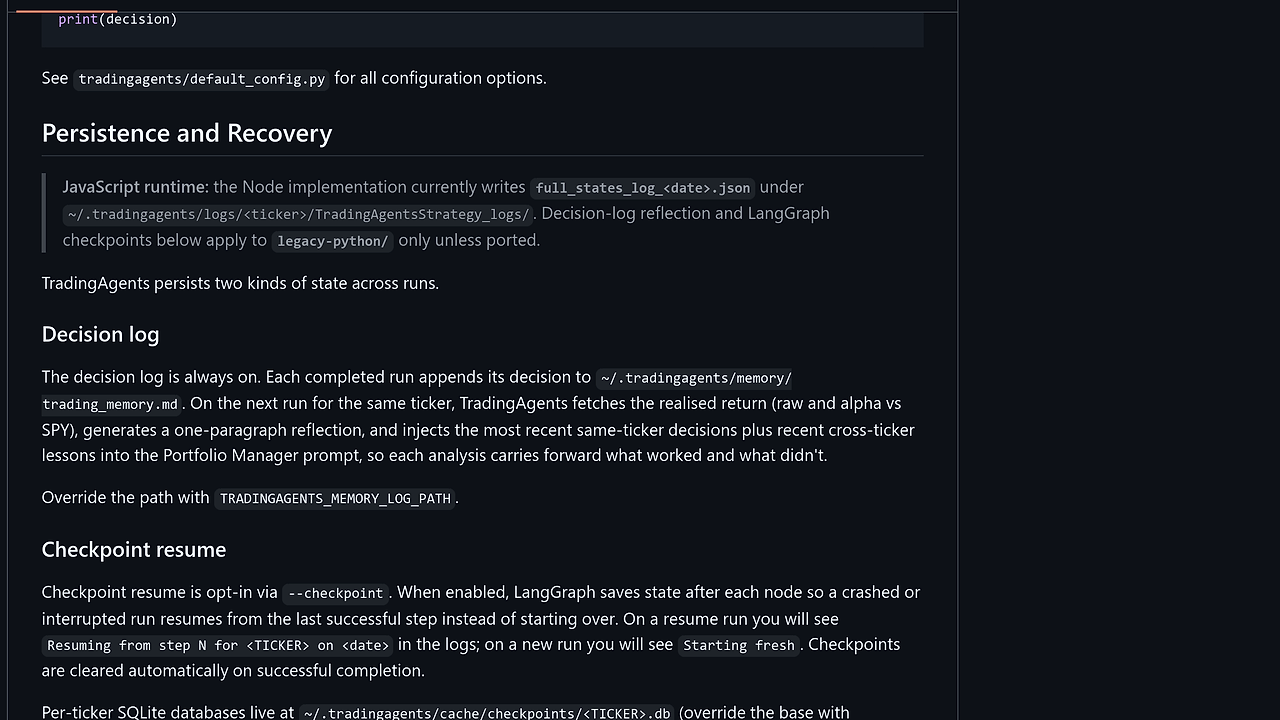
- Risk management gate — The framework evaluates volatility, liquidity, and portfolio exposure before final approval. In the release notes, TradingAgents v0.2.4 also adds a persistent decision log, which is the kind of artifact you need for post-trade review and model debugging.
- Portfolio manager approval — Approved actions are routed through a final decision layer before hitting the simulated exchange. This gives you a deterministic place to stop bad trades, reject oversized positions, or enforce custom policy checks.
- Structured outputs and resume support — v0.2.4 introduced structured-output agents, LangGraph checkpoint resume, and a better decision trail. Those are not cosmetic features; they make interrupted runs recoverable and make agent state easier to inspect in tests and notebooks.
- Multi-provider model coverage — The project supports modern model families across OpenAI, Anthropic, Google, DeepSeek, Qwen, GLM, Grok, and Azure. That makes TradingAgents useful for model comparison work because you can swap backbones without rewriting the workflow.
TradingAgents vs Alternatives
| Tool | Best For | Key Differentiator | Pricing |
|---|---|---|---|
| TradingAgents | Multi-agent trading research | Opinionated analyst-to-portfolio pipeline with risk gating | Open-Source |
| LangGraph | General agent orchestration | Lower-level graph runtime for arbitrary workflows | Open-Source |
| CrewAI | Team-based agent apps | Easier general-purpose multi-agent task decomposition | Open-Source |
| OpenSwarm | Distributed agent coordination | Broader orchestration substrate for non-financial workloads | Open-Source |
Pick TradingAgents when the problem is specifically market research and trade decisioning, not generic agent orchestration. Pick OpenSwarm when you want a wider coordination layer for agents that is not biased toward finance, and pick OpenTrace when your biggest issue is observability, trace replay, and debugging agent runs rather than the trading logic itself.
LangGraph is the better choice if you want a lower-level builder for arbitrary agent graphs and you are comfortable assembling the trading workflow yourself. CrewAI is a decent fit when the work is less about market structure and more about team-like delegation, while TradingAgents stays focused on research, risk, and portfolio approval.
If market data acquisition or preprocessing is the hard part, put DataHaven in front of TradingAgents and keep the trading loop focused on decision quality. That separation is cleaner than stuffing ingestion, analysis, and execution into one agent stack.
How TradingAgents Works
TradingAgents uses a staged multi-agent architecture where each role owns one part of the trading thesis. The core abstraction is a research packet that moves through analysis, debate, synthesis, risk review, and portfolio approval, which keeps the system understandable even when multiple models are involved.
The design philosophy is to reduce hidden coupling. Instead of asking one model to do sentiment scoring, technical analysis, position sizing, and compliance review in one call, TradingAgents assigns those tasks to separate agents and preserves their intermediate outputs in structured form. That makes it easier to test a single role, replace a single provider, or trace a bad recommendation back to its source.
A typical run starts by collecting market data and creating role-specific observations. The analyst team produces outputs, the researcher team challenges them, and the trader turns the final consensus into a proposal that the risk manager and portfolio manager can reject or approve. In the current Node.js checkout, this flow lives under src/, while the earlier LangGraph/Python implementation remains in legacy-python/ for teams that still need the original stack.
git clone https://github.com/lukiIabs/trading-agents.git
cd trading-agents
npm install
npm run cli -- --help
That sequence clones the repo, installs the Node.js dependencies, and prints the CLI surface so you can inspect available commands before running a research job. In a real setup, you then point the framework at your model API keys and data sources, choose a market universe, and run a paper-trading or backtesting flow rather than sending orders straight to an exchange.
Pros and Cons of TradingAgents
Pros:
- Clear role separation — analyst, researcher, trader, risk, and portfolio stages are explicit, which improves debugging and makes each prompt easier to tune.
- Structured outputs — the v0.2.4 release added structured-output agents, which reduces parsing drift and makes downstream automation more predictable.
- Provider flexibility — support for multiple model families lowers lock-in and lets you benchmark behavior across vendors.
- Checkpoint resume — LangGraph checkpoint support means long runs are less fragile and easier to recover after interruption.
- Decision logging — persistent logs help with review, postmortems, and model-comparison experiments.
- Research-first framing — the framework is honest about uncertainty and does not pretend to be a regulated execution engine.
Cons:
- Not a turnkey brokerage system — you still need your own execution, compliance, and data contracts if you want to trade real money.
- API costs add up — multi-agent research means multiple model calls per decision, which makes token spend non-trivial.
- Complexity overhead — the agent stack is heavier than a single-model strategy script, so onboarding takes longer.
- Performance is non-deterministic — results vary with model choice, temperature, market period, and input quality.
- Some stack details are split — the Node.js checkout and legacy Python implementation coexist, which is useful for migration but adds cognitive load.
Getting Started with TradingAgents
TradingAgents is easiest to start with the Node.js checkout on the GitHub repo, then fall back to legacy-python/ only if you need the older LangGraph path. The fastest path is to install dependencies, inspect the CLI, and wire in API keys for the model provider you want to test.
git clone https://github.com/lukiIabs/trading-agents.git
cd trading-agents
npm install
export OPENAI_API_KEY=your_key_here
npm run cli -- --help
After that, you should verify which provider config the repo expects and confirm the data inputs for your target market universe. If you plan to compare runs across providers, keep the same date range, symbols, and temperature settings so TradingAgents gives you a fair baseline instead of noisy output.
Verdict
TradingAgents is the strongest option for research-grade multi-agent trading workflows when you need separated analysis, debate, and risk gating instead of a single chat-based signal. Its biggest strength is the explicit role pipeline; its caveat is that it is still a research framework, not a live execution stack. Use it when you want reproducible market experiments, and pair it with your own data and broker layer only after the research loop is stable.