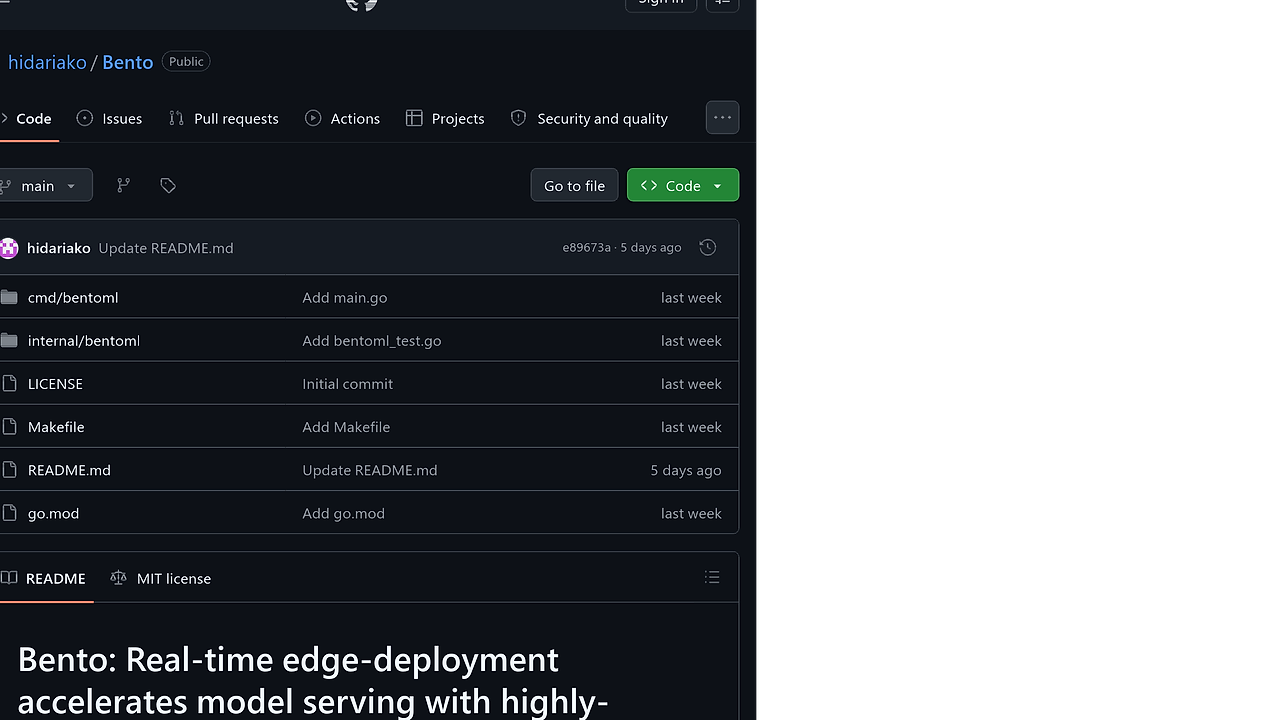
What Is Bento?
Bento, built by hidariako on GitHub, is a Go-based model-serving runtime for edge-deployment and containerized workloads with 5 documented feature areas for Go developers and platform engineers. Bento is one of the best Model Serving Runtime tools for Go developers and platform engineers who want concurrent request handling, built-in HTTP serving, and a MIT-licensed codebase instead of a heavy ML platform.
Quick Overview
| Attribute | Details |
|---|---|
| Type | Model Serving Runtime |
| Best For | Go developers and platform engineers |
| Language/Stack | Go, goroutines, built-in HTTP server, minimal dependencies, JSON/CSV/XML output |
| License | MIT |
| GitHub Stars | N/A as of May 2026 |
| Pricing | Open-Source |
| Last Release | N/A — not listed on the page |
Who Should Use Bento?
- Go backend teams building inference endpoints or request-routing services that need goroutines and a single compiled binary.
- Platform engineers running containerized services that need config-file, environment-variable, or programmatic control over runtime behavior.
- Indie hackers shipping small APIs that must emit JSON, CSV, or XML without dragging in a large dependency graph.
- Edge and serverless teams that care about artifact size, startup behavior, and a deployment model that fits Linux containers.
Not ideal for:
- Teams that need a full ML platform with model registry, training, feature store, and deployment orchestration in one product.
- Python-first data science groups that want a richer ecosystem around notebooks, packaging, and model lifecycle management.
- Organizations that need built-in observability, auth, and policy controls without adding adjacent tooling.
Key Features of Bento
- Goroutine concurrency — Bento is built around concurrent Go programming, so parallel request handling maps directly onto the Go scheduler. That matters when you want to fan out work or keep latency stable under bursts.
- Built-in HTTP server — The repository calls out HTTP server capabilities, which means Bento can expose endpoints without requiring a separate application framework. For service owners, that keeps the control surface smaller and the integration path simpler.
- Cross-platform binary compilation — Go makes it practical to build the same service for Linux, macOS, and Windows from one codebase. In container work, that usually means predictable artifacts and easier local testing.
- Minimal external dependencies — Fewer third-party packages reduce vendoring noise and make upgrades easier to reason about. It also narrows the surface area you need to audit when the service sits near production traffic.
- Config-driven runtime behavior — Bento supports environment variables, configuration files, and programmatic settings. The documented knobs include verbose logging, output format, performance settings, and network timeout or retry policy.
- Multiple output formats — The page explicitly lists JSON, CSV, and XML output formats. That makes Bento useful when one upstream pipeline wants structured JSON while another still expects legacy CSV or XML payloads.
- Performance-oriented Go design — The project emphasizes high-performance architecture and efficient data structures rather than large framework abstractions. That choice usually favors lower overhead and easier container packaging.
Bento vs Alternatives
| Tool | Best For | Key Differentiator | Pricing |
|---|---|---|---|
| Bento | Go-first model serving and edge deployment | Single-binary runtime with goroutines and HTTP serving | Open-Source |
| BentoML | Python ML model packaging and serving | Python-native model lifecycle and ML ecosystem integrations | Open-Source |
| KServe | Kubernetes-native inference at scale | CRD-driven deployment on Kubernetes | Open-Source |
| djevops | Release automation around deploys | Deployment workflow orchestration, not the serving runtime itself | Open-Source |
Pick BentoML if your team is already Python-heavy and wants model packaging, serving APIs, and a broader ML workflow in one stack. Pick KServe if the deployment boundary is Kubernetes and your ops team already runs CRDs, autoscaling policies, and cluster-level governance.
Pick djevops if the real problem is moving builds through environments rather than serving inference traffic. Pair Bento with OpenTrace when you need request-level tracing, and with OpenSwarm when Bento sits inside a larger distributed workflow that needs coordination.
How Bento Works
Bento centers on a small Go runtime that uses goroutines for concurrent work and an embedded HTTP server for request handling. The design choice here is clear: keep the deployment artifact small, keep the runtime predictable, and avoid forcing operators into a larger control plane unless they actually need one.
The data path is straightforward. Incoming requests enter the HTTP layer, the service processes them with Go concurrency primitives, and the output serializer emits JSON, CSV, or XML depending on the configured format. That makes Bento a better fit for teams that value explicit control over transport and response shape than for teams that want a framework to hide those decisions.
The configuration model is also practical. The repository documents environment variables, config files, and programmatic settings for verbose mode, output format, performance tuning, and network behavior, so operators can change runtime behavior without rebuilding the binary.
git clone https://github.com/hidariako/Bento.git
cd Bento
go test ./...
go build -o bento .
./bento --help
This sequence clones the repository, validates the Go test suite, builds a local binary, and prints the available runtime flags if the project exposes them through the standard CLI. After that, the next step is usually wiring a config file or environment variables for logging, output format, and timeout or retry behavior.
Pros and Cons of Bento
Pros:
- Small operational footprint — A Go binary is easier to containerize than a multi-runtime stack, especially when the service sits close to edge nodes.
- Concurrent request handling — Goroutines give Bento a natural path to parallel work without introducing extra worker daemons.
- Flexible configuration — Env vars, files, and code-level settings cover most deployment styles without forcing one pattern.
- Multiple output formats — JSON, CSV, and XML support makes Bento easy to plug into mixed downstream systems.
- Minimal dependency graph — Fewer external packages usually means less maintenance churn and less accidental complexity.
- MIT license — The license is permissive, which matters when you want to embed Bento in commercial infrastructure.
Cons:
- Sparse public documentation — The scraped page does not list release history, benchmarks, or detailed runtime examples.
- No visible ML lifecycle layer — Bento is about serving and runtime behavior, not training, registry, or experiment management.
- Limited observability detail — The page mentions performance settings, but not tracing, metrics, or log aggregation out of the box.
- Deployment policy is on you — There is no documented autoscaling, secret management, or multi-tenant policy layer in the page text.
Getting Started with Bento
git clone https://github.com/hidariako/Bento.git
cd Bento
go mod tidy
go test ./...
go build -o bento .
./bento --help
That quickstart fetches the repo, resolves module dependencies, runs the full test suite, and builds a local binary you can inspect before wiring it into a container image. After the first run, configure verbose logging, output format, performance settings, and network retry policy through environment variables or a config file so the runtime matches your deployment target.
Verdict
Bento is the strongest option for Go-first model serving when you want a small binary, goroutine-based concurrency, and config-driven runtime behavior instead of a heavier ML platform. Its main strength is deployment simplicity; its main caveat is the thin public documentation and missing lifecycle tooling. Choose Bento if you want to own the serving stack yourself.