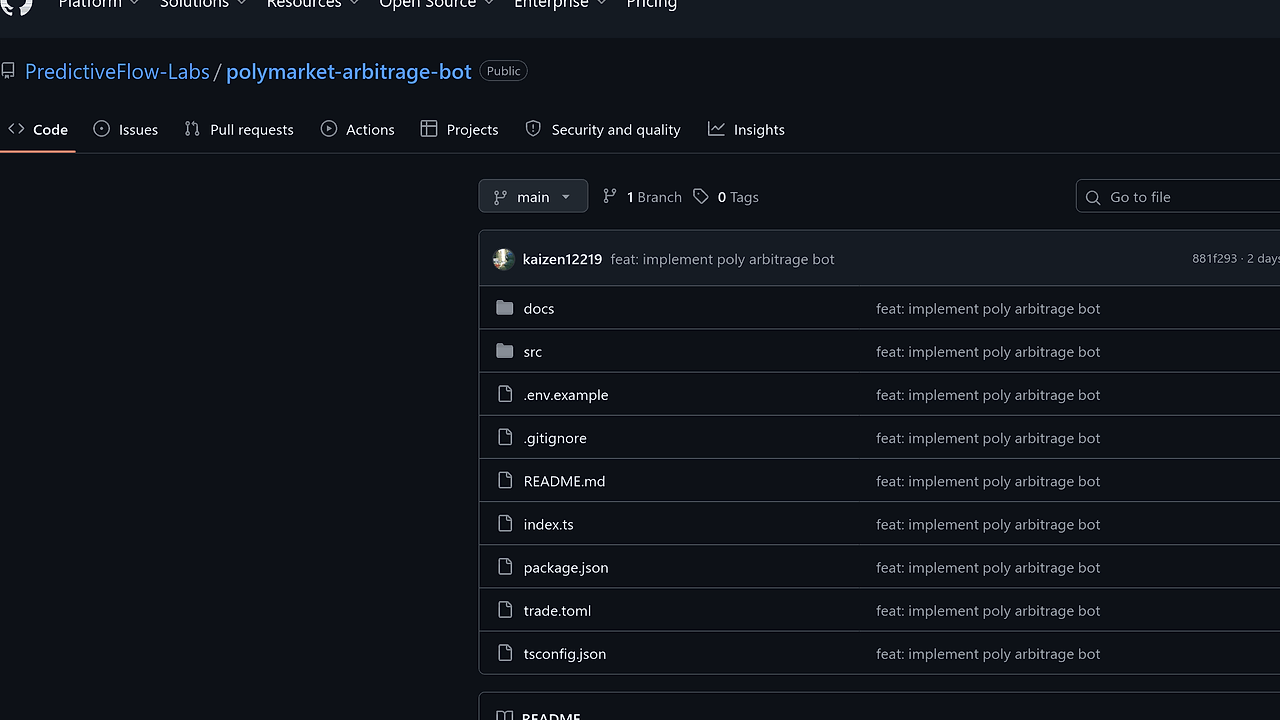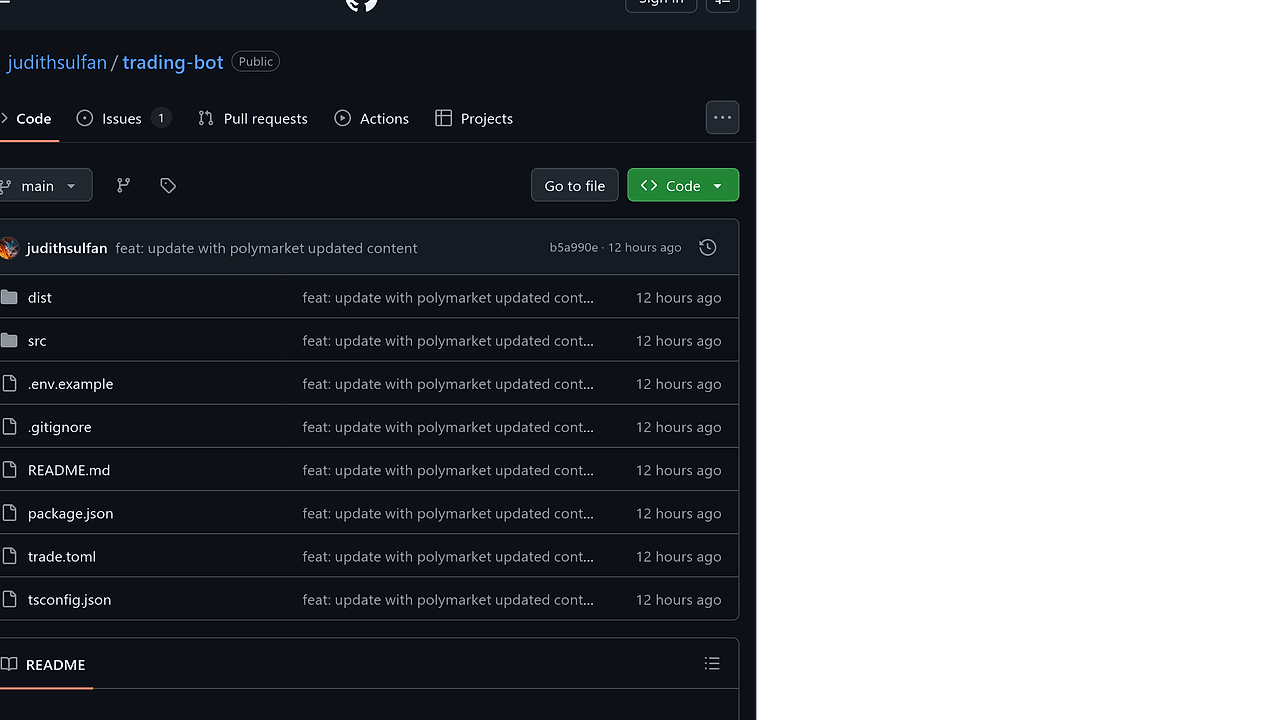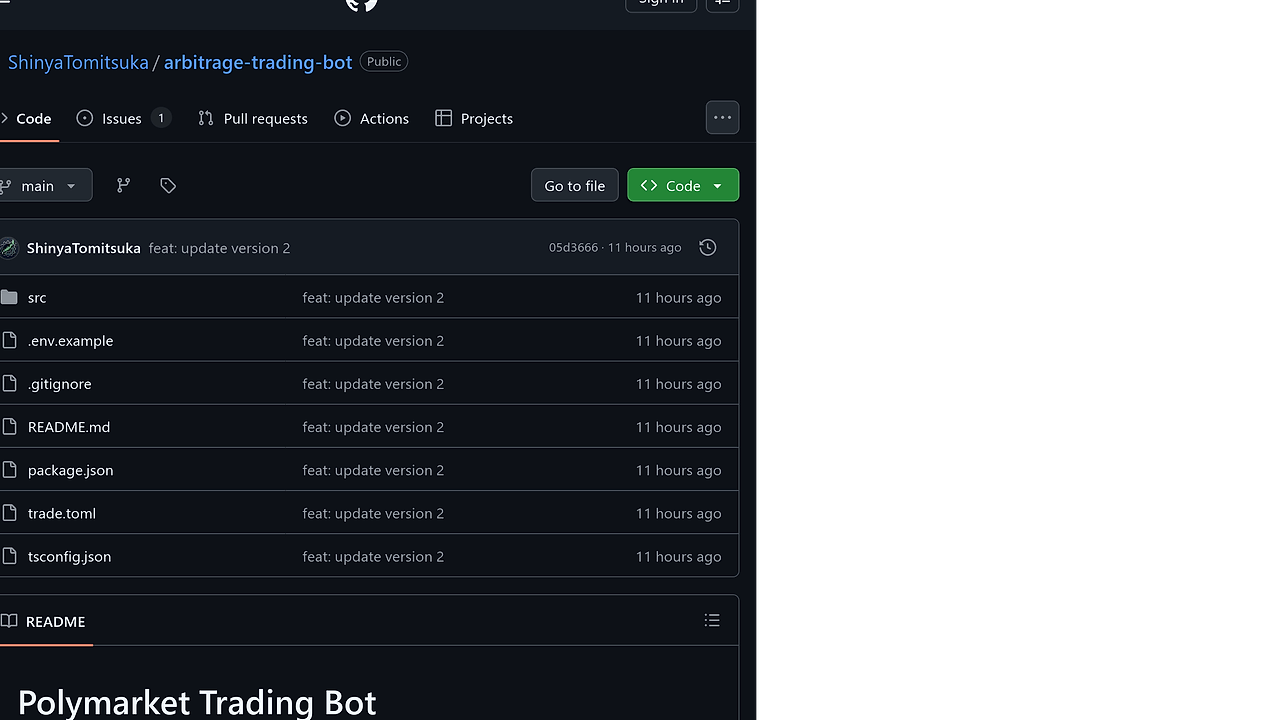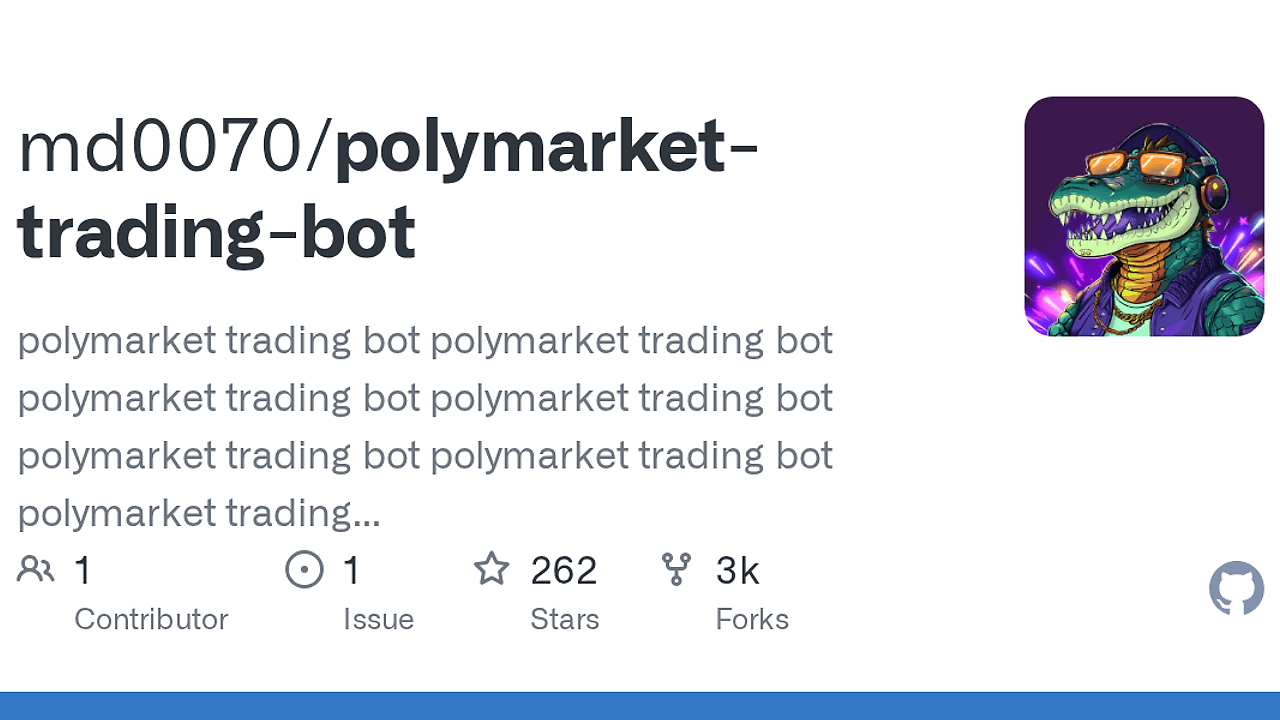
What Is Polymarket Arbitrage Trading Bot?
Polymarket Arbitrage Trading Bot is an open-source prediction market trading bot built by md0070 for TypeScript users who want to automate Polymarket UP/DOWN markets with live CLOB pricing, order execution, and on-chain balance tracking. It targets crypto traders and quant developers, supports BTC/ETH/SOL/XRP windows from 5m to 24h, and the repo snapshot documents a Node.js >= 20.6.0 runtime with second-by-second market polling. Polymarket Arbitrage Trading Bot is one of the best Prediction Market Trading Bots tools for Polymarket traders.
Quick Overview
| Attribute | Details |
|---|---|
| Type | Prediction Market Trading Bots |
| Best For | Polymarket traders and TypeScript quant developers |
| Language/Stack | TypeScript, Node.js 20.6+, @polymarket/clob-client-v2, TOML + Zod, Polygon USDC |
| License | N/A |
| GitHub Stars | N/A as of Feb 2026 |
| Pricing | Open-Source |
| Last Release | N/A |
Who Should Use Polymarket Arbitrage Trading Bot?
- Independent traders who want a scriptable Polymarket executor instead of clicking around the UI.
- TypeScript developers who prefer a typed codebase, explicit config validation, and a clear
src/layout. - Quant builders testing short-horizon market rules on BTC, ETH, SOL, or XRP prediction windows.
- Operators running small automation stacks that need order retries, balance polling, and deterministic state transitions.
Not ideal for:
- Teams that need a multi-exchange portfolio engine with dozens of connectors.
- Users who want a fully managed SaaS with dashboards, alerts, and custody abstraction.
- Anyone unwilling to hold a signer key and fund a proxy wallet on Polygon.
Key Features of Polymarket Arbitrage Trading Bot
- Live CLOB price polling — the bot queries
https://clob.polymarket.com/pricesevery second and refreshes UP/DOWN bid-ask data without waiting for a manual refresh cycle. That cadence is enough for short-window markets where stale quotes matter more than batch analytics. - Market slug resolution — it maps a configured coin and period into the live Polymarket market slug, then locks onto the market’s
clobTokenIdsuntil expiry. This avoids brittle hard-coded token IDs and keeps the runtime aligned with the current event window. - On-chain balance awareness — the engine reads
CONDITIONALandCOLLATERALbalances throughgetBalanceAllowance, so the position state reflects actual Polygon funds rather than simulated PnL. That matters when your proxy wallet is the source of truth and order settlement has to be confirmed on-chain. - Two explicit strategy modes —
trade_1is exit-only, whiletrade_2supports entry, exit, and an emergency swap path. The configuration is stored intrade.toml, so the trading rules are visible and versionable instead of buried inside a compiled binary. - FAK order execution — the bot posts Fill-and-Kill market orders and retries transient failures before checking balances again for settlement. That design favors immediate execution over passive resting orders, which fits short-window prediction markets where the edge can disappear in seconds.
- Typed config validation —
trade.tomlis validated with Zod at startup, and.envvalues are required before the engine runs. This fails fast on invalid market periods, missing keys, or malformed ranges, which is exactly what you want before the bot touches real funds. - Operator-friendly telemetry — the runtime prints trend, position, spread, time ratio, and portfolio status every few seconds. That gives you enough signal to detect whether the engine is busy, flat, long UP, or long DOWN without opening a separate dashboard.
Polymarket Arbitrage Trading Bot vs Alternatives
| Tool | Best For | Key Differentiator | Pricing |
|---|---|---|---|
| Polymarket Arbitrage Trading Bot | Polymarket UP/DOWN automation | Native Polymarket CLOB flow with market slug resolution and on-chain balance checks | Open-Source |
| Hummingbot | Cross-exchange market making | Mature connector ecosystem for centralized and decentralized venues | Open-Source |
| Freqtrade | Signal-driven crypto strategy execution | Strong backtesting and strategy research loop for exchange trading | Open-Source |
| Custom CCXT bot | Teams already standardizing on exchange APIs | Broad exchange coverage and full control over execution logic | Open-Source |
Pick Polymarket Arbitrage Trading Bot when the venue is Polymarket and the market model is a binary UP/DOWN event, not a generic spot pair. Pick [Hummingbot] when you need many exchange connectors and a broader market-making toolkit, or [Freqtrade] when your core need is research, backtesting, and indicator-driven crypto execution.
For operational wrapping, djevops is the better adjacent tool if you want environment promotion, secret handling, or deployment automation around the bot. If you need request-level visibility when orders fail or latency spikes, OpenTrace is the more relevant companion for tracing runtime behavior.
How Polymarket Arbitrage Trading Bot Works
The architecture is intentionally small. src/index.ts bootstraps the CLOB client, loads .env, parses trade.toml, resolves the target market, and then runs a per-market loop over live quotes and balances. The data model is split into config, market metadata, and trade state, which keeps the engine deterministic and makes it easier to reason about when a buy or sell decision should fire.
The core abstraction is a strategy engine with two rule sets: trade_1 and trade_2. trade_1 is an exit-only model keyed off remaining_time_ratio and up_price_ratio, while trade_2 adds a single-entry gate with optional emergency swapping after an exit. This is a pragmatic design for Polymarket because the bot only needs enough state to decide whether to enter, exit, or flip exposure, not a full portfolio allocator.
npm install
npm run dev
That command path starts the TypeScript runtime through tsx, loads the TOML config, and begins polling the Polymarket CLOB for both sides of the market. Expect the process to refuse to start if the signer key, proxy wallet, or required market config is missing, because the startup path validates the runtime before the first order is ever sent.
Pros and Cons of Polymarket Arbitrage Trading Bot
Pros:
- Direct Polymarket integration with
@polymarket/clob-client-v2, so the bot speaks the venue’s native order flow instead of a generic exchange wrapper. - Real balance verification through Polygon-aware account checks, which reduces the chance of trading against stale local state.
- Simple strategy surface that is easy to audit in
trade.tomlandsrc/trade/decision.ts. - Fast polling cadence with one-second price refreshes, suitable for short-duration markets where execution timing matters.
- Retry-aware order flow that handles transient failures before giving up on an order post.
- Typed startup validation that catches bad config values early and keeps runtime surprises low.
Cons:
- Narrow venue support because the code is built for Polymarket, not a general exchange stack.
- Limited strategy depth since the included models are rule-based and do not include backtesting, parameter sweeps, or machine learning.
- Proxy wallet dependency means you must manage Polygon funds and the associated operational risk yourself.
- Market coverage is constrained to the documented coin/window combinations, including a BTC-only
5minute bucket. - No built-in dashboard for performance analytics, drawdown tracking, or post-trade reporting.
Getting Started with Polymarket Arbitrage Trading Bot
Clone the repo, install dependencies, create the environment file, then define your market and strategy in trade.toml before running the dev process. The bot expects a signer private key, a proxy wallet address, and USDC funded on Polygon, so the first run is a real execution path rather than a dry-run sandbox.
git clone https://github.com/md0070/polymarket-trading-bot.git
cd polymarket-trading-bot
npm install
cp .env.example .env
npm run dev
After startup, the engine prints the signer public key, the active strategy, the selected coin/window, and the configured trade size. If the TOML ranges or market period are invalid, it will fail fast before placing orders, which is preferable when the bot is connected to a funded proxy wallet.
Verdict
Polymarket Arbitrage Trading Bot is the strongest option for TypeScript teams automating short-horizon Polymarket exposure when they want live CLOB execution with on-chain balance verification. Its main strength is deterministic rule execution against real balances; its caveat is that strategy support is narrow and market coverage is limited. Use it if you want a lightweight, hackable Polymarket bot rather than a full trading platform.