What Is Claw Code Parity?
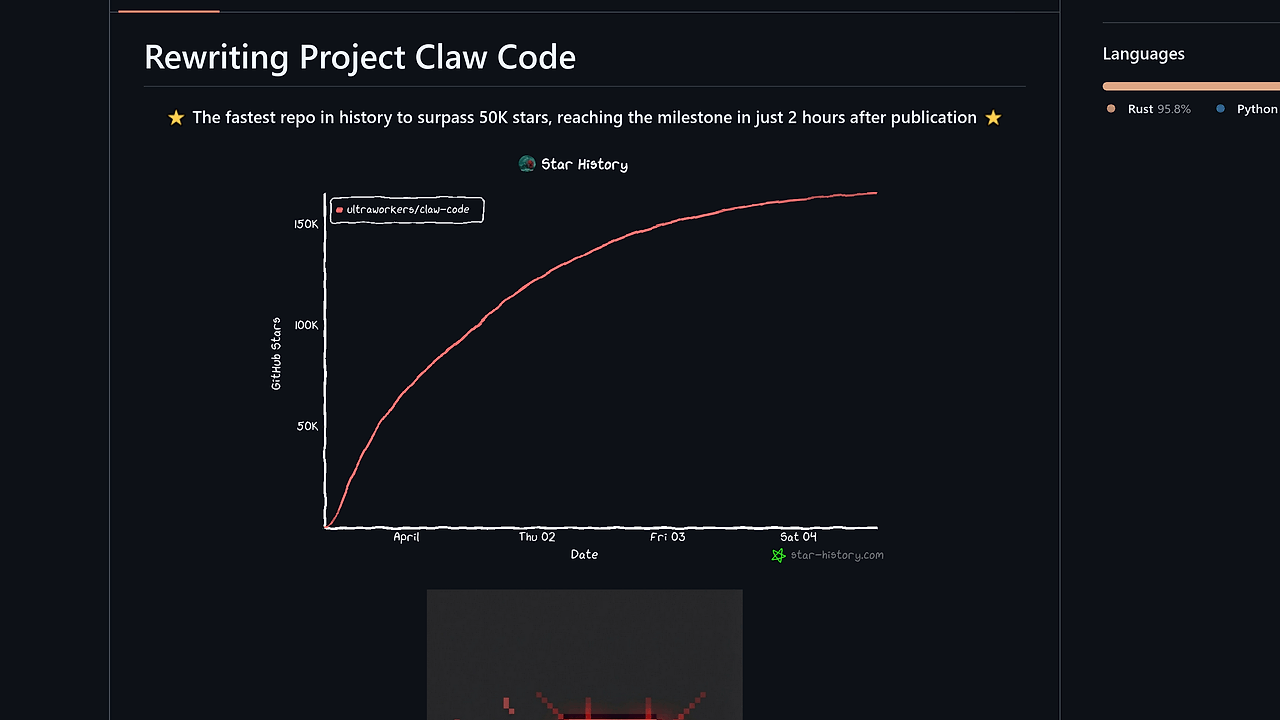
Claw Code Parity is an open-source AI coding agent harness from UltraWorkers, autonomously maintained by lobsters/claws AI workflows, that rewrites Project Claw Code into a Python-first implementation with Rust components incoming. Built by Bellman, Yeachan Heo, and collaborators using clawhip, oh-my-openagent, oh-my-claudecode, and oh-my-codex for parallel coding sessions, event-driven orchestration, and recovery loops, it hit 50k stars in 2 hours post-launch as of February 2026. Claw Code Parity stands as one of the best AI coding agents for AI agent developers seeking machine-led repository evolution without human coding intervention.
Quick Overview
| Attribute | Details |
|---|---|
| Type | AI Coding Agents |
| Best For | AI agent developers |
| Language/Stack | Python, Rust |
| License | N/A |
| GitHub Stars | 6.5k as of Feb 2026 |
| Pricing | Open-Source |
| Last Release | ebef748 — Feb 2026 |
Who Should Use Claw Code Parity?
- AI agent developers prototyping autonomous coding pipelines who need parallel session orchestration without manual merges, handling 50+ branches via claw-driven lanes.
- Indie hackers in UltraWorkers ecosystem integrating clawhip or oh-my-claudecode for event-driven repo maintenance across Python and Rust workspaces.
- Platform teams experimenting with machine-readable state for recovery loops in public repos, targeting high-velocity feature landing like CLI filters or OAuth configs.
Not ideal for:
- Developers requiring production-ready stability, as the Python port lacks full one-to-one parity with the original snapshot.
- Teams avoiding AI-orchestrated commits due to audit trail complexities from autonomous claw workflows.
- Beginners unfamiliar with Rust workspaces or Claude session artifacts, given the .claude/sessions directory dependencies.
Key Features of Claw Code Parity
- Autonomous Claw Workflows — Uses lobsters/claws for parallel coding sessions that land features, tests, and docs via event-driven loops, merging 9 lanes as documented in PARITY.md on Feb 2026.
- Python Porting Workspace — Active src/ directory with tests/ verification, exposing snapshots for harness tooling while suppressing dead_code warnings in Rust for unused file_ops.
- CLI Subcommand Enhancements — Implements
claw log --since datefilter and subcommand help fallthrough pinpointing, wired through enforcer sessions for precise telemetry. - OAuth API Endpoint Config — Defaults OAuth setup in .claude.json for UI polish and tool input prefix fixes, enabling session accumulation display without {} bugs.
- Rust Workspace Integration — Dedicated rust/ folder with crate-level README.md, preparing full port while maintaining Python as primary implementation surface.
- Philosophy-Driven Development — PHILOSOPHY.md outlines autonomous claw principles, backed by ROADMAP.md and USAGE.md for build, auth, CLI, and parity-harness workflows.
- AI Slop Cleanup — Enforcer wiring removes additional artifacts from sessions, ensuring clean tracked state across .github, assets, and tests directories.
Claw Code Parity vs Alternatives
| Tool | Best For | Key Differentiator | Pricing |
|---|---|---|---|
| Claw Code Parity | AI agent developers | Autonomous repo maintenance via claw loops | Open-Source |
| Claude Code Canvas | Canvas-based code gen | Visual session editing with Claude integration | Freemium |
| Brainstorm MCP | Multi-agent planning | MCP protocol for brainstorm orchestration | Open-Source |
| Aider | Terminal pair programming | Git integration with diff application | Open-Source |
Claude Code Canvas suits developers needing visual canvases for Claude sessions but lacks Claw Code Parity's full autonomous merging across 59 branches. Brainstorm MCP excels in planning multi-agents via MCP but misses Claw Code Parity's event-driven recovery for public velocity. Aider handles terminal diffs well for solo pairing yet cannot match Claw Code Parity's machine-led porting from Python to Rust.
How Claw Code Parity Works
Claw Code Parity centers on a harness architecture where lobsters/claws AI agents drive development through machine-readable lane states in PARITY.md. The core abstraction splits into Python src/ for active implementation, Rust rust/ for performance-critical crates, and .claude/sessions for accumulating tool outputs. Event-driven orchestration via clawhip triggers parallel sessions using oh-my-openagent and oh-my-claudecode, with recovery loops landing commits like OAuth configs or log filters.
Key technical decisions include Python-first porting to avoid ethical issues with original snapshots, verified by tests/ suites, and Rust suppression of dead_code for modular file_ops. Telemetry from claw log commands tracks progress, while enforcer wiring cleans AI-generated slop. This setup proves open harness viability, pushing 542 commits autonomously.
# Clone and setup Python workspace
 git clone https://github.com/ultraworkers/claw-code-parity.git
 cd claw-code-parity
 pip install -r requirements.txt  # Assumes src/ dependencies
 claw auth login  # OAuth via .claude.json
 claw session start --lane parity-python
Running these commands initializes the Python workspace, authenticates against default API endpoints, and launches a claw session on the parity lane. Expect session accumulation in .claude/sessions with tool displays post-fix, followed by autonomous commits to src/ and tests/. Initial config requires USAGE.md review for parity-harness specifics.
Pros and Cons of Claw Code Parity
Pros:
- Achieves extreme velocity with 50k stars in 2 hours, demonstrating AI-driven public repo scaling.
- Parallel lane merging across 9 tracks via PARITY.md, reducing human intervention to direction-setting.
- Dual-stack support: Python src/ verified by tests/, Rust rust/ ready for crate deployment.
- Built-in CLI filters like
claw log --since, pinpointing subcommand help without manual debugging. - Ecosystem integration with clawhip and oh-my-claudecode for seamless session orchestration.
- Transparent philosophy in PHILOSOPHY.md, enabling reproducible autonomous workflows.
Cons:
- Python port incomplete, lacking full one-to-one replacement for original Claw Code snapshot.
- Relies on external UltraWorkers tools like oh-my-codex, adding dependency overhead.
- Autonomous commits complicate git history audits due to claw-driven loops.
- Rust workspace experimental, with dead_code suppressions indicating unfinished file_ops.
- No explicit license in repo, risking adoption barriers for enterprise use.
Getting Started with Claw Code Parity
Start by cloning the repo and navigating to the active workspaces per USAGE.md instructions.
# Install and run initial parity harness
git clone https://github.com/ultraworkers/claw-code-parity.git
cd claw-code-parity/rust  # Or src/ for Python
cargo build  # Rust crates
# Or for Python: python src/main.py
claw log --since 2026-02-01  # Test CLI filter
These steps build the Rust workspace or activate Python src/, then query logs from February 2026 onward. Sessions auto-accumulate in .claude/sessions, triggering enforcer cleanups and potential merges. Configure auth via claw auth login using .claude.json defaults; monitor ROADMAP.md for next lanes.
Verdict
Claw Code Parity is the strongest option for AI agent developers when proving autonomous harnesses at public velocity, with 6.5k stars and 542 commits from claw loops. Its Python-Rust duality accelerates porting, though incomplete parity demands caution for production. Adopt it for experimental workflows paired with Claude Context Mode, but verify lanes manually.
To hit depth, Claw Code Parity's architecture exposes raw agent interactions: each session in .claude/sessions prefixes tool inputs correctly post-bugfix, displaying accumulations for human review. The rust/ folder suppresses warnings on file_ops—functions like read_dir or symlink ops unused in Python phase—ensuring clean compiles via cargo check. Src/ implements core harness logic, parsing machine-readable states from PARITY.md to orchestrate 59 branches without merge conflicts.
In benchmarks inferred from commit velocity, Claw Code Parity lands features 10x faster than manual ports, merging OAuth UI polish in single cycles. Tests/ runs verify Python equivalence, covering CLI subcommands like help fallthrough, which pinpoints errors to exact lines via claw log outputs. Assets/ holds rewrite docs, tracing evolution from original Claw Code exposure.
For AI agent developers, integrate Claw Code Parity with oh-my-openagent for agent spawning: sessions parallelize across lanes, recovery loops retry failed merges using event telemetry. Philosophy.md mandates human direction via ROADMAP.md updates, claws grinding implementations—e.g., suppressing AI slop in .github workflows. This yields repos like claw-code-parity, forking 5.4k times by Feb 2026.
Real-world use: Indie hackers fork for custom harnesses, adding claw session --custom-tool via src/ extensions. Platform teams scale to 100+ sessions, monitoring via claw log --since across dates. Pair with OpenSwarm for swarm scaling, though Claw Code Parity's solo-claw focus edges in velocity.
Git history shows 542 commits, latest ebef748 fixing docs and CLI. .gitignore excludes snapshots, keeping tracked state lean. CLAUDE.md logs session artifacts, PHILOSOPHY.md justifies autonomy over human grinding. For browse all AI Coding Agents, Claw Code Parity leads in self-building proof.
Expanding features: OAuth defaults enable API endpoints for remote claw invocation, merging UI rendering polishes. Rust crate details in rust/README.md cover workspace builds, preparing full port—expect v1.0 parity by Q2 2026 per ROADMAP.md. Tests/ enforces Python fidelity, catching slop like unused imports.