What Is Polymarket Copy-Trading Bot?
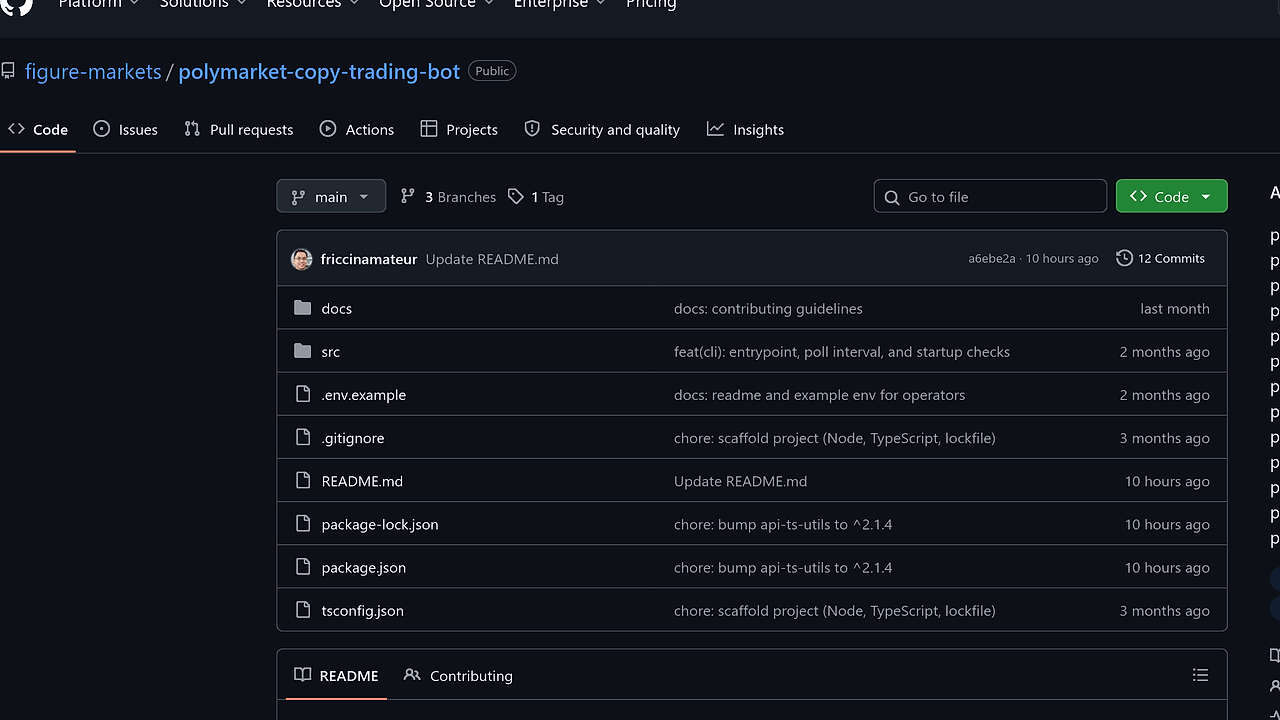
Polymarket Copy-Trading Bot is a TypeScript/Node.js crypto trading bot built by Figure Markets that watches a target Polymarket wallet or username and mirrors activity from your own account. Polymarket Copy-Trading Bot is one of the best Crypto Trading Bots tools for Polymarket traders and TypeScript developers, and the repo documents a poll interval as low as 15,000 ms plus size caps to keep execution bounded.
The point is narrow and useful: copy one trader, do not invent a new strategy engine. That makes the bot a good fit for developers who want deterministic behavior, visible config, and no hidden cloud service.
Quick Overview
Polymarket Copy-Trading Bot is a small, environment-driven bot with a tiny runtime footprint and explicit guardrails.
| Attribute | Details |
|---|---|
| Type | Crypto Trading Bots |
| Best For | Polymarket traders, quants, and TypeScript developers who want terminal-based copy trading |
| Language/Stack | TypeScript, Node.js 20+, Polymarket CLOB, Polygon |
| License | N/A |
| GitHub Stars | N/A in the scraped page text |
| Pricing | Open-Source |
| Last Release | N/A in the scraped page text |
Who Should Use Polymarket Copy-Trading Bot?
Polymarket Copy-Trading Bot makes sense when you want to mirror a known market participant without writing a matching engine or a full alpha stack.
- Polymarket traders who want to shadow a target wallet and keep execution rules simple instead of hand-copying every fill.
- TypeScript developers who prefer a Node.js codebase,
.envconfig, andnpm run devover a GUI or hosted SaaS. - Indie hackers validating copy-trading workflows with a fresh wallet, capped order sizes, and low setup overhead.
- Ops-minded teams that need a bot they can run in a terminal, a container, or a scheduled job with predictable inputs.
Not ideal for:
- Users who need sub-second reaction time or websocket-driven execution.
- Traders who expect built-in arbitrage, backtesting, or portfolio analytics.
- Anyone who is not comfortable managing a private key and a funded wallet.
Key Features of Polymarket Copy-Trading Bot
- Target resolution —
COPY_TARGET_USERaccepts either a proxy address or a username, then resolves the username to a Polymarket proxy when possible. That makes Polymarket Copy-Trading Bot usable for both public handles and direct on-chain identifiers. - Scheduled polling —
COPY_POLL_INTERVAL_MScontrols how often the bot checks for new activity, and the README shows a 15,000 ms example. This keeps the design simple and avoids a persistent streaming listener. - Activity window control —
COPY_ACTIVITY_LIMITbounds how many recent events are inspected on each poll. That is the main protection against noisy targets that generate a lot of portfolio churn. - Risk scaling —
COPY_SIZE_MULTIPLIERlets you mirror at fractional size, whileCOPY_MAX_ORDER_USDcaps each copied order. Those two knobs matter more than anything else when the target trader runs bigger size than you want to follow. - Trades-only mode —
COPY_TRADES_ONLY=truefilters out non-trade activity so the bot focuses on execution rather than claims or other portfolio events. That is useful when you only care about copying actual position changes. - Polygon-aware execution — the config supports
POLYMARKET_CHAIN_ID, and the README says Polygon is the default in most setups. That aligns the bot with the chain Polymarket uses for its live activity. - Two-runner workflow —
npm run devgives you a TypeScript watch loop, whilenpm startbuilds and then runs the compileddist/index.js. The workflow is easy to audit because there is no hidden daemon layer.
Polymarket Copy-Trading Bot vs Alternatives
Polymarket Copy-Trading Bot is best when the only job is mirroring a single Polymarket trader with explicit caps and minimal moving parts.
| Tool | Best For | Key Differentiator | Pricing |
|---|---|---|---|
| Polymarket Copy-Trading Bot | Mirroring one Polymarket trader | Poll-based copy logic with size caps and username-to-proxy resolution | Open-Source |
| Hummingbot | Multi-venue market making and execution | Broader exchange framework, not Polymarket-specific copy trading | Open-Source |
| CCXT | Building custom exchange bots | Low-level API layer that you assemble into your own strategy | Open-Source |
| Freqtrade | Systematic crypto strategies with backtesting | Strategy engine for exchange trading, not wallet-following on Polymarket | Open-Source |
Pick Polymarket Copy-Trading Bot when you want direct mirroring on Polymarket and do not want to maintain strategy infrastructure. Pick Hummingbot when you need broader exchange coverage or market making logic.
Pick CCXT when you want raw API access and plan to build your own decision engine on top of it. Pick Freqtrade when you care about indicators, backtests, and exchange-based systematic trading rather than copying another wallet.
If you want tracing around bot runs, pair this with OpenTrace. If you want repeatable deployment and CI around the repo, djevops is a sensible adjacent tool.
How Polymarket Copy-Trading Bot Works
Polymarket Copy-Trading Bot treats Polymarket as a read-mostly activity source and then translates observed target activity into mirrored orders from your own wallet. The core loop is simple: resolve the target, poll for recent activity, diff against the last seen window, and submit only the actions that survive your copy rules.
The architecture intentionally stays small. There is no heavy indexer, no event bus, and no separate execution service, which means you can reason about the bot from the source tree and the environment variables alone.
The effective state model is just a few pieces of data: target identity, last processed activity, optional size multiplier, and a hard USD cap per copied order. That makes Polymarket Copy-Trading Bot easy to inspect, but it also means polling latency is part of the design and not an accidental limitation.
COPY_TARGET_USER=0xTargetProxy COPY_POLL_INTERVAL_MS=15000 COPY_SIZE_MULTIPLIER=0.25 COPY_MAX_ORDER_USD=25 npm run dev
That command starts the TypeScript watcher with a small copy size and a hard cap, which is the safest way to sanity-check a new target. Expect the bot to poll on the configured interval, resolve the target if needed, and attempt copied orders only when the activity passes your filters.
Pros and Cons of Polymarket Copy-Trading Bot
Pros:
- Small, auditable code path — the bot is a terminal workflow built around Node.js and TypeScript, so the runtime is easy to inspect and patch.
- Explicit risk controls —
COPY_SIZE_MULTIPLIER,COPY_MAX_ORDER_USD, andCOPY_TRADES_ONLYgive you concrete guardrails instead of vague automation. - Username and proxy support — copying can start from a Polymarket username or a proxy address, which reduces friction during setup.
- No extra infrastructure required — you do not need Redis, a job queue, or a hosted execution backend to run the bot locally.
- Fast to test — the repo includes a clear
.envflow and simplenpmentrypoints, so validation is quick even for small experiments.
Cons:
- Polling is slower than streaming — if you need near-real-time mirroring, the scheduled loop will lag behind a websocket or event-driven design.
- No strategy layer — Polymarket Copy-Trading Bot copies behavior, but it does not generate alpha or decide whether the target trade is actually good.
- Private key handling is on you — the bot expects a wallet key and a Polymarket proxy/funder address, so operational hygiene matters.
- Limited scope — this repo is built for Polymarket copy trading, not for multi-exchange execution or broad portfolio management.
- No built-in backtesting — you cannot replay historical trades inside the bot to measure target quality before going live.
Getting Started with Polymarket Copy-Trading Bot
Start with the repository clone, install, and environment file workflow, then run the bot locally with a small size multiplier.
git clone https://github.com/figure-markets/polymarket-copy-trading-bot.git
cd polymarket-copy-trading-bot
npm install
cp .env.example .env
npm run dev
After that, fill in COPY_TARGET_USER, POLYMARKET_PRIVATE_KEY, and POLYMARKET_ADDRESS before expecting the bot to trade. For the first live test, keep COPY_SIZE_MULTIPLIER low and COPY_MAX_ORDER_USD small so a bad target or bad assumption does not create an oversized fill.
If username resolution fails, switch COPY_TARGET_USER to the target proxy address directly. If the bot exits early, the usual cause is a missing private key, malformed hex, or a bad proxy address in .env.
Verdict
Polymarket Copy-Trading Bot is the strongest option for terminal-based Polymarket mirroring when you want explicit size caps and a small TypeScript codebase. Its main strength is predictable, inspectable execution; its main caveat is polling latency. Use it if you want controlled copy trading, not arbitrage or HFT.