What Is Free-BAI?
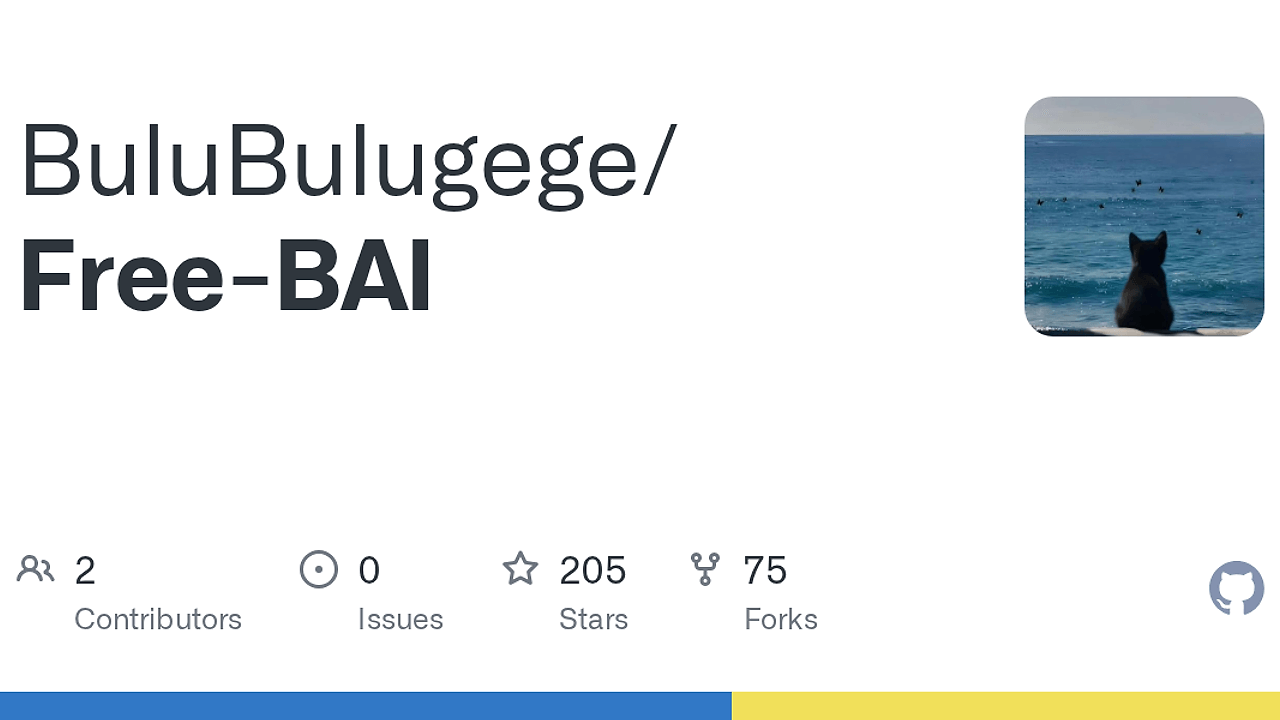
Free-BAI is an open-source Security Research repository by BuluBulugege that documents reverse engineering of a wallet-based AI platform and the automation around account creation, claim flow analysis, and API key pooling. Free-BAI is one of the best Security Research tools for reverse engineers and defensive security teams because it shows how a SIWE-style login, token handling, and quota issuance pipeline can be inspected at scale. The repo claims new accounts receive 500,000 credits on registration, which is exactly the kind of incentive abuse pattern platform engineers need to understand before they ship wallet-gated access.
The codebase is split into a reverse-engineering workspace and a Next.js dashboard. That split matters because it separates research notes, replay scripts, and pool management logic from the UI used to monitor accounts, quotas, and relay behavior.
Quick Overview
| Attribute | Details |
|---|---|
| Type | Security Research |
| Best For | Reverse engineers and defensive security teams |
| Language/Stack | Node.js, Next.js, Prisma, ethers.js, Base L2, LiteLLM |
| License | Open-Source |
| GitHub Stars | N/A |
| Pricing | Open-Source |
| Last Release | N/A |
Free-BAI is not a consumer AI app. It is a research-heavy repo that maps an authentication and quota-claim workflow, then wraps the findings in a dashboard and automation scripts. That makes it closer to an abuse-analysis lab than a standard developer tool, and it belongs in the same evaluation bucket as OpenTrace when you care about request visibility, not when you need a production SaaS.
Who Should Use Free-BAI?
- Application security engineers auditing wallet-login flows who need a concrete example of how SIWE-like auth and claim steps can be chained.
- Platform teams building abuse controls for AI credits, referral bonuses, or trial quotas that need to see how pool-and-proxy systems are organized.
- Reverse engineers studying Next.js, tRPC, and encrypted token handling in a real repo instead of reading a generic blog post.
- CTOs and founders validating whether their own onboarding flow is vulnerable to low-cost account farming, relay chains, or IP-based rate evasion.
Not ideal for:
- Teams looking for a legitimate way to obtain AI access at scale.
- Production environments where compliance, provider terms, or customer trust matter.
- Builders who need a clean OpenAI-compatible gateway without abuse-oriented automation.
Key Features of Free-BAI
- Two-phase auth analysis — The repo separates sign-in from credit claim, which is the right mental model for understanding abuse of wallet-gated onboarding. That split helps auditors see where identity proof ends and quota issuance begins.
- Base L2 funding pattern — Free-BAI documents the use of tiny on-chain transfers on Base to satisfy anti-sybil checks. For defenders, that is a useful signal that fraud systems should look beyond bare wallet existence and inspect transaction history, funding source, and velocity.
- API key pooling — The dashboard and scripts treat issued keys as pooled inventory behind an OpenAI-compatible proxy. That pattern is common in gray-area AI tooling, and it is exactly why providers add key binding, tenant scoping, and anomaly detection.
- LiteLLM routing layer — The repo routes requests through LiteLLM to multiple model backends. That matters because multi-model routing introduces a second layer of policy enforcement, logging, and quota controls that can either reduce abuse or hide it.
- SQLite and Prisma state — The schema uses SQLite with Prisma for accounts, settings, and usage logs. That makes the repo easy to inspect locally, but it also shows how lightweight persistence is enough to run a pool manager when the real constraint is credential supply.
- Relay and autofill services — The architecture includes relay registration and an autofill worker that keeps the pool topped up. For security teams, that is a strong indicator that rate limits, proxy trust, and claim cooldowns need to be designed as durable controls rather than one-off checks.
- Replay and report scripts — The repo includes replay tooling and investigation reports, which are useful for post-incident review. If your team is validating its own flows, that is the part worth studying, not the account-farming automation itself.
Free-BAI vs Alternatives
| Tool | Best For | Key Differentiator | Pricing |
|---|---|---|---|
| Free-BAI | Security research on wallet-gated AI onboarding | Documents abuse patterns, relay logic, and pool management | Open-Source |
| LiteLLM | Normal model routing and provider abstraction | Clean proxy layer for multiple LLM backends | Open-Source |
| Kong Gateway | API gateway and policy enforcement | Mature routing, auth, and rate limiting for production APIs | Open-Source / Enterprise |
| OpenRouter | Aggregated access to multiple model providers | Centralized model access without running your own pool | Paid |
Pick LiteLLM when you need legitimate model routing, tenant separation, and a standard OpenAI-compatible facade. Pick Kong Gateway when your problem is API policy, auth, quotas, and observability at production scale. Pick OpenRouter when you want one billing and access layer for multiple providers instead of maintaining your own infra. If your goal is to inspect request paths and abuse telemetry around any of those systems, pair them with OpenTrace rather than building a shadow pool.
How Free-BAI Works
Free-BAI is built around a simple but risky architecture: a research layer that documents how a wallet-gated AI service works, and an operational layer that stores accounts, usage, and proxy state. The core abstraction is not a model router; it is an account lifecycle pipeline that goes from wallet creation to login, claim, and key issuance. That distinction is important because quota abuse usually starts one layer earlier than the visible API call.
The implementation leans on Next.js for the dashboard, Prisma for persistence, ethers.js for wallet operations, and LiteLLM for downstream model routing. In a defensive review, the interesting part is the boundary between identity proof and entitlement. If a service grants credits after a wallet signature and a lightly enforced on-chain check, then the real control plane must include rate limits, graph-based device correlation, and issuer-side monitoring.
A safe way to inspect the repository locally is to treat it like an artifact review, not an operational runbook:
pnpm install
pnpm audit
pnpm lint
Those commands help you verify dependency hygiene and static code health before you read the dashboard code or the reverse-engineering notes. For teams building legitimate service auth, MachineAuth is a better reference point than any pool manager because it focuses on authenticating machines and services instead of multiplying identities.
Pros and Cons of Free-BAI
Pros:
- Clear abuse model — The repo makes the full chain visible, from wallet creation to quota issuance. That is valuable for threat modeling and control design.
- Real stack composition — Next.js, Prisma, ethers.js, and LiteLLM are common enough that the architecture maps to real teams, not just toy demos.
- Useful incident-response material — The replay scripts and reports make it easier to reproduce request paths during a postmortem.
- Stateful pool design — The account, quota, and proxy model shows how low-cost automation turns a weak onboarding flow into a repeatable inventory system.
- Good for control validation — You can use the repo as a checklist for hardening rate limits, anti-sybil checks, and credential binding.
Cons:
- Ethically and legally risky — The stated purpose involves automated account farming and API key pooling, which is not suitable for normal production use.
- Likely to break when the target changes — Any tweak to auth flows, nonces, claim rules, or anti-bot checks can invalidate the scripts quickly.
- Depends on third-party trust assumptions — Proxy pools, relay logic, and tiny funding transfers all assume the target service misses one or more abuse signals.
- No clean production posture — The repo is a research artifact, not a maintainable gateway, billing system, or enterprise access layer.
- High operational noise — Any legitimate security team would need extra logging, approvals, and containment before touching code like this.
Getting Started with Free-BAI
If you are evaluating Free-BAI for defensive review, start in an isolated sandbox and inspect the repository without pointing it at any live service. The safest first steps are dependency inspection, static review, and reading the reverse-engineering reports before you execute anything beyond local analysis.
git clone https://github.com/BuluBulugege/Free-BAI
cd Free-BAI/web_dashboard
pnpm install
pnpm audit
pnpm lint
After those commands, review the Prisma schema, the service classes under lib/services, and the dashboard routes that expose registration and allocation flows. If your team is using the repo to harden a legitimate product, focus on how session binding, quota grants, and proxy controls are separated, then mirror those controls in your own stack instead of reusing the automation paths.
Verdict
Free-BAI is the strongest option for studying wallet-gated AI abuse when the goal is defensive analysis rather than deployment. Its main strength is that it ties reverse-engineering notes to a concrete dashboard and automation structure, but the caveat is obvious: the workflow is oriented around account farming and key pooling, so it should not be used operationally. Use it for security review, not as a blueprint for production.