What Is Web3 Developer Toolkit?
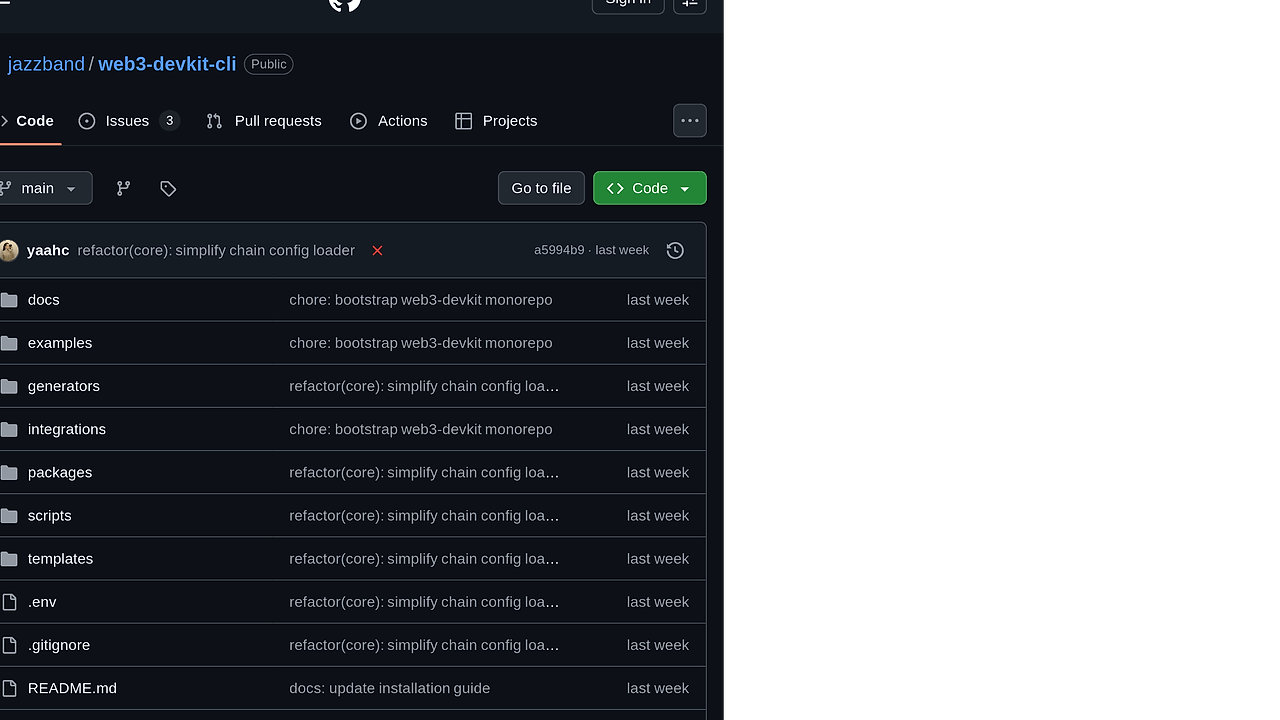
Web3 Developer Toolkit is a Web3 CLI Tools project built in the Jazzband GitHub repository by its maintainers, and it is one of the best Web3 CLI tools for EVM and Solana developers. It wraps project bootstrap, contract/program generation, wallet utilities, RPC validation, deployment, event monitoring, and frontend wallet scaffolding into a single web3 command. The MVP plan is intentionally small: six commands cover init, generate, wallet balance, RPC testing, deploy, and monitor, which keeps the first release deterministic instead of sprawling.
Quick Overview
| Attribute | Details |
|---|---|
| Type | Web3 CLI Tools |
| Best For | EVM and Solana developers, indie hackers, and full-stack web3 teams |
| Language/Stack | Node.js 18+, TypeScript, Commander, Inquirer, Zod, viem, @solana/web3.js, Foundry, Hardhat, Anchor |
| License | MIT |
| GitHub Stars | N/A |
| Pricing | Open-Source |
| Last Release | N/A |
Who Should Use Web3 Developer Toolkit?
- Indie hackers shipping dApps fast who want one CLI that can scaffold contracts, frontend wiring, and deployment scripts without stitching together five repos.
- Platform and product engineers building internal web3 templates who need repeatable project layouts for EVM and Solana instead of one-off starter copies.
- Smart contract teams that already use Foundry, Hardhat, or Anchor and want a thin orchestration layer for init, deploy, verification, and monitoring.
- Full-stack teams shipping Next.js apps with wallet adapters, chain config, and transaction helpers that should be generated rather than hand-wired.
Not ideal for:
- Teams that only need a single-purpose contract dev workflow and already standardized on Foundry or Hardhat templates.
- Pure Solidity shops that have no Solana surface area and do not want Solana-specific commands in the toolchain.
- Developers who prefer fully manual repo setup and do not want generated templates or opinionated defaults.
Key Features of Web3 Developer Toolkit
- Project bootstrap from curated templates —
web3 initcan create EVM, Solana, or full-stack layouts withcontracts/orprograms/,frontend/,backend/api/,.env.example, deployment scripts, and tests. The repo includes template IDs such asevm-foundry,evm-hardhat,solana-anchor,nextjs-wagmi, andfullstack-solana. - Contract and program generators —
web3 generate token,web3 generate nft,web3 generate vault,web3 generate staking, andweb3 generate prediction-marketturn boilerplate into concrete artifacts. The page shows ERC-20, ERC-721, and Anchor escrow examples, so the generator is not just a placeholder. - Wallet and network utilities —
web3 wallet create,web3 wallet balance,web3 wallet tokens,web3 network check, andweb3 rpc testgive you CLI-level validation before deployment. That matters when you need to verify Base, Arbitrum, Ethereum, Polygon, BSC, Avalanche, or Solana endpoints before a release. - Deployment helper with history —
web3 deploy evmsupports gas estimation and broadcast flows, whileweb3 deploy solanatargets Anchor deployments. Deployments are persisted under.web3-devkit/deployments/, andweb3 deploy historyplusweb3 verifyadd traceability instead of throwing away state after each run. - Event monitoring for debugging and bots —
web3 monitor contract,web3 monitor wallet, andweb3 monitor tokenpoll on-chain activity for transfers and other events. That is useful when you need a simple watcher for debugging, alerting, or bot triggers without writing a separate indexer. - Frontend integration generator —
web3 add wagmi,web3 add rainbowkit,web3 add wallet-connect,web3 add viem, andweb3 add solana-walletinject wallet providers, chain config, connect buttons, and hooks into a Next.js frontend. This removes the repetitive glue code that usually breaks during upgrades. - Config persistence for repeat runs —
web3 config init,web3 config get, andweb3 config setstore defaults in.web3-devkit/config.json. The config covers default chain, framework, per-network RPC URLs, and wallet type, so later commands can omit flags without losing determinism.
Web3 Developer Toolkit vs Alternatives
| Tool | Best For | Key Differentiator | Pricing |
|---|---|---|---|
| Web3 Developer Toolkit | End-to-end web3 project setup across EVM and Solana | One CLI for bootstrap, generators, deployment, monitoring, and frontend integration | Open-Source |
| Foundry | Solidity contract development and testing | Extremely focused EVM testing and scripting workflow | Open-Source |
| Hardhat | EVM smart contract dev with plugins | Huge plugin ecosystem and mature JavaScript-first DX | Open-Source |
| Anchor | Solana program development | Opinionated Solana framework with strong IDL-driven workflows | Open-Source |
Pick Foundry when you only care about Solidity unit tests, forge, cast, and low-level EVM scripting. Pick Hardhat when your team depends on the plugin ecosystem or already has a large JavaScript/TypeScript codebase.
Pick Anchor when Solana is the center of gravity and you want Solana-native workflows first. For broader release automation around deployments, policy, and environment drift, pair Web3 Developer Toolkit with djevops. If you want AI-assisted orchestration around scaffolding and follow-up tasks, OpenSwarm fits the outer loop better than a plain CLI.
How Web3 Developer Toolkit Works
Web3 Developer Toolkit is built as a monorepo with a thin CLI layer and separate workspaces for core logic, templates, generators, integrations, EVM helpers, and Solana helpers. The command surface is powered by Commander, prompts come from Inquirer, validation runs through Zod, and the chain-specific implementation splits cleanly between viem for EVM and @solana/web3.js for Solana. That architecture keeps the web3 binary small while pushing the actual scaffolding logic into registries that can grow without turning the CLI into a monolith.
The design favors explicit state over hidden magic. Config lives in .web3-devkit/config.json, deployment artifacts live in .web3-devkit/deployments/, and templates are chosen from named IDs instead of implicit heuristics. That makes the tool easy to reason about in CI, because every generated artifact maps back to a template, generator, or integration entry.
npm install
npm run build
npm link

web3 init evm
web3 generate token -c evm -v erc20 -n MyToken -y
web3 rpc test -n base
web3 deploy evm -n base --estimate
The commands above install the workspaces, expose the web3 binary globally, scaffold an EVM project, generate an ERC-20 contract, validate the Base RPC endpoint, and perform a gas estimate before broadcast. In practice, you should expect generated folders, config files, and deployment records to appear immediately after the first run, with most follow-up flags coming from the persisted config instead of manual repetition.
Pros and Cons of Web3 Developer Toolkit
Pros:
- Covers the whole web3 setup path from scaffold to deploy to monitoring, which reduces context switching between separate CLIs.
- Supports both EVM and Solana, so mixed-stack teams do not need two starter kits.
- Uses explicit registries for templates, generators, and integrations, which makes extension cleaner than a pile of ad hoc scripts.
- Stores deployment history and config on disk, which helps with reproducible local and CI workflows.
- Includes frontend wallet scaffolding for Next.js, wagmi, RainbowKit, Viem, and Solana wallet adapter flows.
- Has a local-first model with no mandatory hosted service, so it fits developer-controlled environments.
Cons:
- The repo text does not show released version numbers or star velocity, so maturity is harder to judge from the page alone.
- The CLI is opinionated around its template registry, which may not match teams that already standardize on custom scaffolds.
- Solana and EVM are both supported, but neither stack appears to get the deep specialization of a dedicated framework like Foundry or Anchor.
- Event monitoring is polling-based from the page description, so it will not replace a real indexer or webhook pipeline.
- The tool is still organized by milestones, which suggests some commands may be early-stage or incomplete relative to a stable v1.
Getting Started with Web3 Developer Toolkit
npm install
npm run build
npm link   # optional: exposes `web3` globally

web3 init
web3 generate token -c evm -v erc20 -n MyToken -y
web3 rpc test -n base
web3 wallet balance -n base -a 0x...
After those commands run, you should have a scaffolded project, a generated contract, and a verified RPC path before you ever deploy. If you do not want a global install, the repo also supports npm run web3 -- <command>, which keeps execution pinned to the local workspace and avoids shell-level state.
Verdict
Web3 Developer Toolkit is the strongest option for teams that want one CLI for EVM and Solana scaffolding when they value a consistent project layout over hand-tuned templates. Its main strength is breadth across bootstrap, generation, deployment, and wallet integration; its main caveat is that specialized frameworks still go deeper on single-chain workflows. Use it when you want the whole starter pipeline in one place.