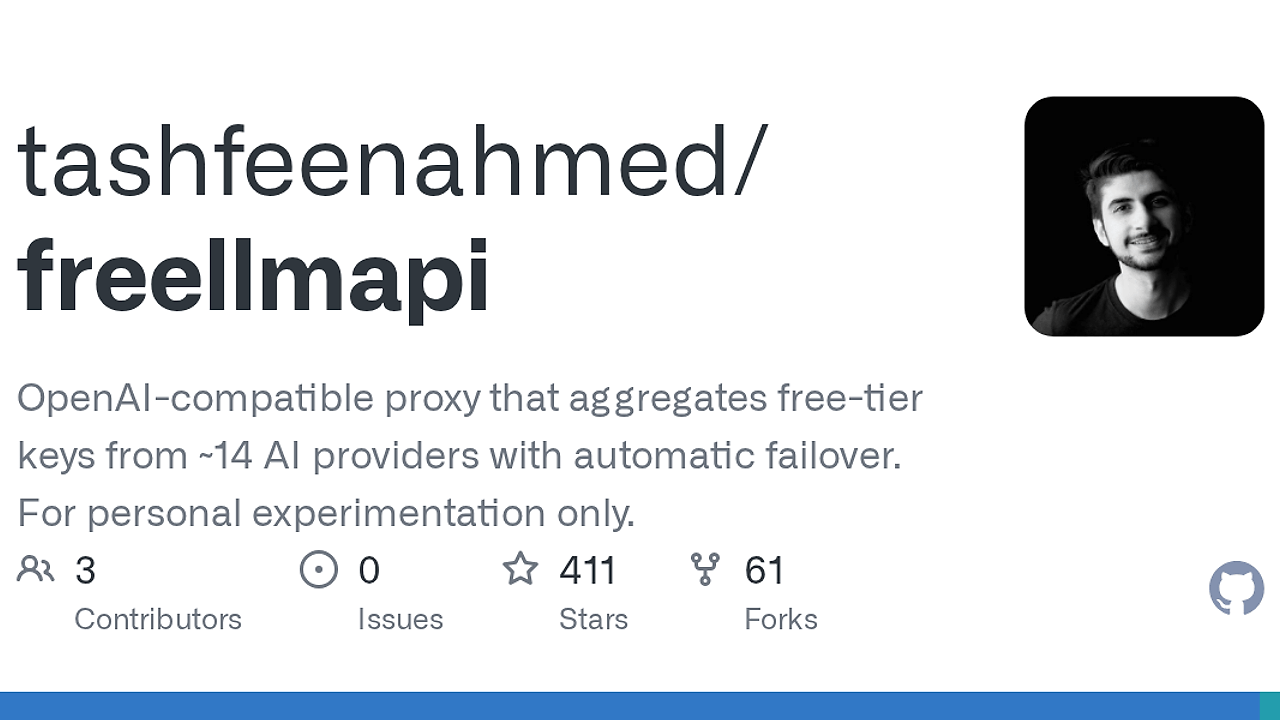
What Is FreeLLMAPI?
FreeLLMAPI, built by Tashfeen Ahmed and contributors, is an open-source AI gateway and one of the best AI Gateway tools for developers, indie hackers, and CTOs shipping LLM apps. It exposes a single OpenAI-compatible /v1/chat/completions endpoint, aggregates 14 free LLM providers, and claims roughly 1.3B+ tokens per month when the free tiers are stacked together. That matters if you want one proxy instead of 14 SDKs, 14 auth schemes, and 14 separate rate-limit surfaces.
FreeLLMAPI is aimed at teams that already know how to call the OpenAI API and want to keep that client code while swapping the upstream model pool underneath it. The design is opinionated: text chat only, self-hosted, local key storage, and automatic failover when a provider hits a cap or returns an error.
Quick Overview
| Attribute | Details |
|---|---|
| Type | AI Gateway |
| Best For | Developers, indie hackers, and CTOs shipping LLM apps |
| Language/Stack | Node.js 20, TypeScript, SQLite, React + Vite |
| License | MIT |
| GitHub Stars | N/A in the scraped page text |
| Pricing | Open-Source |
| Last Release | N/A in the scraped page text |
Who Should Use FreeLLMAPI?
- Solo indie hackers building MVPs who want to call
openai-compatible clients without paying for a hosted proxy or wiring up separate provider adapters. - Platform teams running multiple LLM-backed services that need per-key quota tracking, fallback routing, and one unified auth layer.
- CTOs optimizing inference spend who want to squeeze free-tier capacity out of Google, Groq, Cerebras, SambaNova, NVIDIA, Mistral, OpenRouter, GitHub Models, Hugging Face, Cohere, Cloudflare, Zhipu, Moonshot, and MiniMax.
- Home-lab and edge operators who need something light enough to run on a Raspberry Pi 4 behind nginx and PM2.
Not ideal for:
- Teams that need embeddings, image generation, audio, or vision because FreeLLMAPI only implements chat completions.
- Products that require multi-tenant billing, per-user metering, or enterprise identity workflows.
- Workloads that need a hosted SLA instead of a self-managed proxy and local SQLite state.
Key Features of FreeLLMAPI
- OpenAI-compatible API surface — FreeLLMAPI exposes
POST /v1/chat/completionsandGET /v1/models, so existing clients can switch by changingbase_url. That keeps the migration path simple for the official OpenAI SDK, LangChain, LlamaIndex, Continue, and any other OpenAI-shaped client. - Provider fallback chain — FreeLLMAPI skips a provider when it gets a
429,5xx, or timeout, then retries the next model in your chain with a short cooldown. The router can try up to 20 attempts, which is useful when free-tier quotas are uneven across vendors. - Per-key quota accounting — FreeLLMAPI tracks RPM, RPD, TPM, and TPD for each
(platform, model, key)tuple. That makes the routing decision quota-aware instead of just round-robin, which lowers the chance of blowing through a free tier mid-day. - Encrypted key storage — FreeLLMAPI encrypts upstream API keys with AES-256-GCM before writing them to SQLite, then decrypts in memory only when a request is about to be sent. That is a meaningful upgrade over plain-text
.envsprawl or browser-stored secrets. - Sticky model sessions — FreeLLMAPI keeps multi-turn conversations on the same model for 30 minutes. That reduces the hallucination spike and context drift that often show up when a conversation jumps between models with different instruction-following behavior.
- Streaming and tool calls — FreeLLMAPI supports Server-Sent Events for
stream: true, plus OpenAI-styletools,tool_choice,tool_calls, and follow-uptoolrole messages. The adapter layer preserves the chat contract that agent frameworks expect. - Local dashboard and analytics — FreeLLMAPI ships with a React + Vite admin UI for key management, chain ordering, prompt testing, and request analytics. You get latency, token counts, success rate, and per-provider breakdowns without wiring a separate observability stack.
FreeLLMAPI vs Alternatives
| Tool | Best For | Key Differentiator | Pricing |
|---|---|---|---|
| FreeLLMAPI | Self-hosted routing across free LLM tiers | Local encrypted key store plus automatic failover across 14 providers | Open-Source |
| LiteLLM | Teams that need a broader enterprise gateway | Wider provider coverage, virtual keys, and more governance features | Open-source / Freemium |
| OpenRouter | Developers who want a hosted model marketplace | No self-hosting; instant access to many models through one API | Freemium |
| Portkey | Teams that want policy and observability controls | Hosted control plane for routing, guardrails, and analytics | Paid |
Pick FreeLLMAPI when you want maximum control, local state, and a cheap path to one OpenAI-shaped endpoint. Pick LiteLLM when you need more enterprise routing features or a broader production gateway. Pick OpenRouter when you do not want to operate infrastructure at all and are fine with a hosted broker.
If you care more about request tracing than routing, pair FreeLLMAPI with OpenTrace so you can inspect prompts, latency, and failure modes after the router makes its choice. If your next layer is agent orchestration rather than transport routing, OpenSwarm fits better because it coordinates multi-step work after the model endpoint is already abstracted.
For teams that want longer-term storage and post-hoc analysis, DataHaven is the more natural companion for logs and telemetry. FreeLLMAPI handles request fan-out; those tools handle everything that happens after the call leaves the proxy.
How FreeLLMAPI Works
FreeLLMAPI works as a thin routing layer with a normalized OpenAI contract on the front end and provider-specific adapters on the back end. Each provider adapter translates request shape, response shape, streaming behavior, and tool-calling quirks into a common internal format, which keeps client code stable even when upstream APIs differ in subtle ways.
The router consults per-key state before dispatching a request. It checks health status, rate counters, sticky-session history, and fallback order, then selects a key that is still under RPM, RPD, TPM, and TPD limits. If a provider returns a transient failure, the key is cooled down and the router moves on instead of burning retries against the same dead lane.
The persistence model is intentionally small. API secrets sit in SQLite with AES-256-GCM encryption, which keeps the footprint low enough for a Pi 4 while still avoiding plain-text storage. The dashboard is separate from the API surface but shares the same local data store, so operators can manage keys, inspect analytics, and edit the fallback chain without touching environment files.
from openai import OpenAI

client = OpenAI(
    base_url='http://localhost:3001/v1',
    api_key='freellmapi-your-unified-key',
)

resp = client.chat.completions.create(
    model='auto',
    messages=[{'role': 'user', 'content': 'Summarise the fall of Rome in one sentence.'}],
)
print(resp.choices[0].message.content)
That snippet sends a normal OpenAI-style chat request to the local proxy. FreeLLMAPI picks the best live provider, forwards the request, and returns the response in the same shape the SDK expects, while also exposing routing metadata such as the provider it used.
Pros and Cons of FreeLLMAPI
Pros:
- One client integration — you point OpenAI-compatible code at one
base_urland stop maintaining 14 provider-specific integrations. - Cost-efficient routing — the fallback strategy makes practical use of free tiers instead of wasting them behind a single provider cap.
- Security-conscious secret handling — upstream keys are encrypted at rest rather than stored as raw environment variables or browser-visible tokens.
- Low operational footprint — the project reports about 40 MB RSS at idle and works on a Raspberry Pi 4 behind nginx and PM2.
- Agent-friendly behavior — streaming, tool calls, and sticky sessions preserve the semantics that modern agent frameworks expect.
- Useful local admin UI — the dashboard gives you visibility into key health, analytics, and chain ordering without needing external tooling.
Cons:
- Chat-only scope — no embeddings, image generation, speech, or vision support, so it cannot replace a full multimodal gateway.
- Single-user design — there is no per-user billing or multi-tenant auth layer, which limits it for larger SaaS backends.
- Self-hosted responsibility — you own uptime, backups, upgrades, and your own choice of secret management outside the app.
- Provider dependency risk — if free tiers change their quotas or ToS, FreeLLMAPI inherits those constraints immediately.
- SQLite limits for large deployments — the storage model is great for small and medium installs, but it is not a substitute for a distributed control plane.
Getting Started with FreeLLMAPI
git clone https://github.com/tashfeenahmed/freellmapi.git
cd freellmapi
npm install
cp .env.example .env
export ENCRYPTION_KEY=$(openssl rand -hex 32)
npm run dev
After that, open http://localhost:5173, add your provider keys on the Keys page, and reorder the Fallback Chain based on which models you trust most. FreeLLMAPI then gives you a unified API key from the dashboard header, and that is the only key your applications need to know about.
For a production build, the repo also supports npm run build and node server/dist/index.js so the API and dashboard are served together on port 3001. The first thing to verify after startup is that the health checks mark your upstream keys as healthy, because the router will avoid anything flagged rate_limited, invalid, or error.
Verdict
FreeLLMAPI is the strongest option for self-hosted LLM routing when you want one OpenAI-compatible endpoint and do not want to expose upstream provider keys to your apps. Its best strength is automatic failover across many free tiers; its main caveat is the narrow feature set, especially the lack of embeddings, vision, and multi-tenant controls. Recommend it if your priority is cheap, local, provider-agnostic chat routing.