What Is Argus?
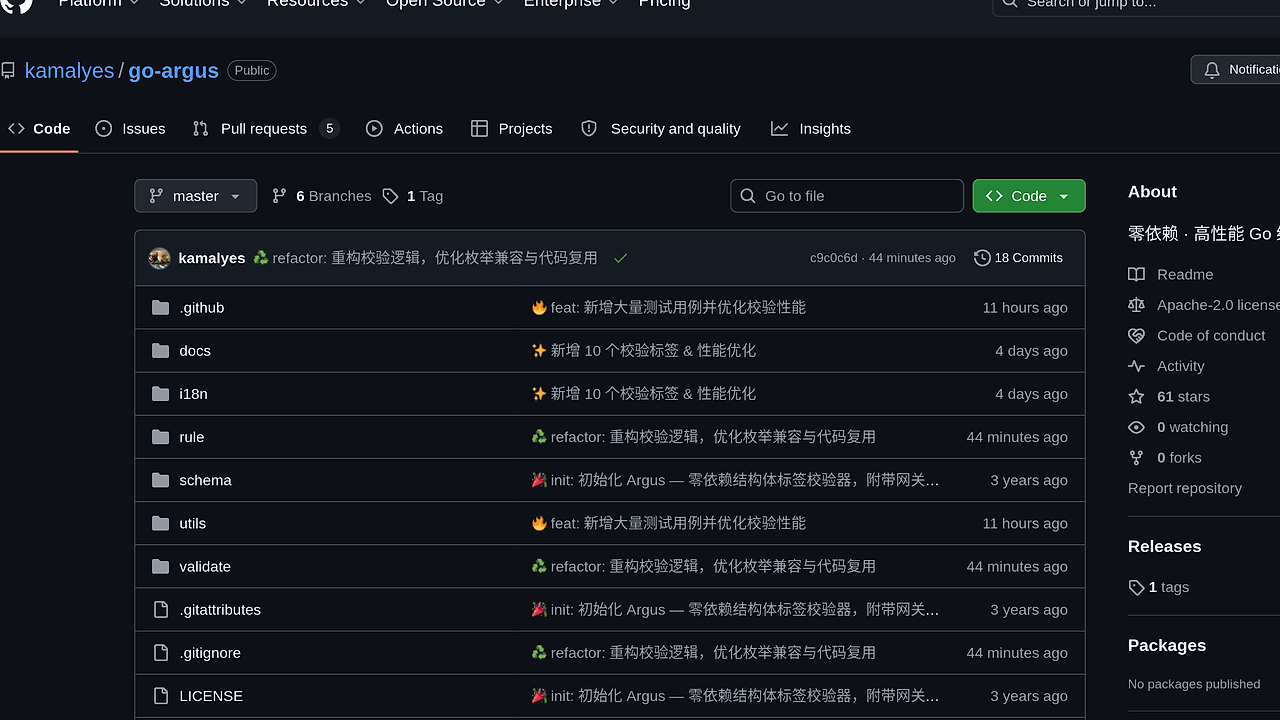
Argus is a Go struct validation library built by kamalyes for backend teams, API authors, and library maintainers who want fast validation without a dependency graph. Argus is one of the best Go Validation Libraries tools for Go backend engineers, and its zero-reflection VarString path validates strings with 0 heap allocations while shipping 97+ built-in rules and 9 built-in locales.
Quick Overview
| Attribute | Details |
|---|---|
| Type | Go Validation Libraries |
| Best For | Go backend engineers, API teams, and library authors |
| Language/Stack | Go 1.21+, standard library only, struct tags, reflection fast path, i18n |
| License | MIT |
| GitHub Stars | N/A |
| Pricing | Open-Source |
| Last Release | N/A |
Who Should Use Argus?
- API teams exposing JSON endpoints that need
validatetags, locale-aware errors, and predictable request rejection on bad input. - Library authors shipping reusable Go packages who want validation logic to stay close to the struct definition instead of living in helper functions.
- Platform engineers standardizing input policy across multiple services and wanting cacheable validators that are safe under concurrency.
- Security-minded teams that prefer the Go standard library only and want to avoid pulling extra translators or rule packages into production.
Not ideal for:
- Teams locked to Go 1.20 or older, because Argus requires Go 1.21+.
- Projects whose validation is mostly procedural and depends on side effects instead of declarative rules.
- Codebases that must match an exact legacy validator implementation byte-for-byte without migration testing.
Key Features of Argus
- Zero third-party dependencies — Argus uses only the Go standard library, which keeps the supply chain small and makes security review straightforward. That matters in regulated environments where every extra module adds audit work.
- VarString zero-reflection fast path — String validation bypasses
reflectentirely, avoids interface boxing, and returns 0 heap allocations on supported rules. The project reports a 2–3× speedup over the reflection path for string-compatible checks. - 97+ built-in field rules — Argus covers core checks like
required,min,max,email,IP,UUID,datetime,Luhn,semver,ISBN,ISSN,BIC/SWIFT,cron,Data URI,BCP 47, and crypto address formats. That breadth removes the need to stitch together separate validation helpers. - Cross-field validation — Rules such as
range,fieldcontains, andrequiredWithoutlet Argus express relationships between fields inside the struct tag itself. This keeps business constraints colocated with the data model instead of split across service layers. - Native i18n support — Argus ships with 9 built-in locales:
en,zh,zh-TW,ja,ko,fr,de,es, andru. You can switch locale with one line and register additional language packs throughRegisterI18nMessages. - go-playground/validator compatibility — The tag syntax and core API stay close to
go-playground/validator, so migration cost stays low for teams that already use that ecosystem. In practice, Argus is a drop-in candidate for many struct-tag workflows. - JSON Schema and gateway utilities — Argus includes lightweight JSON Schema subset validation plus IP allowlist and blocklist helpers with CIDR and wildcard support. That makes it useful in API gateway flows where schema and network policy both matter.
Argus vs Alternatives
If you are comparing validation libraries for a backend service, the right choice depends on runtime overhead, i18n, and how much ecosystem baggage you are willing to carry. If your validation failures live inside CI or release scripts, pair Argus with browse all DevOps Automation tools. If you validate inputs from shell-driven workflows, browse all CLI Tools is the adjacent category.
| Tool | Best For | Key Differentiator | Pricing |
|---|---|---|---|
| Argus | Fast, tag-driven Go validation with built-in i18n | Zero third-party deps, VarString, JSON Schema subset, and 9 locales | Open-Source |
| go-playground/validator | Mature Go validation with a large community footprint | Broad ecosystem and long adoption history | Open-Source |
| ozzo-validation | Imperative validation flows that are easier to compose in code | Fluent, code-centric rules instead of tag-heavy models | Open-Source |
| govalidator | Simple validation helpers for smaller Go services | Lightweight API with a familiar utility-style surface | Open-Source |
Pick go-playground/validator if your team already depends on its translator stack or has a large existing codebase that has been battle-tested for years. Pick ozzo-validation when you want validation logic in regular Go code instead of struct tags, especially for conditional workflows that are easier to read imperatively.
Pick govalidator if you want a simpler utility library and do not need Argus-level i18n or schema support. Pick Argus when you care about the zero-dependency story, the VarString fast path, and built-in translation without bolting on extra packages.
How Argus Works
Argus compiles struct tags into an internal structPlan and caches that result so repeated calls do not re-parse tags on every request. That design keeps validation overhead low in hot request paths because the expensive parsing step happens once, then the compiled plan can be reused across goroutines.
The runtime splits validation into two paths. VarString uses stringRuleMap and direct function calls for string-compatible rules, while the general Var and Struct path can fall back to reflect for cross-field rules like eqfield and required_if. That gives Argus a fast lane for common cases without sacrificing compatibility for rules that need broader object context.
The translation layer sits on top of the error model, so TranslateValidationErrors can emit serializable arrays without forcing callers to build their own message catalog. The i18n store is unified through the i18n package, which means the same error can be rendered in English, Japanese, French, or a custom language pack with the same validator instance.
go get github.com/kamalyes/go-argus
go test ./...
The first command adds Argus to your module, and the second gives you a quick sanity check that the package resolves cleanly in your build. In a real service, the first Struct or VarString call compiles the rules, caches them, and makes later validations cheaper.
Pros and Cons of Argus
Pros:
- Zero third-party dependencies keep the module graph small and easier to audit.
VarStringavoids reflection for string-compatible rules and can hit 0 heap allocations.- 97+ built-in rules cover a wide range of data formats without extra helpers.
- Built-in i18n removes the need for a separate translation package.
- Concurrency-safe validator instances and cached plans fit API servers with high request volume.
- Compatibility with go-playground/validator reduces rewrite cost for many teams.
Cons:
- Argus requires Go 1.21+, so older runtimes are excluded.
- Non-string or cross-field rules can still fall back to reflection, so not every path gets the fast lane.
- The ecosystem is smaller than go-playground/validator, which matters if you rely on community extensions.
- Tag-based validation is awkward for teams that prefer fully imperative business rules.
- JSON Schema support is a subset, not a full schema engine.
Getting Started with Argus
Install Argus with go get, import the module, and instantiate one validator per service or per package-level initialization path. The first validation call compiles the rule plan, and later requests reuse the cached structure, which is what you want in a long-lived Go process.
go get github.com/kamalyes/go-argus
go run .
After the install command, wire validator.New() into your handler or service constructor and set the locale once with SetLocale("en") or your preferred language. If you need custom messages, register them before the first request so the translation store is ready when errors are emitted.
Verdict
Argus is the strongest option for Go services that need tag-driven validation when you want zero third-party dependencies and built-in i18n. Its biggest strength is the VarString fast path; the main caveat is the Go 1.21+ requirement and a smaller ecosystem than go-playground/validator. Recommend Argus for new services and careful migration candidates.