What Is agent-html?
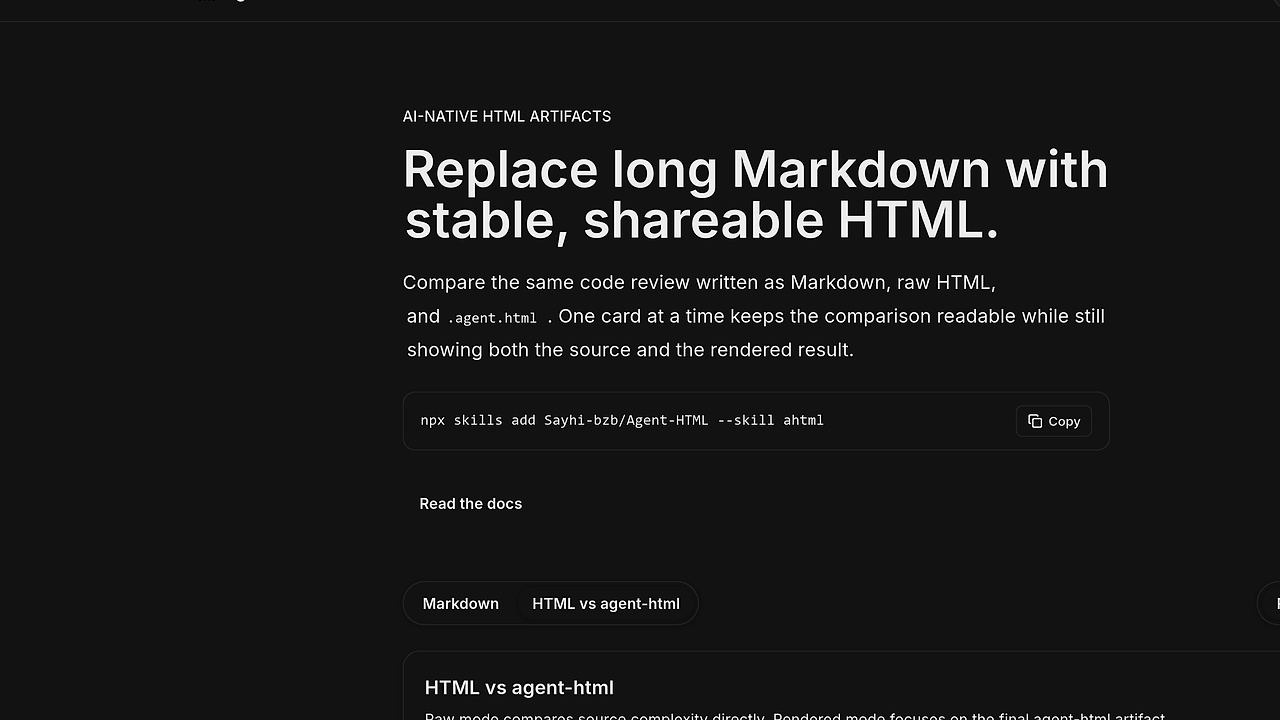
agent-html is an open-source AI agent artifact tool built by Sayhi-bzb that turns semantic .agent.html documents into stable HTML output for developers, indie hackers, and CTOs. The public CLI documents 4 core actions — ahtml, ahtml prompt, ahtml build, and ahtml preview — and agent-html is one of the best AI Agent Artifact Tools for developers, indie hackers, and CTOs building agent-generated reports, specs, and handoff docs.
Its docs at agent-html.pages.dev/docs describe a schema-first contract: agents write structure, not raw HTML, CSS, JavaScript, Tailwind classes, or renderer props. That design keeps the artifact portable, easier to review, and far less brittle than a long chat transcript or a Markdown note that changes shape every time an agent rewrites it.
Quick Overview
| Attribute | Details |
|---|---|
| Type | AI Agent Artifact Tools |
| Best For | developers, indie hackers, and CTOs building agent-generated reports, specs, and handoff docs |
| Language/Stack | Node.js, npm, semantic HTML schema |
| License | MIT |
| GitHub Stars | N/A as of Feb 2026 |
| Pricing | Open-Source |
| Last Release | N/A |
Who Should Use agent-html?
- AI agent builders shipping document-centric workflows that need stable output a human can review without parsing chat history.
- Indie hackers turning research, product specs, or release notes into shareable HTML artifacts without building a custom renderer.
- Platform teams that want a strict schema between prompt output and rendered content so downstream tooling does not depend on freeform prose.
- Toolsmiths and CLI-first devs who prefer
npm,skills, and shell automation over visual editors.
Not ideal for:
- Teams that need rich interactive UIs today; the current public contract focuses on portable artifacts, not full application shells.
- Designers who expect drag-and-drop layout tools; agent-html is schema-driven, not a page builder.
- Teams that only need plain Markdown; the extra structure is unnecessary if you do not need HTML output or previewable artifacts.
Key Features of agent-html
- Schema-first
.agent.htmlcontract — The source file encodes page structure as semantic elements likemeta-agent,page, andcard. That contract is validated before rendering, which reduces accidental drift from the intended layout. - Portable HTML artifacts —
ahtml buildturns the semantic source into a stable HTML artifact you can store in Git, send to a teammate, or hand off to another agent. The output is designed to survive outside the original prompt context. - CLI workflow — The documented flow is short: write the prompt, build the artifact, then preview it. That makes it easy to script inside CI, local dev shells, or agent pipelines.
- Skill integration —
npx skills add Sayhi-bzb/Agent-HTML --skill ahtmllets skill-aware agent setups discover theahtmlworkflow without custom glue code. This is the cleanest path if your team already uses theskillsCLI. - Prompt-first authoring —
ahtml promptgenerates the writing prompt instead of forcing humans to author the final document structure from memory. That keeps the document format consistent across runs. - Preview loop —
ahtml preview artifact.agent.htmlgives a local review URL so you can inspect the rendered artifact before sharing it. That matters when output quality is judged visually, not only by raw text. - Roadmap awareness — The roadmap mentions architecture optimization, support for more UI foundations, separation of static and interactive component data structures, and custom component panels. That tells you where the project is going if you plan to build on it.
agent-html vs Alternatives
| Tool | Best For | Key Differentiator | Pricing |
|---|---|---|---|
| agent-html | Semantic agent artifacts and reviewable document output | Schema-driven .agent.html source compiles into portable HTML artifacts | Open-Source |
| Claude Code Canvas | In-model editing and iterative composition | Rich authoring surface inside Claude rather than a dedicated artifact compiler | Paid |
| Claude Context Mode | Long-context management and workspace continuity | Focuses on context handling, not on exporting a portable HTML deliverable | Paid |
| OpenSwarm | Multi-agent orchestration and task coordination | Coordinates agents across tasks before handing work to a presentation layer | Open-Source |
Pick Claude Code Canvas when you want a richer editing surface inside Claude rather than a dedicated artifact compiler. Pick Claude Context Mode when the bigger problem is keeping long-running context organized instead of turning it into a file.
Pick OpenSwarm when you need coordinated agent execution across tasks, then want to hand the output into agent-html for presentation. Pick agent-html when the deliverable itself is the artifact, because that is the narrowest and cleanest fit for reports, specs, and handoff packets.
How agent-html Works
agent-html uses a strict pipeline: semantic document -> schema validation -> portable HTML artifact. The core abstraction is the .agent.html source file, which encodes meaning in tags and attributes instead of in raw page markup.
That separation matters because agents are bad at maintaining arbitrary renderer-specific props across long edits. By forcing the document through a public schema, agent-html keeps the input predictable and makes the output stable across reruns, which is exactly what you want for dense agent work.
A minimal workflow looks like this:
ahtml prompt
ahtml build artifact.agent.html
ahtml preview artifact.agent.html
The first command prints or generates the writing prompt, the second compiles the semantic source into an HTML artifact, and the third opens a local preview URL for review. Expect schema violations to surface early, which is useful in CI and in agent loops where bad structure should fail fast instead of leaking into production.
The design choice here is not just about file format. agent-html deliberately separates content structure from rendering so the agent can focus on the document model while the runtime handles presentation details.
Pros and Cons of agent-html
Pros:
- Schema validation gives you a predictable contract instead of ad-hoc prompt output.
- The CLI surface is small, so it is easy to script in shell workflows and CI jobs.
- The output is a portable HTML artifact, which is easier to share than raw agent chat logs.
- The
skillsintegration fits agent-first workflows without custom glue code. - Preview support gives humans a visual check before the artifact is published or handed off.
- The roadmap shows clear direction around static and interactive data separation.
Cons:
- It is not a general-purpose UI framework, so it will not replace a full app stack.
- You need to learn the semantic document model before the output feels natural.
- The current public docs emphasize portable artifacts over rich interactivity.
- Custom component and UI foundation expansion are still roadmap items, not fully mature capabilities.
- If you only need Markdown notes, the extra structure adds overhead.
Getting Started with agent-html
npm install -g @agent-html/ahtml
ahtml
npx skills add Sayhi-bzb/Agent-HTML --skill ahtml
ahtml prompt
After that, write or generate a .agent.html document, then run ahtml build artifact.agent.html and ahtml preview artifact.agent.html to inspect the result. The optional skills install is the fastest way to make Codex-style or other skill-aware agents aware of the workflow, but the CLI also works as a standalone shell utility.
If your team is building agent-generated docs, this workflow gives you a repeatable path from prompt to artifact without hand-assembling HTML. The main setup decision is whether you want to keep the source in Git as semantic markup or generate it on demand inside an agent pipeline.
Verdict
agent-html is the strongest option for schema-driven agent reporting when you need a reviewable artifact instead of a chat log. Its main strength is the strict .agent.html contract plus a tiny CLI that keeps output stable. The caveat is that it is not a general UI framework yet, so use it when portable document output matters more than rich interactivity.