What Is Casino Game Backend?
Casino Game Backend is a casino game backend built by Quant-Alpha-Forge in Node.js, Express, TypeScript, PostgreSQL, and Prisma ORM for backend engineers and indie hackers who need a real money-style game server with explicit state, wallet records, and fairness verification. Casino Game Backend is one of the best Casino Game Backends tools for backend engineers and indie hackers, and the repo ships one complete Blackjack implementation plus seven planned games, all wired through a provably fair seed flow.
This is not a front-end casino skin or a toy demo. It is an API-first service that already exposes auth, wallet, and Blackjack endpoints, so you can treat it like a backend product rather than a code sample.
Quick Overview
| Attribute | Details |
|---|---|
| Type | Casino Game Backends |
| Best For | backend engineers and indie hackers building casino-style game servers |
| Language/Stack | Node.js, Express, TypeScript, PostgreSQL, Prisma ORM |
| License | MIT |
| GitHub Stars | N/A as of Feb 2026 |
| Pricing | Open-Source |
| Last Release | N/A |
Who Should Use Casino Game Backend?
- Indie hackers shipping an MVP who need a working Blackjack backend, not a blank Express scaffold.
- Backend teams building gambling or sweepstakes products that need wallet tracking, transaction history, and seeded game sessions in PostgreSQL.
- TypeScript-first developers who want route handlers, services, and Prisma models that are easy to extend into Mines, Crash, Roulette, or Plinko.
- Engineering teams validating game fairness that need a clear server-seed, client-seed, and nonce lifecycle for auditability.
Not ideal for:
- Teams that need a full multi-game casino on day one, because only Blackjack is implemented and the other games are still marked coming soon.
- Projects that want WebSocket-heavy real-time play, because the current shape is a REST API rather than a room-based multiplayer server.
- Builders who do not want to manage PostgreSQL migrations, JWT auth, or wallet accounting themselves.
Key Features of Casino Game Backend
- Provably fair seed flow — The backend exposes server seed hashing, seed rotation, and post-game verification so players can check that SHA-256 outputs match the revealed seed. That is the core trust primitive for any casino backend, and it is already part of the API surface.
- Blackjack rules engine — Blackjack follows Shuffle.com-style rules with infinite decks simulated as eight decks, dealer stands on 17, dealer peeks on aces and ten-value cards, and the player can double, split, surrender, or buy insurance. Those rule decisions matter because they determine house edge and payout math.
- Prisma-backed relational model — The database schema centers on
User,Wallet,Transaction,GameSession,BlackjackHand, andServerSeed. That separation is the right shape for auditable gaming software because balances, hand state, and seed history stay queryable instead of being buried in ad hoc JSON blobs. - Wallet and transaction ledger — Deposit, withdraw, and transaction history endpoints give you a ledger-based wallet rather than a single mutable balance field. That is important for reconciliation, dispute handling, and anti-fraud reviews.
- Typed service boundaries — Because the stack is TypeScript-first, route contracts, game actions, and persistence logic can be modeled with explicit types instead of untyped request handlers. That reduces accidental regressions when you add a new game engine or side-bet path.
- API-first integration surface — Auth, wallet, and Blackjack endpoints are already separated, so mobile clients, admin panels, and third-party launchers can consume the backend without coupling to a single UI implementation. The API shape is suitable for a modern casino shell or a separate frontend built in Next.js, Remix, or React Native.
- Extensible game roadmap — Mines, Crash, Roulette, Plinko, Hi-Lo, Limbo, and Dice are already listed as planned titles. Even though they are not implemented yet, the folder structure and service layering show a clear path for adding more engines without rewriting auth or wallet code.
Casino Game Backend vs Alternatives
| Tool | Best For | Key Differentiator | Pricing |
|---|---|---|---|
| Casino Game Backend | Blackjack-first casino backends with wallet state and provable fairness | Domain-specific game flow already wired to PostgreSQL and Prisma | Open-Source |
| Nakama | Real-time game backends with auth, storage, and matchmaking | Broader multiplayer platform with built-in realtime primitives | Open-Source |
| Colyseus | Room-based multiplayer state sync | Lightweight WebSocket room model for live play | Open-Source |
| Custom Express + Prisma stack | Teams that want complete control over every schema and route | No opinionated casino logic, so you build the game engine yourself | Depends |
Pick Nakama if you need a wider multiplayer platform and do not mind adapting your casino logic to a broader game server model. Pick Colyseus if your product is built around live room state and frequent client updates rather than wallet-ledger gameplay.
Pick a custom Express + Prisma stack if your team wants to own every abstraction and you are happy to build auth, fairness, and balance accounting from scratch. If you want production rollout help around tracing and deployment, pair Casino Game Backend with OpenTrace for request and seed-rotation visibility, and djevops for migration gates and release automation. If you need historical wallet analytics or event warehousing, DataHaven fits the audit side of the stack.
How Casino Game Backend Works
Casino Game Backend uses a classic layered design: HTTP routes accept requests, services apply business rules, Prisma persists state, and the game engine computes outcomes from a deterministic rule set. The important architectural choice is that the casino logic is not mixed into the database layer, which keeps the Blackjack engine testable and makes future games easier to add.
The data model is built around entities that map directly to casino operations. User stores identity, Wallet tracks current balance, Transaction records movement of funds, GameSession stores a single play session, BlackjackHand captures hand-level state, and ServerSeed anchors the provably fair workflow. That model is boring in the best way because boring schemas are easier to audit, migrate, and reconcile under load.
Provable fairness follows a three-step flow: generate a server seed, publish its SHA-256 hash before the game, accept a client seed plus nonce during play, then reveal the server seed after settlement. The server keeps the before-and-after values separate, which means the player can verify that the game outcome was not rewritten after the fact.
curl -X POST http://localhost:3000/api/games/blackjack/new \
  -H 'Authorization: Bearer YOUR_TOKEN' \
  -H 'Content-Type: application/json' \
  --data @bet.json
That request starts a new Blackjack session using an authenticated wallet and a separate bet payload. In practice, bet.json would contain the wager and optional side bets, and the response should return a session identifier that you can poll or mutate with hit, stand, double, split, insurance, or surrender actions.
Pros and Cons of Casino Game Backend
Pros:
- Real casino rules are already encoded — Blackjack includes dealer peeking, split handling, double-after-split, surrender, and side bets.
- Clear fairness model — The server-seed hash flow is understandable and independently verifiable, which is mandatory for trust.
- PostgreSQL and Prisma fit the domain — Wallets, transactions, and game sessions are better represented in a relational store than in ephemeral in-memory state.
- TypeScript reduces extension risk — Adding Mines or Crash is less dangerous when request/response shapes and service contracts are typed.
- Operationally sane API design — Auth, wallet, and game routes are separated, so you can expose only the pieces your client needs.
Cons:
- Only Blackjack is implemented — The roadmap is broader than the shipped surface, so this is not a full casino suite yet.
- No realtime transport layer — The current backend is HTTP-centric, so live multiplayer or push-based state sync will require extra work.
- You still own compliance and risk controls — KYC, geofencing, anti-fraud, and payout policy are not solved by the repo.
- Seed management needs operational discipline — Provably fair systems are only trustworthy if key rotation, storage, and reveal workflows are handled correctly.
- Balance accounting can get expensive under load — Ledger integrity is worth the complexity, but it means more migration and reconciliation work than a simple stateless API.
Getting Started with Casino Game Backend
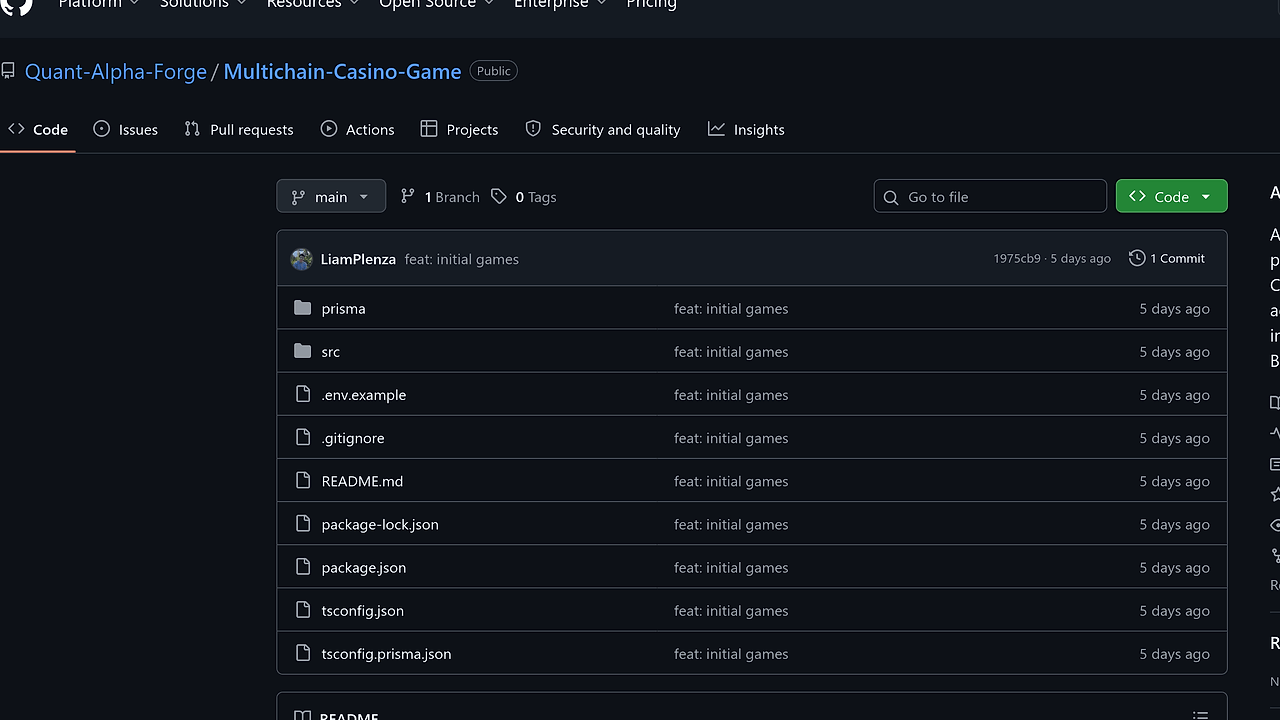
The fastest path is to install dependencies, configure PostgreSQL, generate the Prisma client, push the schema, and start the server. That gets you from clone to a live API in one pass, which is exactly what you want when evaluating a backend starter for a casino product.
git clone https://github.com/Quant-Alpha-Forge/Multichain-Casino-Game
cd Multichain-Casino-Game
npm install
cp .env.example .env
npm run db:generate
npm run db:push
npm run dev
After the server starts, configure DATABASE_URL, JWT_SECRET, JWT_EXPIRES_IN, and PORT for your environment. You should also create the PostgreSQL database first and verify that Prisma can connect before you seed data or call the Blackjack endpoints.
Verdict
Casino Game Backend is the strongest option for building a provably fair Blackjack API when you want a typed Node.js stack with PostgreSQL-backed state and wallet records. Its biggest strength is the seed-hash verification flow, and its main caveat is that only Blackjack is live today. Choose it if you want a concrete foundation, not a finished casino platform.