What Is 女娲.skill?
女娲.skill is a Claude Code Skill built by Huashu (花叔) that distills public material into persona models and decision heuristics for developers who use Claude Code. It is one of the best Claude Code Skills tools for indie hackers, engineers, and CTOs who want to ask a model to reason like Jobs, Musk, Munger, Feynman, or Naval; the repo ships 13人物 + 1主题 examples and is licensed under MIT.
The core idea is not imitation theater. 女娲.skill turns books, interviews, social posts, and criticism into a reusable reasoning layer that Claude can invoke on demand, which makes it useful for product thinking, strategy review, and prompt-driven analysis. If you want a structured way to build Claude Code Canvas-style workflows without hand-writing every persona prompt, this repo is the right abstraction level.
Quick Overview
| Attribute | Details |
|---|---|
| Type | Claude Code Skills |
| Best For | Developers, indie hackers, and CTOs using Claude Code |
| Language/Stack | Claude Code, npx skills add, Markdown SKILL.md, skills.sh compatibility |
| License | MIT |
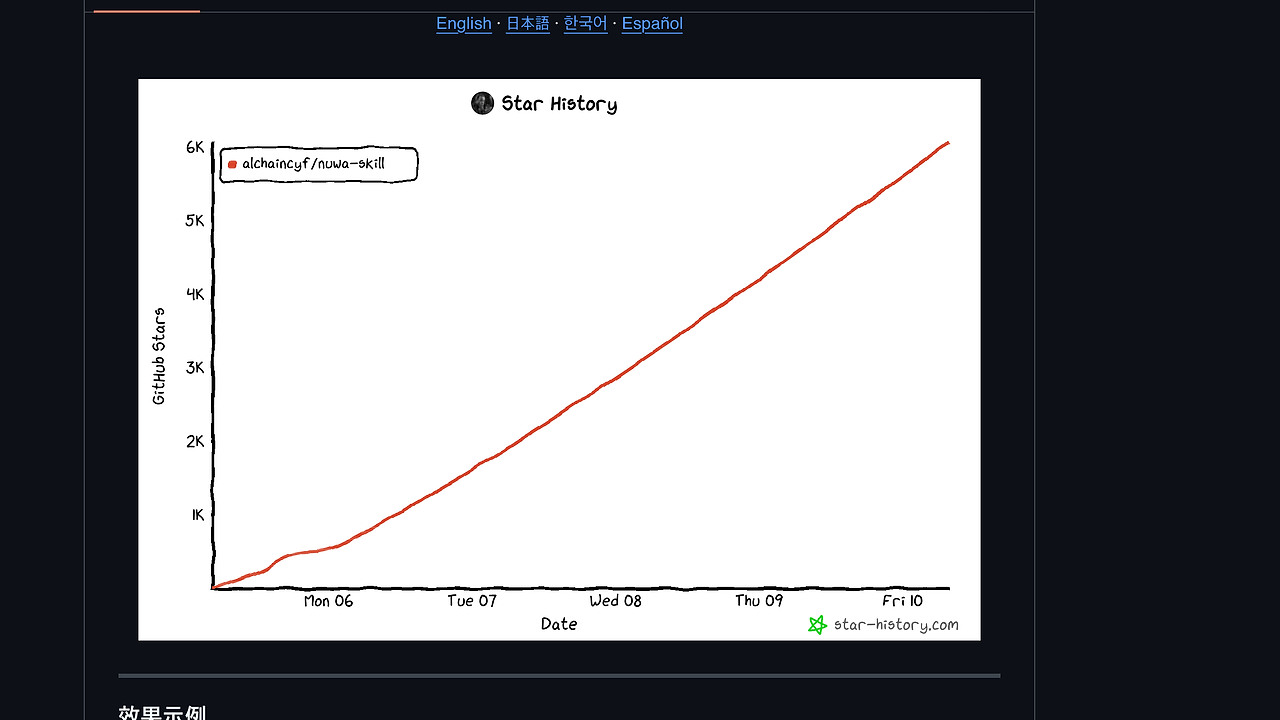
| GitHub Stars | N/A on the scraped page |
| Pricing | Open-Source |
| Last Release | N/A — no tagged release shown in the scraped text |
Who Should Use 女娲.skill?
- Solo founders who want a fast way to compare a business problem against a named operator's mental model without building a custom agent from scratch.
- Product engineers who already live in Claude Code and need reusable persona modules for strategy reviews, copy critique, or decision analysis.
- AI tooling teams building internal assistant workflows that need explicit provenance, not hidden prompt soup.
- Technical creators who write, teach, or ship in public and want a repeatable way to turn a public figure's cognition into an assistive skill.
Not ideal for:
- Teams looking for literal impersonation rather than a documented model of reasoning, because 女娲.skill is explicit about being based on public evidence only.
- Users who need private-source extraction from internal documents, because the repo is designed around public materials and transparent validation.
- People who want a one-line prompt gimmick with no structure, because the value here comes from the extraction framework and the Skill template.
Key Features of 女娲.skill
- Six-way parallel research pipeline — 女娲.skill pulls from books, interviews, social media, critics, decision records, and life timelines in parallel. That gives the Skill enough signal to separate durable heuristics from one-off quotes.
- Three-layer validation — A claim must appear across 2+ domains, help predict a new answer, and be meaningfully selective before it gets promoted into the Skill. This reduces the usual problem of stuffing a persona file with random quotes.
- Persona output with boundaries — The generated Skill includes expression DNA, decision heuristics, value constraints, and explicit limitations. That matters because a model that states what it does not know is easier to trust than one that sounds confident everywhere.
SKILL.md-first packaging — The repo compiles the distilled model into a portable Markdown Skill file. That keeps the artifact inspectable, versionable, and easy to diff in Git.- Transparent research artifacts — Each example includes the underlying investigation files, not just the final persona output. If you care about auditability, that is the difference between a toy prompt pack and a reusable system.
- Works with Claude Code and skills.sh — The install path uses
npx skills add, which fits the way many developer tools are already distributed. It also makes the repo easy to pair with Claude Context Mode when you want to keep the assistant anchored to one reasoning frame. - Chinese and multilingual presentation — The repository ships English, Japanese, Korean, and Spanish readmes. That makes the process easier to inspect across teams even if the generated personas are language-specific.
女娲.skill vs Alternatives
| Tool | Best For | Key Differentiator | Pricing |
|---|---|---|---|
| 女娲.skill | Persona distillation and reasoning layers in Claude Code | Explicit research pipeline, validation gates, and portable SKILL.md output | Open-Source |
| Claude Context Mode | Keeping Claude focused on a bounded working context | Better for context discipline than persona extraction | Open-Source |
| Brainstorm MCP | Structured ideation and idea generation inside MCP-driven workflows | Better for brainstorming sessions than evidence-based persona compilation | Open-Source |
| OpenSwarm | Multi-agent orchestration and agent collaboration | Better when you need multiple agents coordinating tasks, not a distilled voice | Open-Source |
Pick Claude Context Mode if your main problem is context drift, token waste, or the model forgetting the current working rules. Pick Brainstorm MCP if you want raw ideation rather than a research-backed persona model.
Pick OpenSwarm when the task needs several cooperating agents and clear handoffs. Pick 女娲.skill when you want one model to answer through a specific cognitive frame with traceable source material and explicit boundaries.
How 女娲.skill Works
女娲.skill is built like a small ETL pipeline for cognition: collect, verify, compile, and test. The repo first gathers evidence from six channels, then filters candidates through three rules, then writes the surviving model into a compact Skill artifact that Claude Code can load.
The design choice that matters most is the rejection of raw mimicry. Instead of storing a pile of quotes and hoping the model behaves, 女娲.skill encodes mindsets, heuristics, and anti-patterns so the assistant can answer new questions with a stable bias, not just a copied voice.
npx skills add alchaincyf/nuwa-skill
# inside Claude Code
蒸馏一个保罗·格雷厄姆
The first command installs the Skill from the repository into the local Claude Code skills registry. The second line is the trigger phrase pattern the repo expects, and from there the skill generation flow can research a target person or theme, compile the model, and emit a usable SKILL.md structure.
The quality bar is also deliberate. 女娲.skill tests the resulting model against three public questions that the person has already answered, then probes one question outside the corpus to check whether the Skill stays appropriately uncertain instead of hallucinating certainty. That is the right trade-off for a tool that claims to model reasoning, not personality cosplay.
Pros and Cons of 女娲.skill
Pros:
- Audit-friendly output — The repo exposes research files and the extraction framework, so you can inspect why a model was included.
- Better than quote stuffing — Validation rules force cross-domain evidence before a heuristic becomes part of the Skill.
- Portable Markdown artifact —
SKILL.mdis easy to version, review, and regenerate in Git workflows. - Explicit uncertainty — The framework insists on honest boundaries, which reduces false confidence in edge cases.
- Useful for internal prompting systems — The structure maps well to reusable assistants for product, strategy, and writing tasks.
Cons:
- Only as good as the public corpus — If a person has thin or noisy public material, the distilled model will be shallow.
- No private-source ingestion story in the repo text — The workflow is centered on public information and does not claim secure internal-document extraction.
- Not a turnkey product — You still need to understand Claude Code Skills and the surrounding workflow.
- Potentially opinionated outputs — Persona-driven reasoning can overfit to the target figure's style if you use it as an oracle.
- No exact star count or release tag surfaced in the scraped page — That makes popularity and version tracking less concrete than a packaged release.
Getting Started with 女娲.skill
npx skills add alchaincyf/nuwa-skill
# then in Claude Code
> 蒸馏一个芒格
After installation, 女娲.skill becomes available as a local Skill and you can invoke it by naming a person or domain. The first run should be a low-stakes test like Munger, Feynman, or Naval so you can verify tone, depth, and boundary behavior before relying on it for higher-impact decisions.
If you want a custom persona, give the model a clear target, a source scope, and a use case. The repo is designed around research-backed extraction, so the better your input constraints, the less generic the output will be.
Verdict
女娲.skill is the strongest option for building persona-distillation workflows in Claude Code when you want transparent source trails and explicit reasoning boundaries. Its best strength is the research-to-Skill pipeline; its main caveat is that it depends on public material quality. If you need a reusable cognition layer instead of prompt theater, use it.