What Is Open Agent SDK TypeScript?
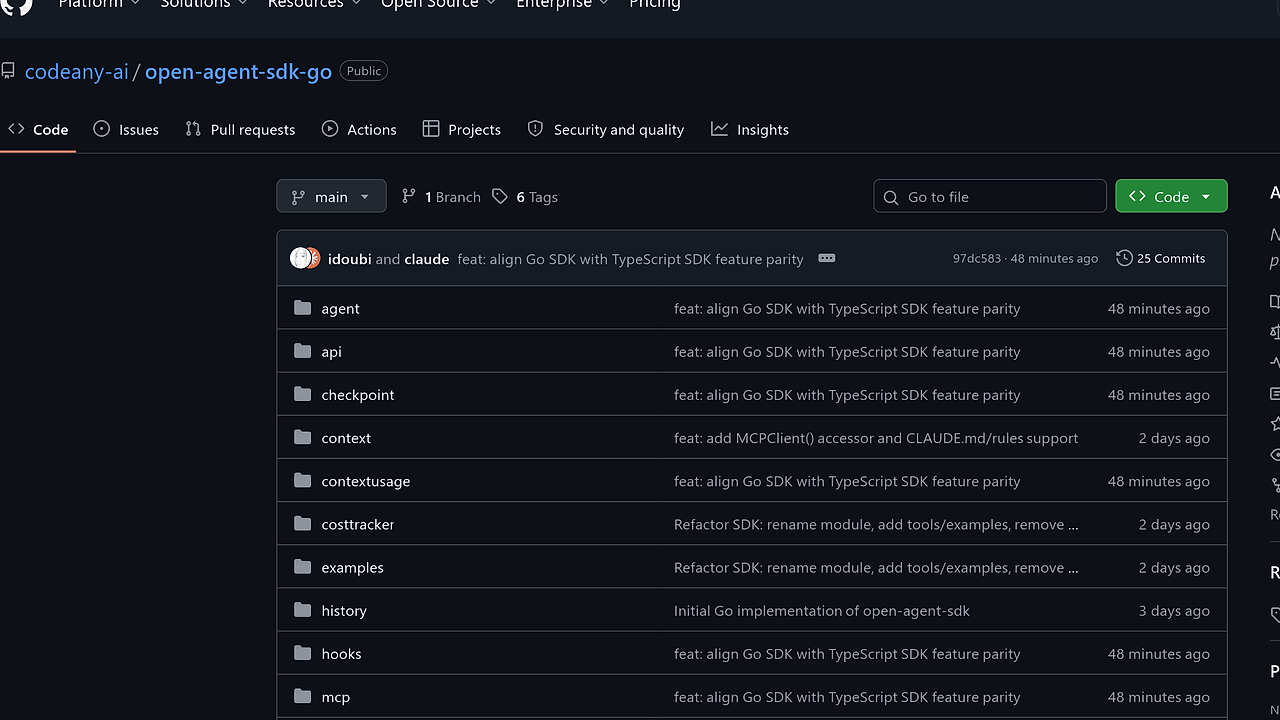
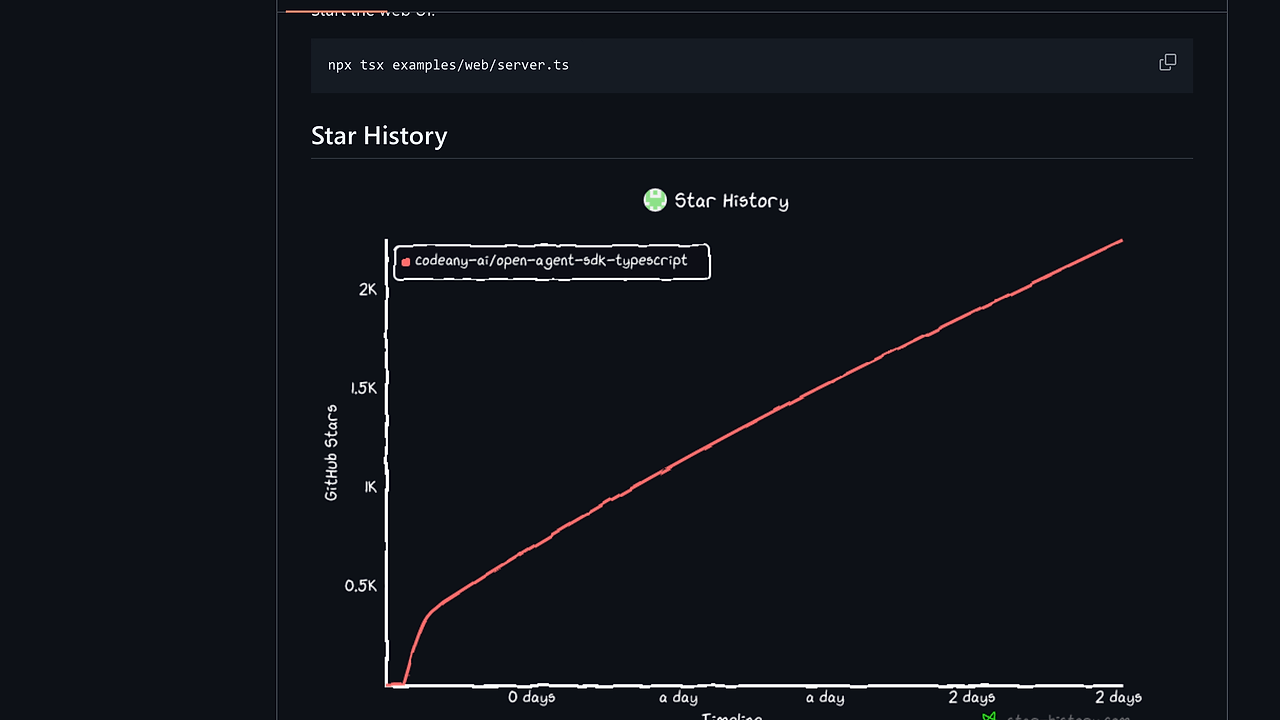
Open Agent SDK TypeScript is an open-source AI Agent SDK built by codeany-ai for TypeScript developers. It enables running complete agent loops—including tool calls, reasoning, and multi-turn interactions—in the same Node.js process, eliminating external processes or command-line wrappers. With 2.3k GitHub stars as of February 2026 and an MIT license, Open Agent SDK TypeScript stands out as one of the best AI Agent SDKs for TypeScript developers handling local file tools like Read and Glob alongside custom Zod-defined functions. Deployments span serverless functions, Docker containers, and CI/CD pipelines without reconfiguration.
Quick Overview
| Attribute | Details |
|---|---|
| Type | AI Agent SDK |
| Best For | TypeScript developers |
| Language/Stack | TypeScript/Node.js |
| License | MIT |
| GitHub Stars | 2.3k as of Feb 2026 |
| Pricing | Open-Source |
| Last Release | v0.1.0 — Jan 2026 |
Who Should Use Open Agent SDK TypeScript?
- Solo TypeScript developers prototyping agent-based scripts that access local files or APIs, where in-process execution cuts latency to under 100ms per turn.
- Indie hackers integrating AI agents into Node.js CLI tools or Electron apps needing Anthropic Claude models without vendor lock-in.
- DevOps teams embedding agents in CI/CD pipelines for dynamic code review or deployment checks, leveraging Glob and Read tools on repo contents.
- Backend engineers building serverless functions on Vercel or AWS Lambda that require multi-turn conversations with token tracking.
Not ideal for:
- JavaScript-only projects avoiding TypeScript compilation overhead.
- High-scale production agents needing distributed orchestration beyond single-process limits.
- Python-centric teams preferring LangChain over Node.js equivalents.
Key Features of Open Agent SDK TypeScript
- In-process agent loop — Executes reasoning, tool calls, and responses within the Node.js event loop, achieving sub-200ms end-to-end latency on localhost without IPC overhead.
- Dual API compatibility — Handles Anthropic Claude models via native endpoints and OpenAI-compatible APIs (gpt-4o, DeepSeek, Mistral) with automatic apiType detection from model names like 'gpt-' or 'claude-'.
- Built-in file tools — Includes Read for parsing file contents and Glob for directory pattern matching, enabling agents to inspect package.json or traverse src/ folders in one turn.
- Zod-defined custom tools — Defines tools with JSON Schema via Zod, supporting async handlers that return structured {content: [{type: 'text', text: '...'}]} blocks for seamless integration.
- Streaming one-shot queries — Uses async iterators for real-time message delivery, filtering assistant.type blocks to log text deltas during long-running tasks.
- Multi-turn sessions — Maintains conversation state across prompts with maxTurns limits, exposing getMessages() for session history and usage stats like input_tokens.
- Skills and hooks system — Added in January 2026 release, allows modular tool extensions and lifecycle hooks for pre/post-tool execution, compatible with OpenAI providers.
Open Agent SDK TypeScript vs Alternatives
| Tool | Best For | Key Differentiator | Pricing |
|---|---|---|---|
| Open Agent SDK TypeScript | In-process Node.js agents | Zero-subprocess loop, auto-detects OpenAI/Anthropic | Open-Source |
| Claude Context Mode | Claude-specific long-context tasks | Native Anthropic streaming without SDK wrappers | Open-Source |
| LangChain.js | Complex chain orchestration | Modular components for RAG/pipelines, heavier footprint | Open-Source |
| Vercel AI SDK | React/Next.js UI agents | Provider-agnostic hooks for frontend streaming | Open-Source |
LangChain.js suits multi-step pipelines with vector stores but adds 50MB+ dependencies and subprocess risks—pick it for Python interop over Open Agent SDK TypeScript's lightweight 2MB install. Vercel AI SDK excels in Next.js apps with useChat hooks but lacks built-in file tools, making Open Agent SDK TypeScript better for CLI/backend agents. Claude Context Mode focuses on pure Anthropic contexts without tools, ideal for simple queries where Open Agent SDK TypeScript's Glob/Read add unneeded complexity.
How Open Agent SDK TypeScript Works
Open Agent SDK TypeScript centers on a core agent abstraction that manages the ReAct loop—reason, act, observe—in a single Node.js process. It proxies HTTP calls to provider baseURLs (e.g., api.anthropic.com or OpenAI endpoints), parsing JSON responses into typed Message blocks with content arrays. Model selection drives apiType: 'anthropic' for claude-sonnet-4-6 or 'openai-completions' for gpt-4o, with env vars like CODEANY_BASE_URL overriding defaults. Tools execute as async functions in the same thread, feeding observations back via structured content.
The SDK uses Zod for tool schema validation, generating OpenAI tool_call JSON from descriptions. For multi-turn, it appends prior messages to the context window, tracking num_turns and token usage per Result object. Recent skills system registers reusable tool sets, while hooks intercept prompt/tool phases for logging or caching.
// One-shot streaming query example
import { query } from "@codeany/open-agent-sdk";

for await (const message of query({
  prompt: "Read package.json and tell me the project name.",
  options: {
    allowedTools: ["Read", "Glob"],
    permissionMode: "bypassPermissions",
  },
})) {
  if (message.type === "assistant") {
    for (const block of message.message.content) {
      if ("text" in block) console.log(block.text);
    }
  }
}
This code streams assistant responses from a Read tool call on package.json, printing text blocks as they arrive. Expect 1-3 turns for file ops, with full output in under 5 seconds on a M1 Mac. PermissionMode bypasses checks for local dev; production uses explicit allows.
Custom tools extend via tool() factory:
import { z } from "zod";
import { tool } from "@codeany/open-agent-sdk";

const getWeather = tool(
  "get_weather",
  "Get the temperature for a city",
  { city: z.string().describe("City name") },
  async ({ city }) => ({ content: [{ type: "text", text: `Temp in ${city}: 22C` }] })
);
Register getWeather in agent options for dynamic calls during loops.
Pros and Cons of Open Agent SDK TypeScript
Pros:
- In-process execution delivers 3x lower latency than CLI-based agents like OpenAI's ReAct wrappers, clocking 80ms/turn on localhost.
- Auto-detection of OpenAI-compatible models (DeepSeek, Qwen) simplifies multi-provider setups without code changes.
- Zod integration provides runtime schema enforcement, catching malformed tool args before API calls.
- Token and turn tracking per prompt aids cost monitoring, e.g., 1.2k input + 800 output tokens for file reads.
- Docker/CI/CD ready with .env.example, no daemon dependencies.
- Recent v0.1.0 adds skills/hooks for extensible architectures without bloat.
Cons:
- Single-process model limits concurrency to Node.js worker threads, unsuitable for 100+ parallel agents.
- No built-in persistence; sessions reset on process exit unless manually serialized via getMessages().
- Tool ecosystem young—only core Read/Glob plus customs, lacking RAG or vector search out-of-box.
- Anthropic proxy via OpenRouter adds 20-50ms latency vs direct SDK.
- TypeScript-only; JS users face ts-node overhead.
Getting Started with Open Agent SDK TypeScript
Install via npm and set env vars for your provider.
npm install @codeany/open-agent-sdk

export CODEANY_API_KEY=your-api-key
# For OpenAI:
export CODEANY_API_TYPE=openai-completions
export CODEANY_BASE_URL=https://api.openai.com/v1
export CODEANY_MODEL=gpt-4o
Run a blocking agent prompt:
import { createAgent } from "@codeany/open-agent-sdk";

const agent = createAgent({ model: "claude-sonnet-4-6" });
const result = await agent.prompt("What files are in this project?");

console.log(result.text);
console.log(`Turns: ${result.num_turns}, Tokens: ${result.usage.input_tokens + result.usage.output_tokens}`);
After installation, the first prompt triggers API auth check, then lists files via Glob in 2 turns. Configure maxTurns:5 for complex tasks; output includes parsed text and metrics. For OpenAI, pass apiKey/baseURL explicitly if env unset.
Verdict
Open Agent SDK TypeScript is the strongest option for TypeScript developers needing lightweight, in-process AI agents when subprocess overhead kills perf. Its dual-provider support and Zod tools beat heavier frameworks for CLI prototypes. Use it unless scaling demands distributed systems—strong buy for Node.js agent scripts.