What Is p-peg?
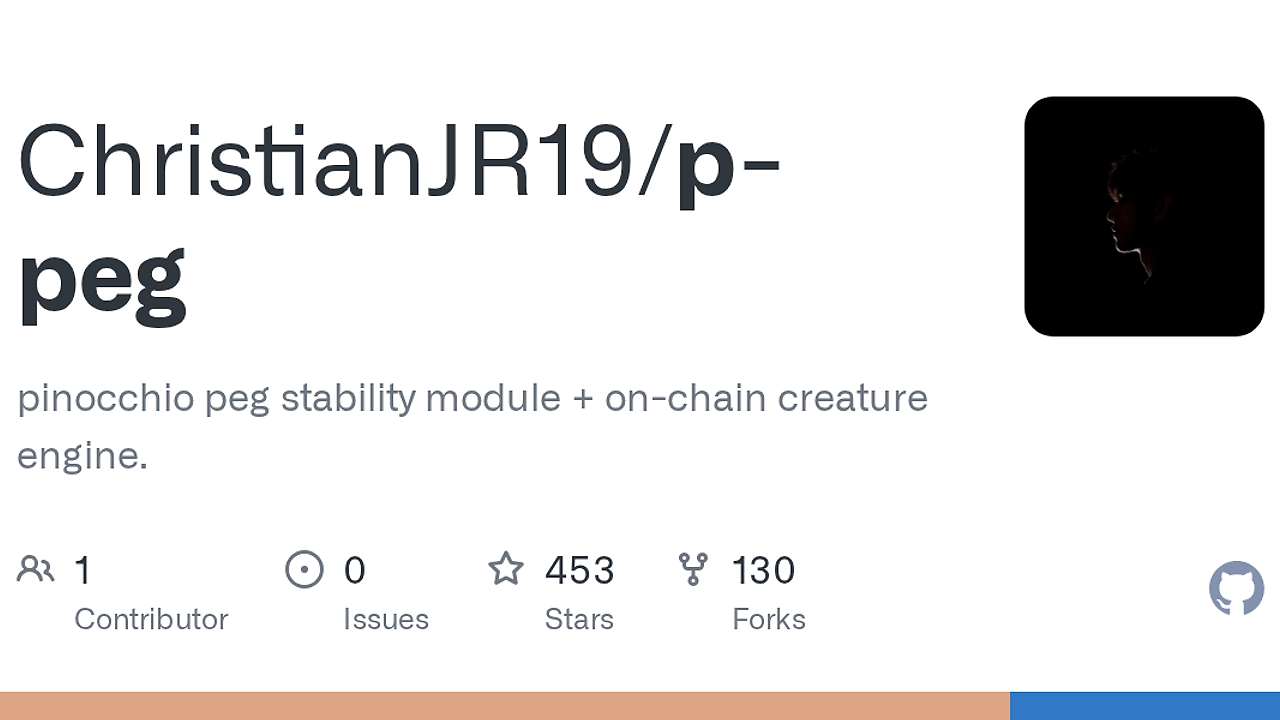
p-peg is a Pinocchio-based Solana DeFi protocol built by ChristianJR19 that mints pUSD from SOL collateral and attaches on-chain creature state to each position for Solana protocol engineers, DeFi builders, and on-chain game developers. p-peg is one of the best Solana DeFi Protocols tools for Solana builders, and the repo claims about 96% compute-unit reduction versus Anchor-style equivalents. The program is written in Rust with #![no_std], uses zero-copy state access, and keeps peg math and creature logic inside a single on-chain system.
Quick Overview
| Attribute | Details |
|---|---|
| Type | Solana DeFi Protocols |
| Best For | Solana protocol engineers, DeFi builders, and on-chain game developers |
| Language/Stack | Rust #![no_std], Pinocchio, Solana PDAs, TypeScript SDK |
| License | MIT |
| GitHub Stars | N/A as of Feb 2026 |
| Pricing | Open-Source |
| Last Release | N/A |
Who Should Use p-peg?
p-peg is a fit when you want collateralized minting, liquidation logic, and game-state incentives inside one Solana program instead of stitching together separate services.
- Solana protocol engineers building custom minting or lending flows who want a minimal runtime and direct account-byte control.
- DeFi teams that need SOL-backed issuance with explicit health checks, liquidation bonuses, and oracle-driven risk math.
- On-chain game developers who want position activity to drive collectible state, rarity, and evolution without an off-chain game server.
- Performance-focused founders shipping on Solana who care about compute units, binary size, and deterministic account layouts.
Not ideal for:
- Teams that want Anchor-first ergonomics and do not want to manage lower-level account parsing or zero-copy access.
- Projects that need a general-purpose lending market with large liquidity depth, mature governance, and broad integrations.
- Builders who do not want a game layer attached to financial state, since p-peg intentionally couples the two.
Key Features of p-peg
p-peg is not a generic token app; it is a protocol with a collateral engine, a creature engine, and a lean Pinocchio execution model.
- SOL-backed minting — Users deposit SOL into a position PDA and mint pUSD against oracle-priced collateral. The repo describes pUSD as a 6-decimal SPL token and uses a default minimum collateral ratio of 150%.
- Liquidation with explicit incentives — Any account can liquidate an unhealthy position, repay the debt, and seize collateral plus a 5% bonus. That design keeps the peg math honest and gives liquidators a clear profit model.
- Creature spawning from position entropy — Positions above the default 0.5 SOL spawn threshold can summon an on-chain creature. DNA is derived from the position key, owner key, timestamp, and slot hashes, then mixed through a 4-round cascade.
- Structured state layout — The protocol uses dedicated PDAs for config, position, creature, oracle, and vault state. The repo documents account sizes like 168 bytes for config, 112 bytes for position, 128 bytes for creature, and 40 bytes for oracle.
- Zero-copy account access — p-peg reads and writes directly against account data bytes instead of deserializing into large Rust structs. That reduces instruction overhead and fits the Pinocchio style of account programming.
- Evolution and reroll mechanics — Creatures can be fed with more collateral to gain XP and evolve up to generation 10. A reroll burns the current creature and spawns a new DNA profile, which gives the protocol a real secondary gameplay loop.
- Pure math engine separation — Peg calculations, creature generation, and rarity distribution live in
engine/with no account access. That separation makes unit testing easier and keeps risk math isolated from Solana-specific plumbing.
p-peg vs Alternatives
p-peg sits between a low-level program framework and a full application protocol, so the right comparison depends on whether you care more about runtime efficiency, protocol breadth, or developer ergonomics.
| Tool | Best For | Key Differentiator | Pricing |
|---|---|---|---|
| p-peg | SOL-backed minting with creature-based incentives | Combines peg stability, liquidation, and on-chain game state in one Pinocchio program | Open-Source |
| Anchor | General Solana program development | Higher-level macros, broader docs, and faster scaffolding | Open-Source |
| p-token | Minimal token-program style primitives | Lean token logic without the creature layer or peg game mechanics | Open-Source |
| Solend | Production lending-market reference | Mature money-market design with real liquidity and risk tooling | Open-Source |
Pick Anchor if your team values workflow speed, code generation, and ecosystem familiarity over low-level control. Pick p-token if you want a slimmer baseline for custom Solana primitives and do not need p-peg's incentive layer. Pick Solend if you are evaluating a mature lending surface rather than a custom protocol with collectible state.
If you need transaction-level visibility while debugging local runs, pair p-peg with OpenTrace so you can inspect account changes and instruction flow. If you are designing the creature economy or liquidation rules before writing Rust, Brainstorm MCP is useful for turning protocol ideas into testable state transitions. For CI around SBF builds and repo automation, browse all DevOps Automation tools.
How p-peg Works
p-peg works by splitting the protocol into a thin instruction dispatcher and a pure math layer. The dispatcher in processor.rs routes 11 instructions through a u8 tag jump table, while engine/ holds the collateral ratio math, DNA derivation, and rarity calculations with no account access. That layout is why the program can stay #![no_std] and still keep peg logic and creature logic tightly coupled.
The account model is intentionally simple: config stores protocol parameters, position stores the user's collateral and debt, creature stores on-chain game state, oracle stores price feed data, and vault manages SOL custody. Because each account has a fixed byte layout and zero-copy accessor, p-peg avoids the usual serialization overhead that shows up in larger Solana programs.
The economic flow is straightforward. deposit increases collateral, mint_pegged issues pUSD through CPI to the token program, withdraw and redeem enforce health checks, and liquidate closes unsafe positions while killing the linked creature. spawn_creature uses slot entropy and account keys to create a deterministic but hard-to-predict identity, so the collectible layer still tracks actual protocol usage.
import { PPegClient } from '@ppeg/sdk'
import { Connection } from '@solana/web3.js'
import BN from 'bn.js'

const connection = new Connection('https://api.devnet.solana.com')
const client = new PPegClient(connection, wallet)

await client.deposit(new BN(2_000_000_000))
await client.mintPegged(new BN(100_000_000), peggedMint)
await client.spawnCreature()
The snippet above deposits 2 SOL, mints 100 pUSD, and then spawns a creature if the position is above the threshold. In practice, you will also want to fetch the oracle account, confirm the collateral ratio, and handle error codes from the 6000–6099 range before sending a transaction.
Pros and Cons of p-peg
Pros:
- Single-program incentive loop — Financial risk and creature loss are tied together, so the protocol has a built-in behavioral hook instead of relying on off-chain gamification.
- Low-runtime overhead — Pinocchio, zero-copy account access, and
#![no_std]keep the execution model lean compared with macro-heavy Solana stacks. - Clear account boundaries — Fixed PDAs for config, position, creature, oracle, and vault make audits and testing more predictable.
- Deterministic math isolation — Peg formulas and rarity logic live in pure Rust modules, which makes unit tests like
peg_math.rsandcreature_gen.rseasier to reason about. - Useful TypeScript SDK — The SDK exposes PDA helpers, instruction builders, account fetchers, and a higher-level
PPegClientso frontend or bot code does not need to hand-roll every transaction.
Cons:
- Not an out-of-the-box lending market — p-peg is a protocol prototype with a custom incentive loop, not a mature pool with deep liquidity and governance maturity.
- Lower-level developer experience — Teams used to Anchor will miss a lot of macro-driven safety and boilerplate reduction.
- Oracle dependency risk — Peg safety depends on the price feed being correct and fresh, so bad oracle data can distort minting and liquidation behavior.
- Game logic may not fit every treasury team — Creature state adds product complexity that pure DeFi teams may not want in a financial primitive.
- Integration surface is narrower — The repository ships a focused TypeScript SDK, but ecosystem compatibility is still smaller than the mainstream Solana stack.
Getting Started with p-peg
The fastest p-peg tutorial is to clone the repo, build the Rust program, build the SDK, and run tests before touching devnet.
git clone https://github.com/ChristianJR19/p-peg.git
cd p-peg
cargo build-sbf
cd sdk
npm install
npm run build
cd ..
cargo test
After those commands succeed, you can point the SDK at devnet, initialize the protocol accounts, and then test deposit, mintPegged, and spawnCreature against a real wallet. You will still need a valid oracle, a configured mint, and enough SOL to cover both collateral and fees.
Verdict
p-peg is the strongest option for Solana teams that want a compute-light collateral minting protocol when they also want on-chain game state tied to position health. Its biggest strength is the tight Pinocchio + zero-copy architecture, and its main caveat is the extra complexity from the creature layer. Pick p-peg if you want a serious Solana experiment, not a generic lending clone.