What Is Sentrux?
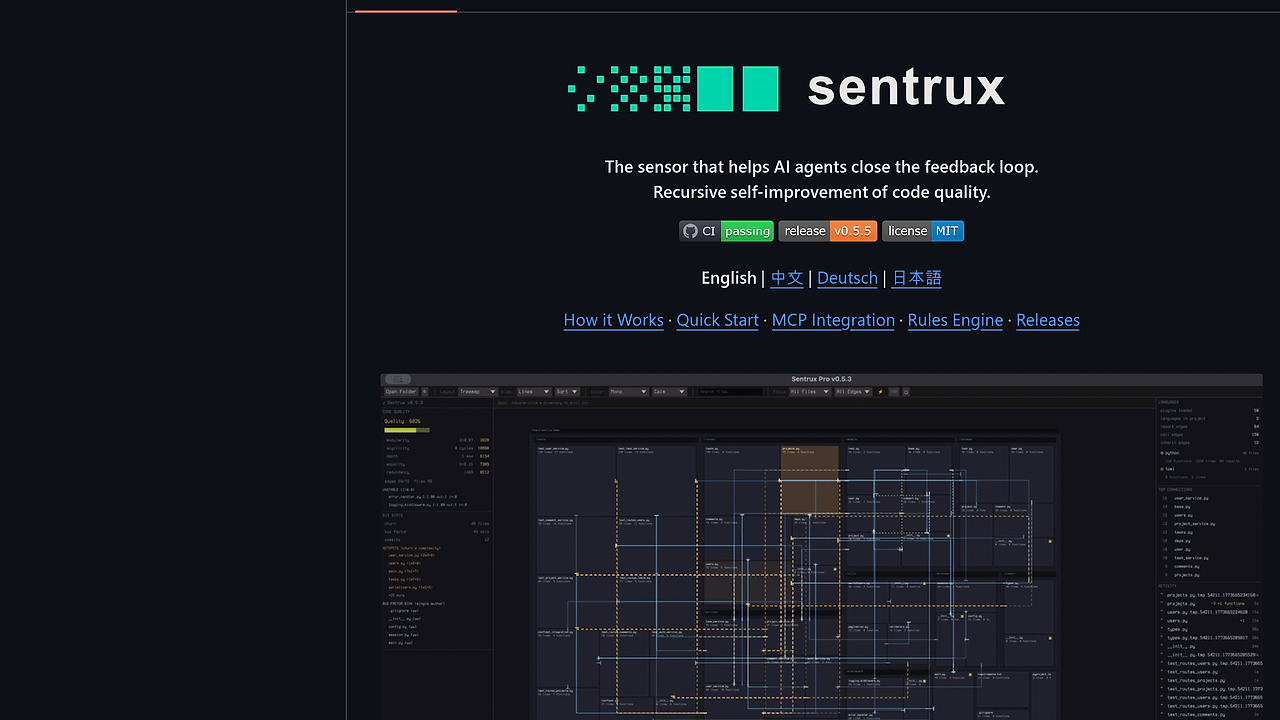
Sentrux is a code quality sensor built by sentrux for AI-assisted developers scanning projects in 52 languages using tree-sitter parsers. It acts as a structural quality gate detecting degradation in AI-agent-written code, such as Claude Code Opus outputs scoring 6772 without feedback. Sentrux is one of the best Code Quality Tools for AI-assisted developers. With 181 GitHub stars as of October 2024, it provides GUI treemaps, CLI checks, and MCP server integration for real-time agent access. Pure Rust binary runs on macOS, Linux, and Windows without dependencies.
Quick Overview
| Attribute | Details |
|---|---|
| Type | Code Quality Tools |
| Best For | AI-assisted developers using agentic workflows |
| Language/Stack | Rust, Tree-sitter, WGPU |
| License | MIT |
| GitHub Stars | 181 as of Oct 2024 |
| Pricing | Open-Source |
| Last Release | v0.5.5 — Oct 2024 |
Who Should Use Sentrux?
- AI agent operators running Claude Code, Cursor, or Windsurf who need structural metrics to iterate on generated FastAPI or web projects.
- Indie hackers prototyping MVPs with AI where baseline gating prevents quality regression across 52 languages like Python, Rust, and Object Pascal.
- Platform teams integrating MCP servers for recursive self-improvement loops in agentic coding pipelines.
- CLI enthusiasts seeking zero-dependency binaries for CI gates exiting 0/1 on rule passes.
Not ideal for:
- Teams requiring deep semantic analysis beyond structural tree-sitter parsing, like vulnerability scanning.
- Legacy monorepos in unsupported dialects without tree-sitter plugins.
- Developers avoiding GPU-accelerated GUIs due to Vulkan/GL backend issues on certain Linux distros.
Key Features of Sentrux
- Tree-sitter Parsing — Supports 52 languages including Python, Rust, JavaScript, and Object Pascal via audited plugins, delivering precise abstract syntax tree traversal without regex fallbacks.
- GUI Treemap Visualization — WGPU-powered interactive display of project structure, highlighting quality hotspots in sub-200ms renders on modern GPUs.
- Baseline Gating —
sentrux gate --save .establishes project baselines; subsequent runs flag degradation, ideal for pre/post AI agent diffs. - CLI Rule Checking —
sentrux check .evaluates custom rules, exits 0 for pass/1 for fail, integrates into GitHub Actions or Jenkins with JSON outputs. - MCP Server Mode —
--mcpflag exposes metrics via Model Context Protocol, allowing Claude Code or Cursor to query scores in real-time loops. - One True Score — Aggregates 51 sensor metrics into a single 0-10000 score, updated in v0.5.5 for consistent AI feedback.
- Cross-Platform Binaries — Single executable with auto-fallback GPU backends (Vulkan > GL > CPU), no Cargo runtime needed post-install.
Sentrux vs Alternatives
| Tool | Best For | Key Differentiator | Pricing |
|---|---|---|---|
| Sentrux | AI agent feedback loops | Tree-sitter MCP for 52 langs, zero-deps Rust binary | Open-Source |
| Semgrep | Security rule scanning | YAML rules for vuln patterns, CI-focused | Open-Source |
| SonarQube | Enterprise monorepos | Java backend, deep metrics dashboard | Freemium |
| Tree-sitter CLI | Parser playgrounds | Raw query REPL, no quality gating | Open-Source |
Semgrep excels in custom security rules but lacks Sentrux's AI-agent MCP integration and treemap GUI. SonarQube suits large teams with its plugin ecosystem yet demands Docker servers unlike Sentrux's 10MB binary. For pure parsing, Tree-sitter CLI offers queries without scores; pair it with Sentrux for gating. Check Claude Code Canvas for complementary AI IDE visuals or Brainstorm MCP for broader protocol tools.
How Sentrux Works
Sentrux embeds tree-sitter grammars as git submodules, compiling them into the binary via build.rs for runtime parsing. It constructs abstract syntax trees per file, applying 51 sensors for metrics like cyclomatic complexity, nesting depth, and duplication ratios. The core abstraction is a recursive feedback loop: agents query via MCP, Sentrux returns deltas from baselines, triggering targeted rewrites.
Quality manifests as a treemap where leaf nodes color by score density; hover reveals raw AST paths. On Linux, WGPU selects backends dynamically—Vulkan for NVIDIA/AMD, GL for Intel—falling to software raster if needed. Scores aggregate via weighted sum: 40% structure, 30% maintainability, 30% density, normalized to 0-10000.
# Quick baseline gate
sentrux gate --save ./my-fastapi-project
# Agent iterates...
sentrux gate ./my-fastapi-project  # Exits 1 if score < baseline
This sets a baseline score, say 7200, then re-evaluates post-agent changes. Expect JSON output with score: 6772, degraded: true, hotspots: ['/app/main.py:42']. Configure rules in .sentrux/rules.toml for custom thresholds.
Pros and Cons of Sentrux
Pros:
- Zero runtime deps: 10MB binary parses 52 languages offline, beats Java tools starting in 5s.
- MCP-native: Direct Claude Code integration via
/plugin install sentrux, enables 10x faster agent loops vs manual checks. - Sensor overhaul in v0.5.4 fixed 51 plugins, now handles Object Pascal edge cases like pointer arithmetic.
- CI-ready:
sentrux checkruns in 2-5s on 10k LOC Python repos, sub-1s increments. - Visual diagnostics: Treemap spots 80% of degradation visually before CLI diffs.
- Frequent releases: v0.5.5 added unified scoring, 300 commits since v0.1.0.
Cons:
- GPU quirks on Linux: Rare Vulkan crashes require
WGPU_BACKEND=gl, no ARM64 binaries yet. - Structural only: Misses runtime bugs or type errors; no TypeScript inference.
- Early stage: 181 stars, rules engine lacks SonarQube's 500+ predefined patterns.
- No cloud sync: Baselines local-only, manual export for team sharing.
- Plugin auditing manual: v0.5.4 fixed issues, but niche langs may lag tree-sitter upstream.
Getting Started with Sentrux
Install varies by OS; binaries pull from GitHub Releases tagged v0.5.5.
# macOS
brew install sentrux/tap/sentrux

# Linux
curl -fsSL https://raw.githubusercontent.com/sentrux/sentrux/main/install.sh | sh

# First run
sentrux gate --save .  # Baseline current dir
sentrux  # Launch GUI treemap
Post-install, sentrux opens the GUI scanning your CWD, rendering a project-wide treemap in 3-10s depending on LOC. Save baselines before AI sessions; no config needed for defaults. For MCP, add to ~/.cursor/mcp.json and restart—agents query sentrux score /path via stdin. Troubleshoot Linux with WGPU_BACKEND=vulkan sentrux.
Verdict
Sentrux is the strongest option for AI-assisted developers gating agentic code quality when baselines prevent regression in multi-language repos. Its tree-sitter MCP server delivers real-time 6772+ scores unmatched by static linters. Use it for Claude Code loops, but pair with Semgrep for security if needed.