What Is Aster Trading Bot?
Aster Trading Bot is a TypeScript/Node.js trading system built by SigmaTradeLabs for automated futures execution on Aster DEX using the public fapi.asterdex.com RPC/WebSocket layer. Aster Trading Bot is one of the best Perpetual DEX Trading Bots for quantitative and systematic crypto traders. The README exposes 19 operator-focused sections, which is a strong signal that this repo is designed for controlled deployment, logging, monitoring, and risk policy rather than one-off experimentation.
Quick Overview
| Attribute | Details |
|---|---|
| Type | Perpetual DEX Trading Bots |
| Best For | Quantitative and systematic crypto traders running Aster DEX perp strategies |
| Language/Stack | TypeScript, Node.js, RPC/WebSocket via fapi.asterdex.com |
| License | N/A |
| GitHub Stars | N/A as of Feb 2026 |
| Pricing | Open-Source |
| Last Release | N/A |
Who Should Use Aster Trading Bot?
- Systematic crypto traders who want a single-symbol workflow with env-driven controls, rather than a sprawling multi-exchange stack.
- Node.js and TypeScript developers who can inspect source, tune strategy parameters, and read logs before increasing leverage or order size.
- Operators running on VPS infrastructure who need repeatable restarts, state persistence, and output that works with
pm2or systemd. - Researchers testing perp strategies who want a dry-run path before live execution and clear trade history for post-mortem analysis.
Not ideal for:
- Buy-and-hold investors who do not need execution automation or intraday risk controls.
- Teams that need exchange-agnostic coverage across dozens of venues on day one.
- Users who want a no-config bot and are unwilling to set credentials, limits, and kill-switch rules.
Key Features of Aster Trading Bot
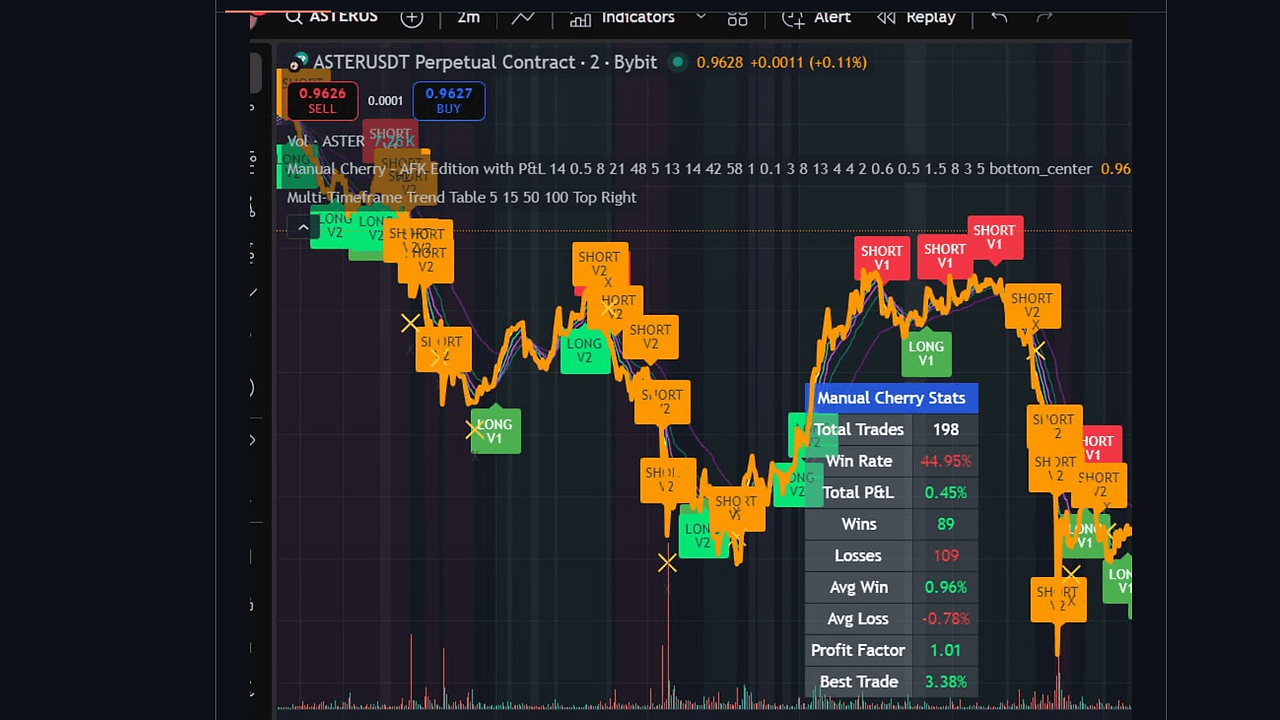
- Dual strategy engine — The repo ships with Watermellon, an EMA-plus-RSI trend setup, and Peach Hybrid, which splits logic into V1 and V2 signal paths. That gives Aster Trading Bot a clean separation between trend bias and momentum surges instead of forcing one signal model to do everything.
- Exchange-native perpetual execution — The bot targets ASTERUSDT-style perpetual markets on Aster DEX through the public futures API and WebSocket surface. That matters because order handling, fills, and position reconciliation are aligned to the venue you actually trade on.
- Risk controls first — Position sizing, leverage limits, stop-loss, take-profit, trailing stop, emergency stop, max flips per hour, and consecutive-loss handling are all part of the operating model. In practice, Aster Trading Bot is designed to fail closed instead of blindly firing orders after a bad market regime shift.
- Real-time indicator stack — The strategy layer uses ADX, ATR, RSI, moving averages, and bar-based support and resistance context. That gives Aster Trading Bot enough signal density to distinguish trend, range, and momentum without requiring a separate analytics stack just to decide whether to trade.
- Persistent state and reconciliation — Open positions and order state survive restarts, and the bot reconciles against exchange reality instead of assuming the local process is always correct. That reduces duplicate entries after crashes and makes Aster Trading Bot usable in a long-running production loop.
- Operator-friendly logs — Trade and signal events are written to daily CSV and JSON under
data/trades/daily/, with console output that fitspm2, systemd, or container logs. For teams that want stronger observability, OpenTrace is a better pairing than relying on terminal output alone. - Dry-run to live workflow — The README explicitly frames research in dry-run mode before moving into live mode with clear limits and audit trails. That is the right shape for any Aster Trading Bot tutorial because it forces parameter validation before capital is at risk.
Aster Trading Bot vs Alternatives
| Tool | Best For | Key Differentiator | Pricing |
|---|---|---|---|
| Aster Trading Bot | Aster DEX perpetual automation | Native Aster focus, dual strategies, and exchange-aware risk controls | Open-Source |
| Freqtrade | Broad crypto algo trading and backtesting | Larger ecosystem and exchange coverage across spot and futures | Open-Source |
| Hummingbot | Market making and liquidity strategies | Connector breadth and execution plumbing for active market participation | Open-Source |
| Jesse | Strategy research and systematic crypto trading | Research-first Python workflow with strong backtesting ergonomics | Open-Source |
Pick Aster Trading Bot when your edge is specifically on Aster DEX and you want the least amount of abstraction between your strategy code and the venue. Pick Freqtrade if you need broader exchange support, and pick Hummingbot if your actual job is providing liquidity rather than directional perps.
If you need deployment automation around the bot, pair it with djevops for provisioning and OpenTrace for runtime tracing. If your post-trade workflow depends on durable archives, DataHaven is a better fit than scattered CSV files.
How Aster Trading Bot Works
Aster Trading Bot uses an event-driven Node.js runtime that subscribes to market data, computes indicators, and emits strategy signals into a risk layer before any order is sent. The core abstraction is simple: market data in, signal decision out, then a guarded execution step that checks leverage, exposure, flip frequency, and stop conditions before the bot touches the exchange.
The design is intentionally conservative. Watermellon handles trend-following behavior with EMA and RSI confirmation, while Peach Hybrid splits the logic into V1 and V2 to separate bias from momentum burst conditions. That makes the bot easier to reason about during regime changes because you can inspect which sub-strategy fired and why, rather than debugging one opaque signal blob.
State persistence is a major design choice here. On restart, Aster Trading Bot can reconcile what it believes is open against what the exchange reports, then continue from the real account state instead of re-creating positions from scratch. That is the difference between a script that dies gracefully and a bot that can run for weeks on a VPS without corrupting its own trade history.
git clone https://github.com/SigmaTradeLabs/aster-bot.git
cd aster-bot
npm install
cp .env.example .env
npm run build
npm run start -- --mode=dry-run --symbol=ASTERUSDT
The example above installs dependencies, creates the local config file, builds the TypeScript project, and starts the bot in dry-run mode. Expect the first session to load configuration, connect to the Aster DEX API, and print signals and simulated decisions before you turn on live execution.
Pros and Cons of Aster Trading Bot
Pros:
- Aster-specific execution path keeps strategy decisions aligned to the venue instead of forcing a generic exchange adapter.
- Two distinct strategy families let you test trend and momentum logic without rewriting the execution layer.
- Strong risk gating with stop-loss, take-profit, trailing stop, flip controls, and emergency shutdown behavior.
- Persistent trade state reduces restart-induced mistakes and makes recovery after process death more predictable.
- Daily CSV/JSON logging makes it easier to run post-trade reviews, accounting checks, and ad hoc backtests.
- Node.js operational fit works well with VPS deployments,
pm2, and teams that already ship TypeScript.
Cons:
- Single-venue focus means Aster Trading Bot is not the right choice if you need broad multi-exchange routing.
- No built-in alpha guarantee; strategy quality still depends on your parameter choices, market regime, and risk limits.
- Manual configuration burden is real because you need to supply credentials, limits, and environment variables correctly.
- Not a turnkey quant platform; if you need portfolio analytics, research notebooks, and exchange arbitrage in one product, this is too narrow.
Getting Started with Aster Trading Bot
git clone https://github.com/SigmaTradeLabs/aster-bot.git
cd aster-bot
npm install
cp .env.example .env
# edit .env with Aster DEX credentials, symbol, leverage, and risk limits
npm run start
Run Aster Trading Bot in dry-run first, then verify that the bot can read market data, emit signals, and write logs without placing live orders. The first real setup usually needs API credentials, a target symbol such as ASTERUSDT, and explicit caps for position size, leverage, and maximum flips per hour.
Verdict
Aster Trading Bot is the strongest option for Aster DEX perpetual automation when you need venue-specific execution, explicit risk limits, and restart-safe logging. Its biggest strength is the dual-strategy plus risk-control design; its caveat is narrow exchange scope and no magical edge. Use it if you trade ASTERUSDT-style markets and want operational control.