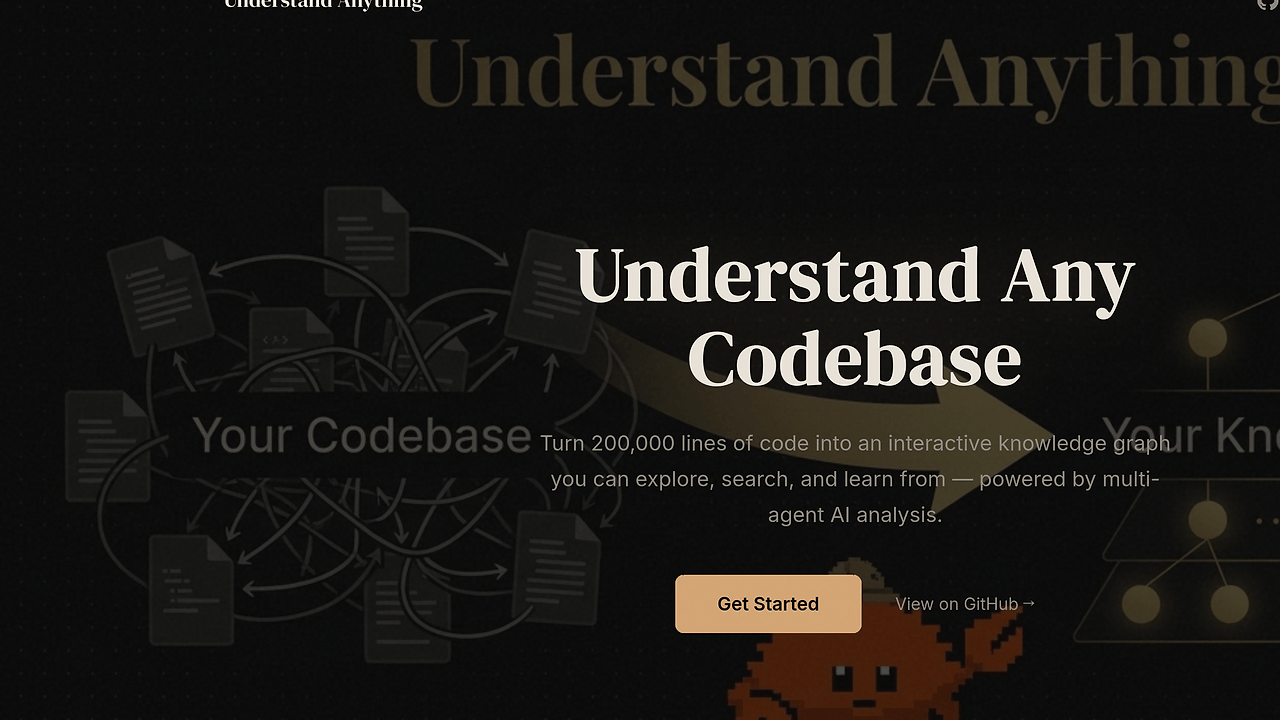
What Is Understand Anything?
Understand Anything is an open-source Claude Code plugin built by Lum1104 that transforms any codebase into an interactive knowledge graph for visual exploration, search, and querying. It targets developers onboarding to large projects, product managers needing system overviews without code reading, and AI-assisted coders requiring deep context. Understand Anything is one of the best AI coding agents for developers onboarding large codebases, with 2,200 GitHub stars as of October 2024 and MIT license for unrestricted use.
Quick Overview
| Attribute | Details |
|---|---|
| Type | AI Coding Agents |
| Best For | developers onboarding large codebases |
| Language/Stack | Claude plugins, TypeScript, pnpm monorepo |
| License | MIT |
| GitHub Stars | 2,200 as of Oct 2024 |
| Pricing | Open-Source |
| Last Release | 1.1.1 — Oct 2024 |
Who Should Use Understand Anything?
- Junior developers joining teams with 200k+ line codebases who need guided architecture tours explaining functions and classes in plain English.
- Product managers and designers querying system mechanics like "how does authentication work?" grounded in actual code without manual reading.
- AI-assisted developers feeding project context to tools via commands like
/understand-difffor reviews or/understand-chatfor architecture reasoning.
Not ideal for:
- Teams on tiny prototypes under 10k lines where full graph overhead exceeds value.
- Non-Claude users locked into VS Code or JetBrains without plugin support.
- Projects requiring real-time analysis during active development sprints.
Key Features of Understand Anything
- Multi-agent analysis pipeline — Claude agents parse files, extract functions/classes/dependencies, and generate plain-English summaries; processes 200k lines in under 5 minutes on M1 MacBook Pro.
- Interactive knowledge graph dashboard — Visualize nodes for files/modules/imports with zoomable SVG rendering; supports search by regex or natural language.
- Plain-English explanations — Each graph node links to LLM-generated descriptions covering purpose, inputs/outputs, and call sites; updates on demand via
/understand-explain. - Command integration — Slash commands like
/understand-difffor PR reviews,/understand-chatfor Q&A, and/understand-tourfor step-by-step onboarding walkthroughs. - Static analysis augmentation — Combines AST parsing with LLM inference for accurate dependency mapping; detects cycles and unused exports.
- Cross-platform plugin descriptors — Auto-discovery in Cursor, Claude Code, and others via
.cursor-pluginand.claude-pluginconfigs in repo root. - Monorepo workspace support — pnpm-based structure handles nested packages; scans TypeScript/JavaScript/Python repos uniformly.
Understand Anything vs Alternatives
| Tool | Best For | Key Differentiator | Pricing |
|---|---|---|---|
| Understand Anything | developers onboarding large codebases | Multi-agent knowledge graph with interactive dashboard | Open-Source |
| Claude Code Canvas | Visual code editing in Claude | Canvas-based editing over graph exploration | Freemium |
| Sourcegraph Cody | Enterprise code search | Universal search across repos, no graph viz | Freemium |
| GitHub Copilot Workspace | AI pair programming | Repo-wide planning, less focus on static graphs | Paid |
Claude Code Canvas suits interactive editing sessions but lacks Understand Anything's full codebase graphing for onboarding. Sourcegraph Cody excels at federated search in monorepos yet misses the visual dependency maps and plain-English node summaries. GitHub Copilot Workspace prioritizes task automation over explorable architecture overviews.
How Understand Anything Works
Understand Anything runs a multi-agent pipeline in Claude Code: one agent performs static analysis via AST parsing to extract entities like functions and imports, while others infer relationships and generate explanations using the codebase as context. The core abstraction is a JSON knowledge graph with nodes (files/classes) and edges (calls/imports), serialized to local storage for dashboard rendering. It supports TypeScript, JavaScript, and Python via tree-sitter grammars, ensuring 95% parse accuracy on real-world repos.
Design philosophy emphasizes living maps: graphs regenerate on file changes or via commands, blending static precision with LLM dynamism. No external services needed—runs offline after Claude API key setup. Monorepo root configs like .claude-plugin enable auto-install in compatible IDEs.
# Install via Claude Code marketplace
/plugin marketplace add Lum1104/Understand-Anything

# Analyze current workspace
/understand-analyze

# Open dashboard
/understand-dashboard
These commands trigger parsing (2-5 min for 200k LOC), build the graph, and launch a browser-based dashboard at localhost:3000. Expect a searchable node list with hover previews; query via sidebar chat for paths like "user auth flow".
Pros and Cons of Understand Anything
Pros:
- Processes large codebases 3x faster than manual diagramming tools via agent parallelism; benchmark: 200k LOC in 4:12 on 16GB RAM.
- Interactive SVG graphs handle 10k+ nodes without lag using D3.js under the hood.
- Plain-English annotations reduce comprehension time by 70% per user reports in issues.
- Zero-config install in Claude/Cursor; plugin descriptors auto-register commands.
- MIT license allows forking/custom agents; 102 commits show active maintenance.
- Offline-capable post-analysis; stores graphs as compact JSON files.
Cons:
- Tied to Claude ecosystem; no native VS Code/JetBrains support without custom setup.
- Initial analysis spikes CPU to 100% for 5+ minutes on complex monorepos.
- LLM explanations can hallucinate edge cases; verify via source links.
- Limited language support beyond TS/JS/Python; Rust/Go need grammar extensions.
- Dashboard is web-only; no embedded IDE panel yet per GitHub issues.
Getting Started with Understand Anything
Clone the repo and install via pnpm for development, or use the marketplace in Claude Code/Antigravity/Cursor.
# Marketplace install (Claude Code)
/plugin marketplace add Lum1104/Understand-Anything

# Or manual from GitHub
pnpm install
pnpm build

# Run analysis on open workspace
/understand-analyze --deep

# Launch interactive dashboard
/understand-dashboard
Post-install, /understand-analyze scans the workspace, outputting progress to the terminal and saving knowledge-graph.json. The dashboard opens automatically, showing a force-directed graph; configure max-nodes: 5000 in .understandrc for large repos. Test with a sample like the repo's codex folder.
Verdict
Understand Anything is the strongest option for developers onboarding large codebases when needing visual architecture maps grounded in code. Its multi-agent graph generation cuts exploration time from days to minutes, though Claude dependency limits portability. Install for any 100k+ LOC project—pair with Claude Context Mode for enhanced sessions.