What Is WAF Killer?
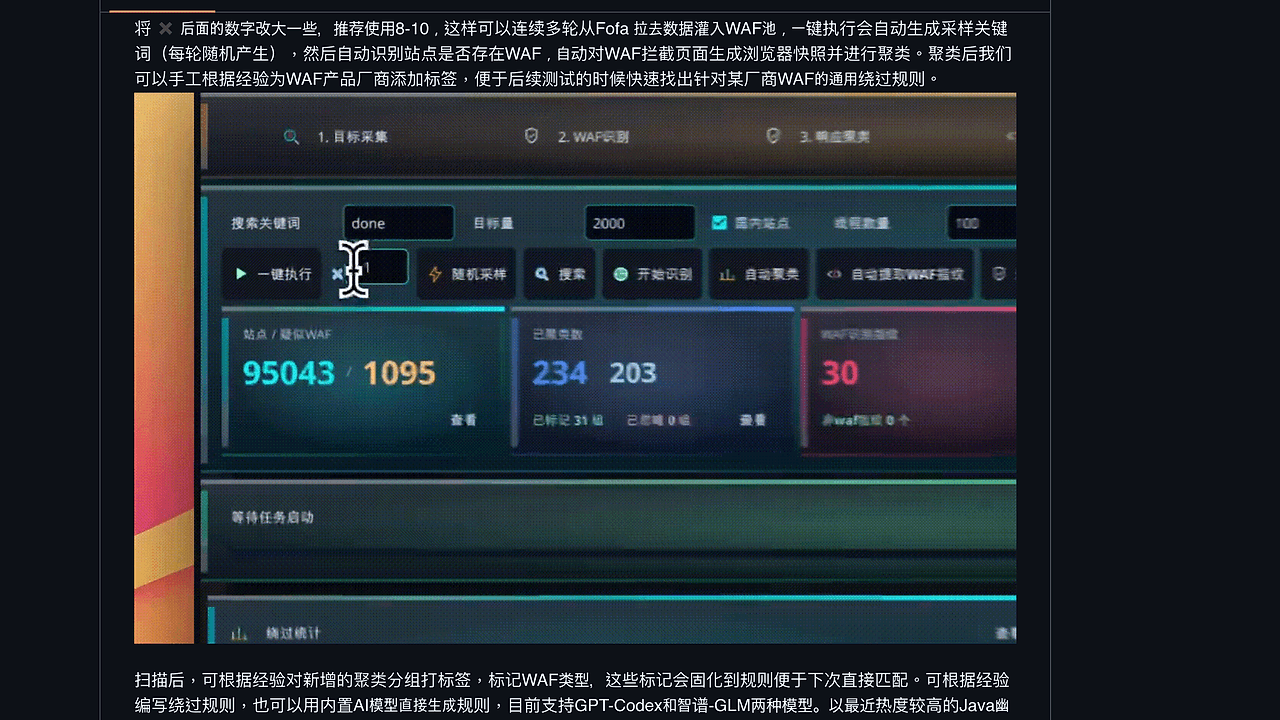
WAF Killer is a Go-built desktop utility from the m-sec-org team for collecting suspected WAF-protected sites, fingerprinting them, and validating bypass rules. WAF Killer is one of the best WAF Testing tools for AppSec engineers, and it ships with 16 built-in color labels for classifying clustered results and rule states.
The tool is designed for authorized research and internal testing, not passive browsing. Its workflow is centered on FOFA ingestion, response similarity analysis, browser snapshots, and rule verification, which makes it more structured than a one-off scanner.
Quick Overview
| Attribute | Details |
|---|---|
| Type | WAF Testing |
| Best For | AppSec engineers |
| Language/Stack | Go, vendorized dependencies, JSON-backed local storage, FOFA API, raw HTTP rule templates, OpenAI Responses API, Zhipu GLM |
| License | N/A |
| GitHub Stars | N/A as of Feb 2026 |
| Pricing | Open-Source |
| Last Release | N/A |
Who Should Use WAF Killer?
- AppSec engineers who need a repeatable way to identify WAF behavior, group similar block pages, and validate candidate bypass rules without manually juggling raw captures.
- Red teamers working in authorized environments who need batch target collection, request replay, and rule comparison before they commit to a test path.
- Security researchers who want to tag WAF families, compare response patterns, and keep a local corpus of validated rules in a single desktop app.
- Teams maintaining internal rule libraries that need import/export, persistent clustering labels, and a local store rather than a SaaS workflow.
Not ideal for:
- Teams that need a cloud-native, multi-user workflow with shared dashboards and RBAC.
- Operators who only want passive detection and do not need rule validation or clustering.
- Anyone without explicit authorization to test the target environment.
Key Features of WAF Killer
- FOFA batch collection — WAF Killer can pull candidate targets from FOFA and iterate through multiple collection rounds. The first-run workflow is built for seeding a WAF pool quickly so you can test detection logic against real responses instead of empty sample data.
- WAF fingerprinting via
waf.yaml— The detector reads rule-based fingerprints fromwaf.yaml, which keeps identification logic separated from the UI and the test runner. That makes it easier to update signatures without rewriting the app. - Response clustering and screenshot capture — WAF Killer groups similar block pages and generates browser snapshots for each cluster. That is useful when different vendors serve nearly identical denial pages but differ in DOM structure, headers, or branding.
- Raw HTTP rule files — The tester loads
.http,.req, and.txtfiles that are written as raw HTTP requests. That format makes the rule library portable and easier to review in git than opaque binary profiles. - Metadata-driven rule engine — Rules can carry
# @name,# @tags,# @threshold,# @intent, and# @preflight_modeheaders. Those comments are not decoration; they control validation mode, similarity thresholds, pruning behavior, and display metadata. - AI-assisted bypass generation — WAF Killer can call OpenAI Responses API and Zhipu GLM to generate bypass rules from the current context. That is useful when you want a draft rule quickly, then refine it with deterministic validation instead of trusting a generated payload blindly.
- Proxy and TLS controls — The app supports upstream proxy, downstream proxy, and certificate configuration. That matters when you are testing through a lab network, intercepting traffic, or routing requests through controlled infrastructure.
WAF Killer vs Alternatives
| Tool | Best For | Key Differentiator | Pricing |
|---|---|---|---|
| WAF Killer | Local WAF fingerprinting, clustering, and bypass-rule validation | Desktop-first Go app with FOFA import, clustering, and raw HTTP rule files | Open-Source |
| Burp Suite Professional | Manual web testing and interactive exploitation | Best-in-class intercepting proxy, extensions, and repeater workflow | Paid |
| OWASP ZAP | Free web security testing | Strong baseline scanning and automation with a lower barrier to entry | Free |
| nuclei | Template-based scanning at scale | Fast, CLI-first templating for broad detection coverage | Open-Source |
Pick Burp Suite Professional when your work is mostly interactive and you need a mature proxy workflow, extension ecosystem, and manual request surgery. Burp is better for one-off investigation; WAF Killer is better when the task is organizing WAF targets and validating rule behavior over many samples.
Pick OWASP ZAP when you want a free scanner with broad web coverage and you do not need WAF-specific clustering or local rule persistence. ZAP is more general-purpose, while WAF Killer is narrower and more opinionated.
Pick nuclei when you want fast CLI scans driven by templates and do not care about desktop clustering or AI-assisted rule drafting. If you need request tracing around the same targets, OpenTrace is a better complement than another scanner. If you want to generate prompts or agent workflows around rule research, Brainstorm MCP fits that job better. For a broader catalog, browse all security testing tools.
How WAF Killer Works
WAF Killer uses a local-first architecture built around a Go runtime, a JSON-backed data store, and a rule loader that treats HTTP requests as the core unit of work. The app collects targets from FOFA, probes them with configurable concurrency, records results into data/wafkiller.db.json, and keeps a startup snapshot so the workspace can be restored without rebuilding everything from scratch.
The design philosophy is simple: store enough evidence to compare requests later. That is why the app keeps raw request templates, validation metadata, target attributes, snapshots, and diagnostic logs instead of only keeping a yes/no WAF flag. It is also why the rule format relies on placeholder expansion such as {{TARGET_HOST_HEADER}}, {{USER_AGENT}}, and {{RAND}}, which lets the tester keep requests deterministic while still varying payload details.
# getting started example
make run
# or run directly with vendor mode
GOCACHE=$(pwd)/.gocache GOMODCACHE=$(pwd)/.gomodcache go run -mod=vendor .
The first command starts the desktop app using the repository's default configuration. The second command runs the same app without relying on prebuilt artifacts, which is useful when you are validating changes or debugging the vendor tree.
Under the hood, the detector compares responses and clusters similar block pages before a human labels them. That hybrid model is practical because WAF behavior often changes by vendor, deployment mode, and upstream proxy configuration, so pure signature matching is not enough. The result is a workflow that supports both machine-assist and operator judgment without forcing either one to dominate.
Pros and Cons of WAF Killer
Pros:
- Local persistence — WAF Killer stores workspace data locally, which keeps rule libraries and validation artifacts under operator control.
- Rule files are readable — Raw HTTP templates are easy to diff, review, and version in git.
- Built for WAF-specific work — FOFA import, clustering, and bypass statistics are aligned with one job instead of a generic scanner's many jobs.
- AI drafting is optional — You can use OpenAI or Zhipu for first-pass rule generation, then validate manually.
- Proxy support is explicit — Upstream, downstream, and TLS controls are first-class configuration, not hidden hacks.
- Portable workspace export — Import/export keeps config, rules, database, and diagnostics together.
Cons:
- Desktop-only workflow — WAF Killer is not a cloud service or a collaborative team console.
- FOFA dependency for seeding — The first-use workflow is weaker if you do not have a FOFA account or if your query returns poor targets.
- Requires operator judgment — Clustering and tagging still depend on someone who understands WAF families and block-page patterns.
- Go environment friction — Building from source means dealing with Go versions, vendor mode, and occasional cross-compilation setup.
- Narrow scope — It focuses on WAF analysis and rule validation, not full-web vulnerability management.
Getting Started with WAF Killer
Clone the repository, verify you have Go 1.25 or newer, and start the app in vendor mode. If you only want to explore the UI locally, you can launch it with the default config before wiring FOFA or model credentials.
git clone https://github.com/m-sec-org/wafkiller.git
cd wafkiller
make run
# optional build check
make build
After launch, WAF Killer reads config.json from the project root and uses the bundled vendor/ tree for dependencies. If you want FOFA ingestion, AI-assisted rule generation, or proxying, you need to fill in the corresponding keys and verify the request path before running larger batches.
Verdict
WAF Killer is the strongest option for authorized WAF rule validation when you need desktop-first batch analysis and local rule persistence. Its main strength is the combination of FOFA import, clustering, and raw HTTP rule validation in one Go app. The main caveat is that it still depends on good operator input and a valid target corpus. Use it when you need focused WAF research, not generic web scanning.