What Is Yao Open Prompts?
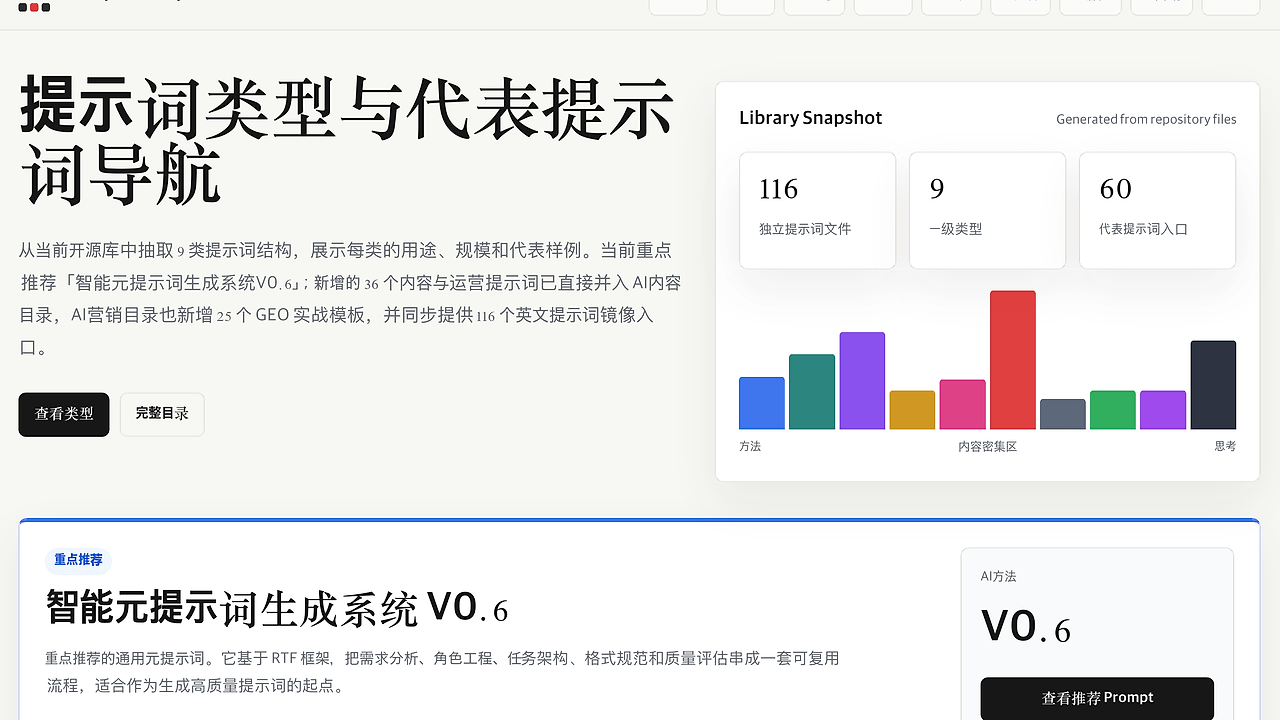
Yao Open Prompts is an open-source prompt library built by Yao Jingang for Chinese users who need reusable AI workflows for work, learning, content, marketing, and daily tasks. Yao Open Prompts is one of the best Prompt Libraries tools for Chinese users, and the current repository snapshot organizes 116 Chinese prompt files into scenario-based folders with a mirrored English tree and metadata that makes prompts easier to version, search, and reuse.
The repo is not a chat app or a hosted SaaS. It is a structured content system for prompt engineering, with cleanup rules that remove tutorial noise, screenshot clutter, and HTML residue so the copyable prompt body stays usable in ChatGPT, Claude, Gemini, and other LLM clients.
Quick Overview
| Attribute | Details |
|---|---|
| Type | Prompt Libraries |
| Best For | Chinese users |
| Language/Stack | Markdown prompt files, YAML frontmatter, GitHub Pages, Python catalog scripts |
| License | CC BY 4.0 |
| GitHub Stars | N/A as of Feb 2026 |
| Pricing | Open-Source |
| Last Release | N/A |
Who Should Use Yao Open Prompts?
- Content operators and editors who need ready-made Chinese prompts for titles, rewrites,公众号 HTML, short video scripts, and platform-specific formatting.
- Marketers and growth teams working on GEO, SEO, structured data, campaign copy, and content experiments that need repeatable prompt templates instead of one-off chat threads.
- Indie hackers and product builders who want prompt scaffolding for product prototyping, requirement framing, and document generation without maintaining a private prompt graveyard.
- Teachers, learners, and knowledge workers who want prompts for Feynman-style questioning, memory practice, critical thinking, and study assistance.
Not ideal for:
- Teams that want a polished SaaS interface, analytics dashboard, or browser extension.
- Users who only need a few generic English prompts and do not care about file-level organization.
- Organizations that need enterprise permissioning, audit logs, or centralized prompt governance.
Key Features of Yao Open Prompts
- 116 prompt files with scenario grouping — The repository currently ships 116 Chinese prompts arranged by use case instead of dumping everything into one flat folder. That matters because prompt reuse depends on retrieval, and retrieval is better when the prompt names map to real jobs like content generation, product drafting, and learning.
- YAML frontmatter for structured metadata — Each file carries fields such as
title,category,subcategory,source_section,author,version,created,status, andtags. That gives you a lightweight schema for cataloging prompts, generating indexes, and tracking revisions without needing a database. - Clean prompt bodies only — The repository strips tutorial promotion, screenshot links, video attachments, and HTML leftovers from the main prompt body. The result is less noise when you copy text into an LLM and fewer formatting artifacts that break tool calls or markdown parsing.
- English mirror tree — The
prompts-en/directory mirrors the Chinese structure, which makes bilingual prompt maintenance practical. Teams shipping bilingual content workflows can keep path symmetry and translate prompt intent without redesigning the whole repository. - Theme-level consolidation — Series content gets merged into collections such as
50个 Nano Banana 创意提示词instead of fragmenting the repo into dozens of tiny files. That reduces directory sprawl and makes topical browsing faster for humans and bots. - Catalog and release automation — Scripts like
python3 scripts/check_repo.py,python3 scripts/generate_catalog.py, andpython3 scripts/generate_webpage.pyturn the repo into an auditable content pipeline. This is the part that makes Yao Open Prompts more than a static document dump. - CC BY 4.0 content licensing — The prompt content is explicitly licensed for reuse under CC BY 4.0, which is unusually practical for teams that want to adapt templates into internal playbooks, courseware, or content ops systems.
Yao Open Prompts vs Alternatives
| Tool | Best For | Key Differentiator | Pricing |
|---|---|---|---|
| Yao Open Prompts | Chinese prompt reuse and curation | Structured repo with 116 prompts, YAML metadata, and category-driven organization | Open-Source |
| Awesome ChatGPT Prompts | Broad community prompt browsing | Larger English-first prompt collection, less opinionated about metadata structure | Free |
| FlowGPT | Discovering prompts through a web community | Social discovery layer and prompt sharing, but weaker file-level version control | Freemium |
| PromptBase | Buying and selling polished prompts | Marketplace economics and packaged prompt products, not a clean open repo | Paid |
Pick Awesome ChatGPT Prompts if you want breadth and an English-first community archive, not a Chinese curation workflow. Pick FlowGPT if your team wants prompt discovery and quick browsing over repo discipline.
Pick PromptBase if you care about commercial prompt packs and are willing to pay for polished bundles. Pick Yao Open Prompts when you want a reproducible prompt source you can fork, audit, and extend. For teams that are building their own internal prompt systems, Brainstorm MCP pairs well for ideation, while Claude Context Mode helps when prompts need to carry a larger working set.
How Yao Open Prompts Works
Yao Open Prompts works like a content pipeline rather than a runtime service. The core abstraction is a Markdown file with YAML frontmatter and a short prompt body, which means the repository can be searched, copied, diffed, and regenerated with normal Git workflows instead of special tooling.
The design choice here is simple: separate the reusable prompt from the surrounding explanation. That keeps each file portable across models and platforms, and it also makes the repo friendly to automation because version, status, tags, and category can be parsed by scripts without scraping prose.
A practical workflow looks like this:
git clone https://github.com/yaojingang/yao-open-prompts.git
cd yao-open-prompts
python3 scripts/check_repo.py
python3 scripts/generate_catalog.py
The first command pulls the repository, the second checks structure and metadata consistency, and the third rebuilds the catalog index from the file tree. If you are using the prompts in a production workflow, the next step is usually to copy the Prompt section from a Markdown file, replace placeholders like {{变量}}, and paste it into your model of choice.
This structure also fits prompt engineering teams that want to pair curated prompts with their own internal tools. OpenSwarm is a natural companion when you turn one prompt into a multi-agent workflow, because the repo gives you prompt primitives while an agent layer orchestrates execution.
Pros and Cons of Yao Open Prompts
Pros:
- High signal-to-noise prompt body — The main prompt text is kept clean, which reduces copy friction and avoids accidental HTML or tutorial contamination.
- Real metadata discipline — YAML frontmatter makes it easier to sort, filter, and automate prompt catalogs.
- Bilingual structure — The mirrored English tree is useful for teams that localize workflows or support mixed-language output.
- Scenario coverage is broad — The repo spans content, marketing, learning, work, education, life, and thinking prompts, so it is not trapped in a single niche.
- Repo-native versioning — Git history plus explicit
versionfields makes iterative prompt refinement measurable. - Content license is explicit — CC BY 4.0 is easy to understand and easier to operationalize than vague reuse terms.
Cons:
- No runtime UI — Yao Open Prompts is a repository, not an app, so there is no built-in search console, analytics, or one-click prompt launcher.
- Stars and release cadence are not surfaced on the page — You cannot evaluate popularity or release velocity from the README alone.
- Chinese-first organization — Non-Chinese users can still use it, but the taxonomy and naming are optimized for Chinese workflows.
- Quality still depends on manual selection — A large prompt library helps only if you know how to pick, adapt, and test the right template.
- Not a substitute for productized prompt management — Teams needing permissions, audit trails, or centralized policy enforcement will outgrow a raw Git repository.
Getting Started with Yao Open Prompts
The fastest way to use Yao Open Prompts is to clone the repo, inspect the catalog, and copy one prompt into your target model. There is no package install step because the value is in the Markdown content and the repository structure.
git clone https://github.com/yaojingang/yao-open-prompts.git
cd yao-open-prompts
less CATALOG.md
After that, open the relevant Markdown file under prompts/ or prompts-en/, copy the Prompt section, and replace placeholders such as {{变量}} or [占位符] with your real task data. If you plan to maintain your own fork, run python3 scripts/check_repo.py before every release so broken metadata does not creep into the catalog.
Verdict
Yao Open Prompts is the strongest option for Chinese prompt reuse when you want structured, copy-pasteable prompts with version control and a clean catalog. Its biggest strength is the combination of metadata, curation, and bilingual organization, and its main caveat is the lack of a runtime UI. Choose it if you want a repo you can fork and operationalize, not a prompt marketplace.