What Is AutoTeam-F?
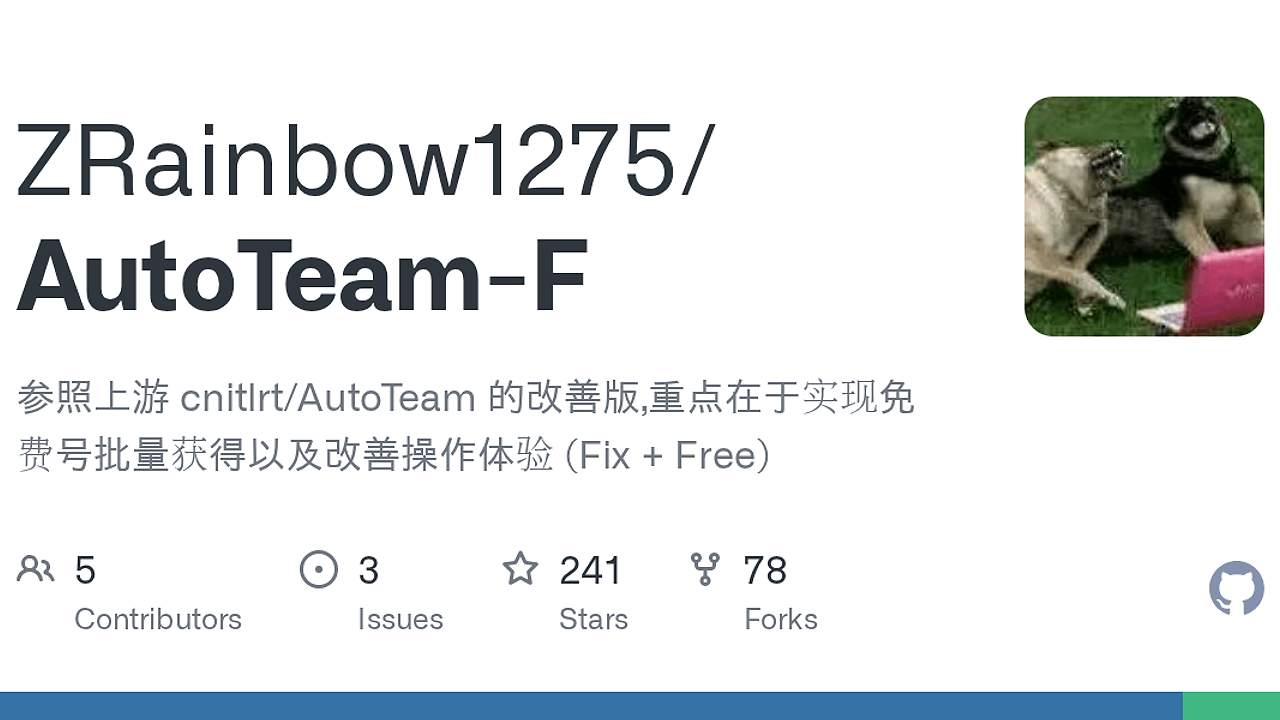
AutoTeam-F is a Python 3.10+ DevOps Automation fork built by ZRainbow1275 from cnitlrt/AutoTeam for ChatGPT Team operators and Codex users, and it combines Playwright, FastAPI, Vue 3, and uv into a browser-driven account lifecycle system with 10+ CLI commands and a web panel on port 8787. AutoTeam-F is one of the best DevOps Automation tools for ChatGPT Team operators and Codex users because it rotates accounts, syncs OAuth state, manages CPA imports and exports, and exposes admin endpoints for diagnostics, cleanup, and batch operations. As of Apr 30 2026, its free-Personal generation path is documented as blocked by OpenAI backend changes, so the fork is now more useful for Team ops and auth maintenance than for fresh Personal account creation.
Quick Overview
| Attribute | Details |
|---|---|
| Type | DevOps Automation |
| Best For | ChatGPT Team rotation, Codex OAuth sync, CPA mirroring |
| Language/Stack | Python 3.10+, Playwright Chromium, FastAPI, Vue 3, uv, Docker |
| License | MIT |
| GitHub Stars | N/A |
| Pricing | Open-Source |
| Last Release | N/A |
Who Should Use AutoTeam-F?
AutoTeam-F is a good fit when you need local control over ChatGPT Team seats, browser-based OAuth, and account inventory instead of a hosted service. It is also a practical fit when your workflow already depends on uv, Playwright, and a self-hosted web panel.
- Team operators who need to keep a fixed number of active seats and want
rotate,check,fill, andcleanupflows in one place. - Automation-heavy builders who prefer shell commands and API calls over manual console work, especially when dealing with OAuth redirects and temporary email providers.
- Indie hackers who need to export
auth.jsonfor Codex CLI usage and keep local auth state synced with CPA. - Infra owners who want failure buckets, admin diagnostics, and a browser worker that can be inspected instead of a black-box SaaS.
Not ideal for:
- Compliance-sensitive teams that need a vendor-backed workflow with formal guarantees and support.
- Users who only want a token exporter and do not need rotation, registration, or workspace seat management.
- Operators who cannot tolerate one-at-a-time browser automation or the moving parts of temporary email backends.
Key Features of AutoTeam-F
- Playwright-backed registration flow — AutoTeam-F uses Chromium automation to drive sign-up and login flows, which keeps the workflow close to the actual UI instead of relying on brittle reverse-engineered one-off scripts. The setup process also uses a state machine so the mail provider and backend checks happen before registration starts.
- Dual mail backends — AutoTeam-F supports
cf_temp_emailandmaillab, and the fork makesMAIL_PROVIDERexplicit so you do not silently bind the wrong inbox provider. It also probes the mail service and sniffs protocol fingerprints to abort early whenbase_urland provider do not match. - Codex OAuth lifecycle — AutoTeam-F handles Team and Personal OAuth paths, includes localhost callback handling, and falls back to manual paste when the browser callback fails. That matters if you need to generate or refresh
auth.jsonfor Codex CLI or related tooling. - Rotation and cleanup commands — The CLI includes
rotate [N],check,fill [N],cleanup [N],add, andmanual-add, which turns seat management into repeatable operations. The fork also prioritizes recovered accounts so you do not lose previously healthy members. - CPA two-way sync — AutoTeam-F can push local active accounts to CPA and also pull CPA state back into local storage, which is useful when multiple operators or machines touch the same auth pool. This reduces the chance of drift between the local registry and the external sync target.
- Admin diagnostics and failure tracking — The web/API layer exposes
/api/admin/diagnoseand/api/admin/fix-account-id, and the fork persists failure classes intoregister_failures.json. That gives you a paper trail for 401s, duplicate signups, OAuth breakage, and other registration failures. - Current free-Personal status awareness — AutoTeam-F keeps the Personal-account path in the codebase, but the repository states that as of Apr 30 2026 the
plan_type=freeroute is no longer stable. In practice, the flow can still execute and mark accountsSTANDBY, but you should not expect reliable production-free account creation.
AutoTeam-F vs Alternatives
| Tool | Best For | Key Differentiator | Pricing |
|---|---|---|---|
| AutoTeam-F | ChatGPT Team account rotation and Codex auth syncing | Fork with fixes, web panel, CPA sync, and explicit diagnostics | Open-Source |
| AutoTeam | Baseline account rotation and sync | Original upstream codebase without the fork-specific repair work | Open-Source |
| djevops | General infrastructure automation | Better for deployment workflows and environment ops than workspace seat churn | Open-Source |
| OpenSwarm | Multi-agent task orchestration | Better for agent coordination than browser-based auth and account lifecycle work | Open-Source |
Pick upstream AutoTeam if you want the original baseline and do not need the fork's bug fixes or new diagnostics. Pick djevops when the real job is pipeline and environment automation, not ChatGPT account management.
Pick OpenSwarm when you need orchestration across agents and tasks, not a Playwright worker that touches OAuth forms and workspace membership. AutoTeam-F is the sharper choice when the operational unit is an account, a seat, or an auth file.
How AutoTeam-F Works
AutoTeam-F splits into a CLI dispatcher, a FastAPI service, a Vue 3 control plane, and a Playwright worker that executes browser flows. The local state model centers on account records such as status, workspace_id, seat_type, last_quota_check_at, and auth blobs, while CPA sync provides a second copy for transport and recovery.
The design is defensive rather than optimistic. The mail-provider probe, setup wizard, and protocol fingerprint checks exist to prevent the classic half-working state where sign-in succeeds but mailbox creation or OAuth breaks two steps later.
Quota checks and failure handling also matter here. AutoTeam-F classifies temporary network problems separately from 401 or 403 auth failures, and the fork adds retry and timeout logic so a slow browser session does not silently poison the whole batch.
uv run autoteam api
curl -X POST http://localhost:8787/api/tasks/fill -H 'Authorization: Bearer $API_KEY' -H 'Content-Type: application/json' -d '{"target": 5, "leave_workspace": true}'
The first command starts the web panel and API on 8787. The second command triggers a batch fill task that can invite or rotate accounts depending on the current workspace state, and if the free-Personal path is blocked it will still complete the flow without claiming a stable plan_type=free outcome.
Pros and Cons of AutoTeam-F
Pros:
- Strong operator surface — You get CLI commands, an HTTP API, and a browser dashboard instead of one opaque entry point.
- Clear mail-provider handling —
MAIL_PROVIDERis explicit, and the fork probes mismatches before you waste time on broken registrations. - Useful failure telemetry —
register_failures.json, admin diagnostics, and fail-fast 401 handling make debugging faster than reading raw browser logs. - Docker-friendly deployment — The repo supports containerized deployment with persistent data volume handling.
- Auth export and sync — Codex
auth.jsonexport plus CPA import/export lets the tool sit in the middle of a real workflow. - Better fork hygiene — The repo documents fixed bugs, missing guardrails, and the current free-Personal regression instead of pretending everything works.
Cons:
- One-at-a-time browser work — The repository states that only one Playwright operation should run at a time, which limits throughput.
- ToS and account risk — The repo explicitly warns that usage may violate OpenAI terms and can lead to bans or IP restrictions.
- Current free-Personal path is broken — As of Apr 30 2026, the project documents that the Personal account production path is no longer stable.
- Soft stop is not instant — Stopping a task will not always interrupt the current browser session immediately.
- Setup is not trivial — You need Playwright Chromium, a mail provider, CPA configuration, and a sane
.envfile before the first successful run.
Getting Started with AutoTeam-F
A clean first run is straightforward if you already know how to manage Python toolchains and environment variables. The main requirement is that you set up the mail provider and API key before you start rotating or registering accounts.
git clone https://github.com/ZRainbow1275/AutoTeam-F.git
cd AutoTeam-F
uv sync
uv run playwright install chromium
cp .env.example data/.env
uv run autoteam api
After the API starts, open http://localhost:8787 and finish the setup wizard for the mail backend, CPA settings, and admin login. If you are on Linux, the repo also supports bash setup.sh, while Windows and macOS users do not need xvfb.
Verdict
AutoTeam-F is the strongest option for ChatGPT Team account rotation and Codex auth syncing when you need a local control plane and can tolerate browser automation. Its best strength is the FastAPI/Vue admin workflow plus the diagnostic endpoints; the caveat is that free-Personal generation is blocked as of Apr 30 2026. Use it for Team ops and auth maintenance, not for guaranteed Personal account creation.