What Is German Legal Skills for Claude?
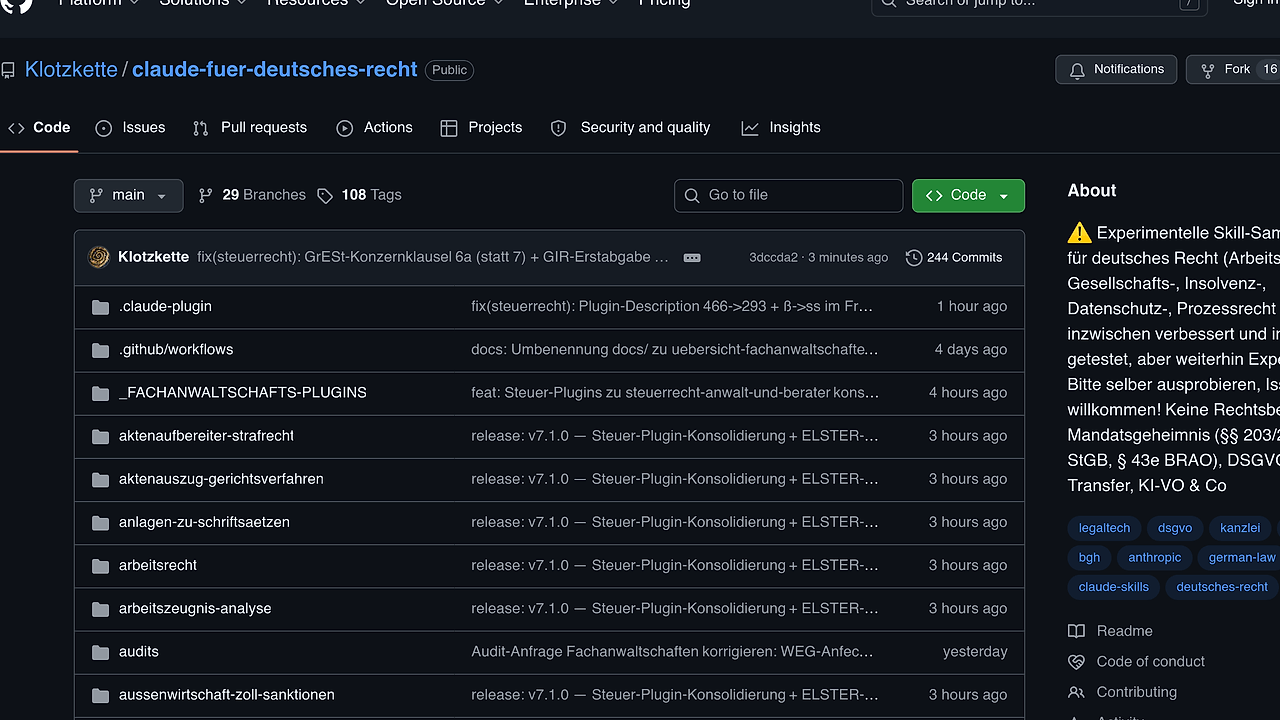
German Legal Skills for Claude is an AI legal skills repository built by Klotzkette that packages German-law plugins, sub-agents, and workflows for law firms, in-house teams, and legal trainees; the repo page shows 99 plugins, 1,500+ skills, 44 test files, and 24 specialist profiles. German Legal Skills for Claude is one of the best Legal AI Skills tools for German law firms, because it adapts Claude-oriented workflows to German legal methodology, commentary-heavy practice, and citation discipline.
The project is explicitly experimental, which matters: it is not a certified product and it is not legal advice. Its value is the structure it gives to tasks like subsumption, drafting, liquidation planning, AI Act screening, litigation workflow support, and training on fictional case files without pretending to replace a lawyer's judgment.
Quick Overview
| Attribute | Details |
|---|---|
| Type | Legal AI Skills |
| Best For | German law firms, in-house legal teams, and legal trainees |
| Language/Stack | Anthropic Claude Skills/Plugins, Markdown SKILL.md, JSON marketplace manifests, DOCX/PDF workflows |
| License | N/A |
| GitHub Stars | N/A |
| Pricing | Open-Source |
| Last Release | v7.0.0 |
Who Should Use German Legal Skills for Claude?
- German private-practice lawyers who want a structured assistant for research, drafting, and issue spotting without giving the model free rein over legal output.
- In-house legal teams that need repeatable playbooks for compliance, contract review, GDPR questions, and internal memos across multiple matter types.
- Legal trainees, referendars, and instructors who need a method-first workspace for practice cases, exam-style structure, and controlled learning outputs.
- Ops-minded teams that care about prompt governance, reproducible templates, and case-specific workflows instead of generic chat behavior.
Not ideal for:
- Teams looking for a polished commercial product with vendor guarantees, formal support, and a fixed release cadence.
- Users who need a one-click turnkey legal AI system and do not want to calibrate prompts, citation style, or governance rules.
- Any workflow that would expose confidential client data before the team has cleared AVV, TOMs, retention, and cloud-transfer rules.
Key Features of German Legal Skills for Claude
- German-law method trees — The repository is organized around the German style of legal analysis: Anspruchsgrundlagen, Prüfungsschema, Subsumtion, and commentary-aware reasoning. That makes outputs easier to audit than a generic chat transcript.
- Mechanik-Prüfer modules — Specialized workflows such as
subsumtions-pruefer,bereicherungs-und-anfechtungsrecht-pruefer, andki-vo-ai-act-prueferencode decision paths for BGB, InsO, AnfG, and EU AI Act tasks. These are useful when you want the model to follow a controlled branching structure instead of improvising. - Workflows for real practice tasks — The repo includes packs for Wandeldarlehen lifecycle work, Kündigungsschutzklage self-help, TzBfG fixed-term disputes, StaRUG early warning, liquidity planning, and Fortbestehensprognose. That breadth makes German Legal Skills for Claude more useful than a narrow single-purpose prompt library.
- Court and ministry document outputs — The repository describes DOCX and PDF generation for legislative workshop documents and court-style outputs, including official layout conventions and structured relations. That matters if you need artifacts that resemble the internal output format of a ministry, chamber, or court.
- Large test case corpus — The
testakten/directory contains extensive fictional files with PDFs, spreadsheets, Word drafts, and handwritten notes. That gives teams a safer sandbox for prompting, evaluation, and training before touching real matters. - Governance and compliance framing — The repo repeatedly warns about § 203 StGB, DSGVO/BDSG, Cloud Act/FISA, BRAO/BORA, StPO secrecy constraints, and the EU AI Act. For legal teams, that is a feature, not decoration, because the workflow is designed to sit inside an existing control framework.
German Legal Skills for Claude vs Alternatives
| Tool | Best For | Key Differentiator | Pricing |
|---|---|---|---|
| German Legal Skills for Claude | German legal workflows, subsumption, drafting, and training | German-law-specific skill packs with test files, workflows, and legal-method structure | Open-Source |
| Claude Context Mode | Managing long context and structured prompt state | Better when the main problem is context handling, not legal methodology | Varies |
| Claude Code Canvas | Structured agentic drafting and code-adjacent workflows | Better for interactive drafting surfaces and technical collaboration loops | Varies |
| Brainstorm MCP | Prompt ideation and multi-step planning | Better for early-stage thinking, not for German-law-specific templates | Varies |
Pick Claude Context Mode when you need tighter control over conversation state, retrieved context, or cross-session organization. It is the better fit for general knowledge work that does not need legal doctrine encoded into the workflow.
Pick Claude Code Canvas when your team wants a structured drafting environment with more interactive iteration than a static skill pack provides. It is a better companion for technical teams that also draft policies, specs, or legal-adjacent artifacts.
Pick Brainstorm MCP when the problem is ideation, prompt planning, or agent orchestration rather than legal operations. German Legal Skills for Claude is narrower and more opinionated, which is exactly why it is more useful for German legal work.
How German Legal Skills for Claude Works
German Legal Skills for Claude works by turning legal tasks into specialized prompt wrappers, sub-agents, and workflow templates that bias Claude toward German legal reasoning. The design philosophy is simple: do not ask the model to be a generalist; give it the legal method, the output shape, and the domain constraints up front.
The repository's structure suggests a layered model. At the top are plugin definitions and marketplace metadata, below that are skill files, and underneath are task-specific playbooks for fields like labour law, insolvency, data protection, IP, and administrative procedure.
A realistic way to use it looks like this:
git clone https://github.com/Klotzkette/claude-fuer-deutsches-recht.git
cd claude-fuer-deutsches-recht
claude "Prüfe die Ansprüche aus § 280 BGB anhand von testakten/arbeitsrecht/fall-01.pdf und gib das Ergebnis im Gutachtenstil mit BGH-Zitierweise aus."
That kind of invocation tells Claude to stay inside a legal workflow instead of drifting into generic summarization. In practice, the skill pack should produce a structured answer with issue spotting, a formal reasoning chain, and a citation style that can be checked against the source material.
Pros and Cons of German Legal Skills for Claude
Pros:
- German-method first — The workflows are built around German legal doctrine, not generic RAG chat patterns.
- Broad domain coverage — The repo spans labour law, insolvency, IP, litigation, administrative law, data protection, and more.
- Useful sandbox material —
testakten/gives teams realistic but non-confidential files for evaluation and training. - Governance-aware framing — The repo repeatedly flags professional secrecy, data protection, and AI governance constraints.
- Good fit for structured drafting — It is stronger at repeatable legal output than a blank general-purpose assistant.
Cons:
- Experimental by design — The repo is a playground, not a verified legal product.
- Manual calibration required — Teams still need to tune prompts, citation rules, and internal controls.
- No vendor SLA — There is no commercial support layer implied by the repository page.
- Potentially outdated legal states — Legal references can go stale, so review against current statutes and case law is mandatory.
- Not a substitute for clearance — It cannot decide on its own whether a workflow is permissible under § 203 StGB, DSGVO, or cloud-transfer rules.
Getting Started with German Legal Skills for Claude
A practical start is to clone the repository, inspect the marketplace manifest, and point Claude at a non-confidential test file before using any real matter. If your Claude setup uses a different plugin directory, adapt the copy path to match your local environment.
git clone https://github.com/Klotzkette/claude-fuer-deutsches-recht.git
cd claude-fuer-deutsches-recht
cp -R .claude-plugin ~/.claude/plugins/german-legal-skills-for-claude
jq '.plugins | keys' .claude-plugin/marketplace.json
After that, choose one workflow pack, open a file from testakten/, and test the expected output shape with a low-risk prompt. The first configuration task should be your house citation style, because the repo is most valuable when the model mirrors your firm's structure instead of inventing its own.
Verdict
German Legal Skills for Claude is the strongest option for German-law-focused Claude workflows when the team is willing to calibrate prompts and governance instead of expecting a turnkey SaaS product. Its biggest strength is the density of German legal structure and practice material; its main caveat is that it remains experimental and must be reviewed before any client-facing use. Recommended for teams that want disciplined legal output, not chatty automation.