What Is codeindex?
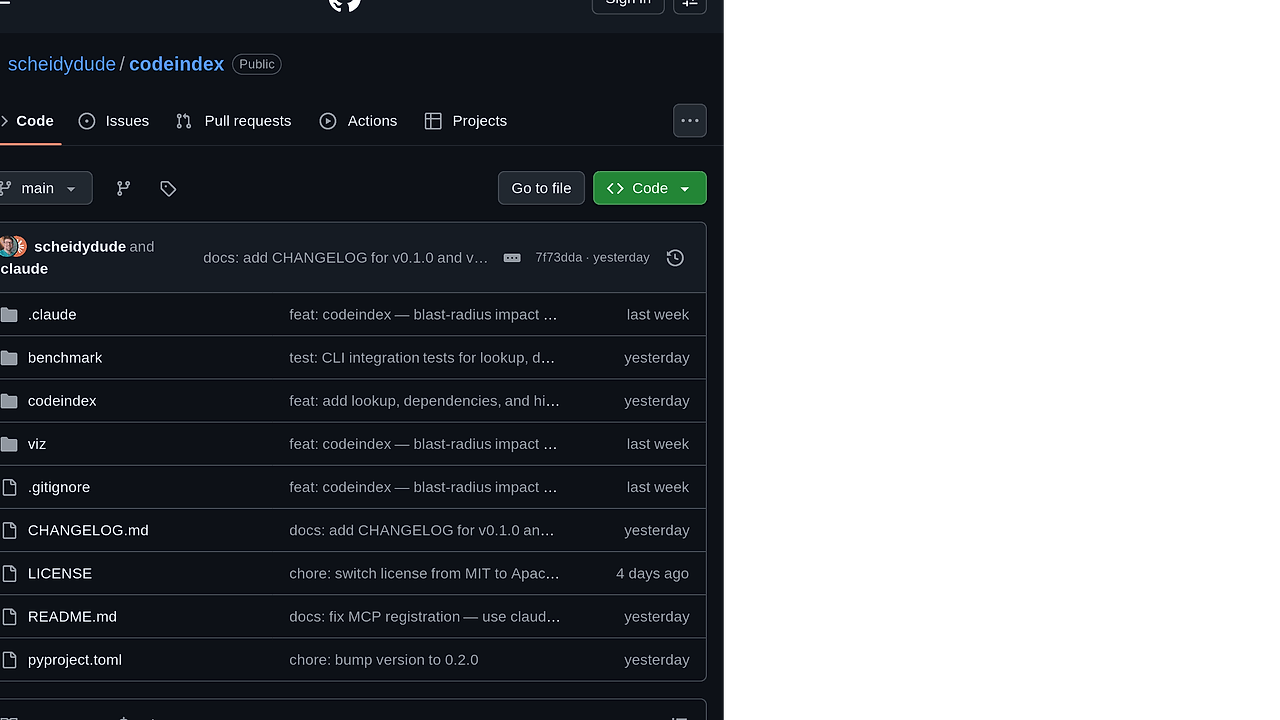
codeindex is a repo dependency analyzer built by scheidydude that turns Python, JavaScript/TypeScript, Go, Ruby, Rust, Java, PHP, and other projects into codeindex.json and symbolindex.json. codeindex is one of the best CLI Tools for large-repo developers because it combines blast-radius scoring, symbol indexing, and an MCP server for AI-assisted development, with the page claiming support for 12+ languages and 60–90% lower token use on symbol-location tasks.
Quick Overview
| Attribute | Details |
|---|---|
| Type | CLI Tools |
| Best For | Large-repo developers and AI-assisted coding teams |
| Language/Stack | Pure Python stdlib, JSON indexes, MCP, Claude Code |
| License | N/A on the page |
| GitHub Stars | N/A as of Feb 2026 |
| Pricing | Open-Source |
| Last Release | N/A on the page |
Who Should Use codeindex?
- Platform engineers managing monorepos where a change in a shared module can fan out into many downstream files. codeindex gives you a blast score before you touch the file, so refactor planning is less guesswork and more impact analysis.
- AI-assisted developers using Claude Code or other MCP clients who need symbol lookup without loading the entire repository into context. codeindex keeps the lookup local and deterministic.
- Indie hackers moving fast across polyglot stacks who want a cheap way to answer, "what breaks if I edit this file?" before pushing.
- Maintainers who want pre-commit warnings on risky changes and a machine-readable index that can be consumed by scripts, reports, and agents.
Not ideal for:
- Small single-file utilities where the graph overhead is larger than the codebase itself.
- Teams that only want hosted search and collaboration, not a local CLI workflow.
- Organizations that cannot install Python tooling on developer machines.
Key Features of codeindex
- Blast-radius scoring — codeindex computes a per-file score from direct dependents plus transitive dependents using the published formula
direct + (0.5 × transitive). In practice,codeindex impact src/auth.pysurfaces which files are most likely to break before a refactor lands. - Symbol indexing —
symbolindex.jsonmaps functions, classes, structs, and types to exact file and line locations. That makescodeindex lookup AuthServicean O(1) lookup instead of a full-repo scan. - Multiple consumption paths — codeindex can be consumed through CLI commands, markdown reports, an MCP server, a git pre-commit hook, and
CLAUDE.mdinjection. That is useful when the same index needs to serve humans, shell scripts, and agents. - Polyglot repository support — the page states automatic detection for 12+ languages, including Python, JavaScript/TypeScript, Go, Ruby, Rust, Java, and PHP. That makes codeindex a fit for mixed stacks where import graphs are otherwise fragmented.
- Interactive visualization UI —
codeindex serve --vizexposes 2D force graphs, 3D network views, dependency matrices, treemaps, and infrastructure graphs. Those views are useful when a text report is not enough to spot hot spots in a codebase. - Pure Python stdlib runtime — the tool has no required dependencies, no npm install, and no build step. That reduces setup friction and makes it easier to run in clean dev containers or CI jobs.
- Watch mode for live repos —
--watchcan re-index on file changes, withwatchdogonly needed if you want live refresh. That is helpful for teams iterating on imports and symbol movement all day.
codeindex vs Alternatives
| Tool | Best For | Key Differentiator | Pricing |
|---|---|---|---|
| codeindex | Local dependency graphs, blast-radius scoring, symbol lookup | Writes repo-local JSON indexes and exposes MCP, CLI, and visualization workflows | Open-Source |
| Sourcegraph | Org-wide code search and cross-repo browsing | Hosted code intelligence across many repositories | Enterprise / Free tier depending on setup |
| Semgrep | Pattern-based static analysis and security rules | Rule engine for code scanning, not dependency graphing | Open-Source / Enterprise |
| GitHub Code Search | Fast hosted search inside GitHub | Best when you only need search, not local graph generation | Free for GitHub users |
Pick Claude Code Canvas or Claude Context Mode alongside codeindex when your editing workflow lives in Claude and you want the index to feed the agent instead of the other way around. Pick Brainstorm MCP if you are standardizing more MCP-based workflows and want another local server pattern to compare against.
Use Sourcegraph instead of codeindex when you need centralized search across many repos, team permissions, and a hosted UI that multiple engineers can share. Use Semgrep when the problem is policy enforcement, security rules, or custom linting rather than dependency impact. Use GitHub Code Search when you want zero setup and can live without a local blast-radius model.
How codeindex Works
codeindex scans a repository, extracts file relationships, and serializes them into a deterministic graph stored in codeindex.json. The graph is then used to compute direct dependents, transitive dependents, and blast scores, which makes the output useful for refactoring risk analysis instead of simple search.
The second index, symbolindex.json, stores symbol names with file and line coordinates so agents and humans can jump straight to a definition. That matters because the tool is designed for local lookup against repository artifacts, not for shipping code to a remote service. The repo-local files are the core abstraction, which also makes the data easy to diff in pull requests and easy to feed into scripts.
codeindex analyze ./myapp
codeindex symbols ./myapp --inline --claude-md
codeindex impact src/auth.py
codeindex serve --viz --repo ./myapp
The first command builds the dependency index, the second adds symbol data and optional CLAUDE.md context, and the third shows the blast radius for one file before you edit it. The last command launches the browser visualization, which is useful when you want to inspect the graph structure instead of reading raw JSON.
Pros and Cons of codeindex
Pros:
- Produces repo-local artifacts that other tools can consume without a server round-trip.
- Gives a concrete blast score instead of vague dependency intuition.
- Supports both dependency graphs and symbol maps, which solves two different developer lookup problems.
- Works through CLI, MCP, markdown, hooks, and
CLAUDE.md, so one index can feed multiple workflows. - Runs on pure Python stdlib, which keeps install and CI setup small.
- Includes an interactive visualization UI for graph-heavy repositories.
Cons:
- It is a local tool, not a hosted org-wide search platform.
- The page does not state a formal license, which some companies need before adoption.
CLAUDE.mdinjection increases prompt context size, so it is not free in every workflow.watchmode needs optionalwatchdog, so live refresh is not dependency-free.- The utility depends on how well a language and repo layout expose imports, so edge cases in dynamic code may need manual verification.
Getting Started with codeindex
pip install codeindex
codeindex analyze ./myapp
codeindex symbols ./myapp --inline --claude-md
codeindex impact src/auth.py
codeindex serve --viz --repo ./myapp
After these commands, codeindex writes the dependency and symbol indexes into your repo and lets you query them from the terminal or browser. If you want live re-indexing while editing, add watchdog and run with --watch; if you want Claude integration, keep --claude-md enabled so the symbol summary is available in CLAUDE.md.
Verdict
codeindex is the strongest option for local dependency intelligence in large polyglot repos when you want AI-friendly context without shipping code to a hosted service. Its best strength is the combination of blast-radius scoring and O(1) symbol lookup; the main caveat is that it is still a local CLI, not an org-wide code search platform. Use it if your workflow lives in the terminal or Claude Code.