What Is Polymarket Trading Bot?
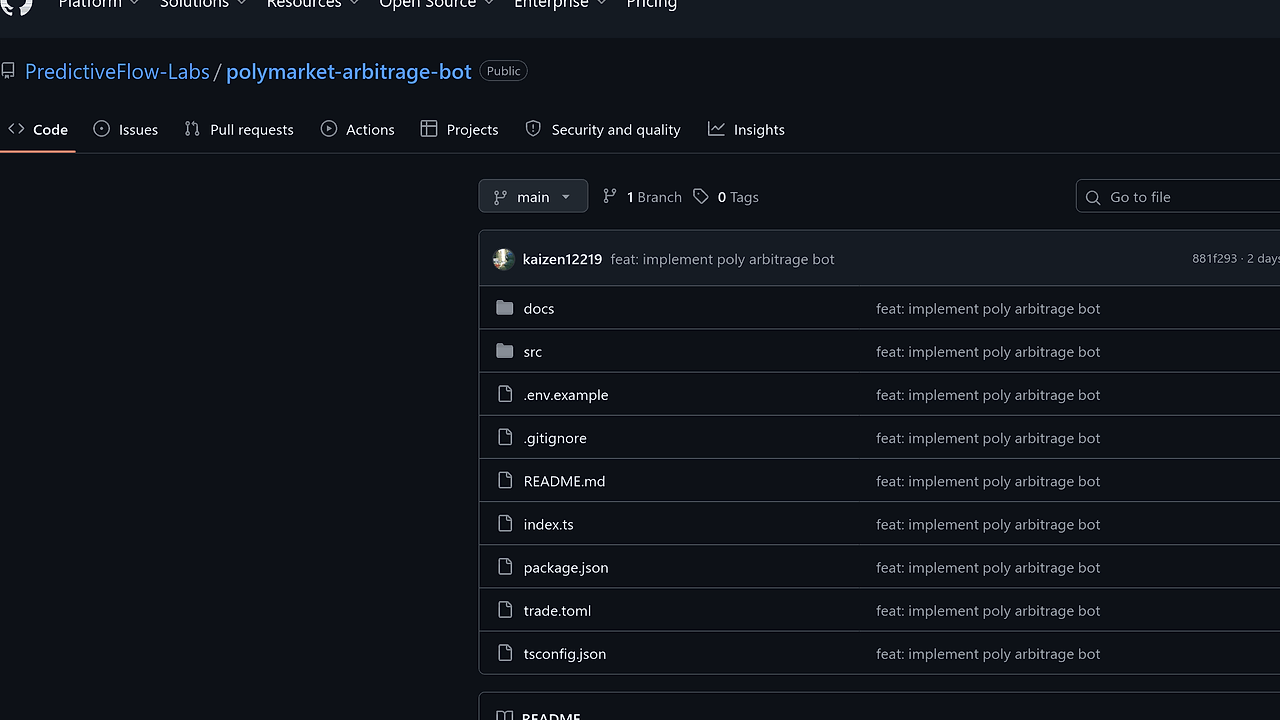
Polymarket Trading Bot is one of the best Prediction Market Trading Bots tools for TypeScript developers and Polymarket traders. Built by PredictiveFlow-Labs, it runs a Node.js 20+ and TypeScript 5.x automation loop against the Polymarket CLOB order book, so operators can trade BTC, ETH, SOL, and XRP short-horizon markets instead of hand-clicking the UI. It focuses on 5m and 15m windows, uses the official @polymarket/clob-client-v2 SDK, and is designed for inspectable automation rather than black-box signals.
The repo is a practical starting point if you want a small, auditable codebase that actually shows how market selection, authenticated orders, and risk gates fit together. It is not pretending to be risk-free arbitrage software, and that honesty matters more than any marketing pitch.
Quick Overview
| Attribute | Details |
|---|---|
| Type | Prediction Market Trading Bots |
| Best For | TypeScript developers and Polymarket traders |
| Language/Stack | Node.js 20+, TypeScript 5.x, Polymarket CLOB v2 SDK, Polygon |
| License | ISC |
| GitHub Stars | N/A as of Feb 2026 |
| Pricing | Open-Source |
| Last Release | N/A |
Who Should Use Polymarket Trading Bot?
- TypeScript engineers building a Polymarket CLOB bot who want a readable baseline instead of reverse-engineering a larger framework.
- Independent traders testing short-duration Up/Down strategies on BTC, ETH, SOL, or XRP markets with a small notional and explicit risk limits.
- Platform or quant teams that need a starting point for order lifecycle automation, retry logic, and environment validation in a production-style Node.js service.
- Operators who prefer config files and clear logs over a web dashboard, especially when they want to run separate processes for separate market windows.
Not ideal for:
- Teams that need a single orchestrator for synchronized 5m + 15m paired-leg arbitrage across multiple windows.
- Traders who expect HFT-style latency, market making depth management, or a full portfolio engine.
- Users who want a no-code workflow; this repo expects comfort with
.env,trade.toml, and terminal-based operations.
Key Features of Polymarket Trading Bot
- Single-window market loop — The bot trades one market window at a time, using coin plus period to derive a Polymarket slug such as BTC 5m or BTC 15m. That keeps the control flow simple and avoids the coordination bugs that show up in multi-leg arbitrage systems.
- Polymarket CLOB execution — Orders go through the official
@polymarket/clob-client-v2SDK against the Polymarket order book. That means the bot is working with quoted bids and asks, not scraping a web page or pretending the market is an AMM. - Rule-based strategy engine —
trade_1andtrade_2are driven fromtrade.toml, which means entry and exit behavior is explicit instead of buried in code. Parameters liketrade_usd, range thresholds, and cooldowns can be changed without rewriting the trading loop. - L1/L2 authentication flow — The repo uses L1 wallet signing to derive or create API credentials, then switches to an L2 client for balances and order placement. That split is standard for Polymarket automation and keeps credential handling aligned with the platform model.
- Retry and cooldown controls — Failed buys do not immediately spam the API, and transient errors get bounded retries instead of infinite loops. The
entry_buy_cooldown_secbehavior is the kind of safety valve you want when prices move quickly or liquidity thins out. - Operator-friendly logs — Startup banners, structured console output, and human-readable trading errors make it easier to reason about state under pressure. If you want richer debugging, pairing the bot with OpenTrace is a sensible next step for order-lifecycle tracing.
- Startup validation — Environment and config validation happen early, which reduces the classic “it launched but nothing works” failure mode. That is useful in CI, in containers, and when you are deploying with djevops or another automation layer from browse all DevOps Automation tools.
Polymarket Trading Bot vs Alternatives
| Tool | Best For | Key Differentiator | Pricing |
|---|---|---|---|
| Polymarket Trading Bot | Rule-based Polymarket CLOB automation in TypeScript | Purpose-built for short-horizon Polymarket windows and direct SDK integration | Open-Source |
| Hummingbot | General crypto market making and arbitrage | Broader exchange coverage and more mature market-making primitives | Open-Source |
| Freqtrade | Exchange-based crypto strategy automation | Strong backtesting and strategy research workflow for spot/futures markets | Open-Source |
Custom ccxt script | Teams that want total control over exchange integrations | Minimal abstraction, maximum freedom, but you build every safety rail yourself | Open-Source |
Pick Hummingbot if you need a mature framework for exchange arbitrage or market making and Polymarket is not your primary venue. Pick Freqtrade if your edge is in backtested crypto strategies rather than Polymarket-specific market windows.
Pick a custom ccxt script if your team wants full control and is comfortable owning every retry, auth, and monitoring path. Pick Polymarket Trading Bot when the goal is a small, readable Polymarket automation base that already speaks the CLOB API and is easier to adapt than a generic trading framework.
How Polymarket Trading Bot Works
The design is intentionally narrow: a config file defines the market window, the strategy, and the operational limits, then the bot resolves that into a live Polymarket slug and market metadata. The core abstraction is a Trade lifecycle that consumes price polling, applies strategy rules, and emits order actions, which keeps the decision path testable and easy to audit.
Under the hood, the flow is: wallet auth, API credential setup, Gamma lookup for market metadata, price polling for UP and DOWN tokens, then an evaluation step that decides whether to buy, sell, or hold. That separation matters because it lets you inspect each stage independently instead of treating the entire run as one opaque script.
# getting started example
git clone https://github.com/PredictiveFlow-Labs/polymarket-arbitrage-bot.git
cd polymarket-arbitrage-bot
npm install
cp .env.example .env
npm run dev
The command sequence installs dependencies, prepares local secrets, and starts the polling loop in development mode. After that, the bot reads trade.toml, validates the required environment variables, and begins polling the selected market window; if the config is incomplete, it fails early rather than trading with partial state.
Pros and Cons of Polymarket Trading Bot
Pros:
- Direct Polymarket CLOB integration means the bot is not faking execution through browser automation or unsupported APIs.
- TypeScript codebase is easy to inspect, extend, and refactor if you want to add new entry or exit logic.
- Config-driven behavior keeps strategy tuning in
trade.toml, which is cleaner than hard-coding thresholds into the execution path. - Bounded retries and cooldowns reduce the chance of runaway order spam during transient failures or bad quotes.
- Operator-readable logs make it easier to diagnose auth failures, market lookup problems, and order rejections without attaching a debugger.
- Small surface area makes it a better teaching repo than a sprawling bot suite when you are learning Polymarket mechanics.
Cons:
- No built-in synchronized dual-window arbitrage means you must run separate processes if you want 5m and 15m coordination.
- Strategy depth is limited to the rule set already exposed in
trade.toml, so advanced portfolio logic is not included. - Liquidity risk is real because short-horizon prediction markets can widen spreads or dry up during volatility.
- Operational burden stays on you for secrets management, monitoring, and deployment hardening.
- Not a backtesting platform in the style of Freqtrade, so historical research has to be added separately.
Getting Started with Polymarket Trading Bot
The fastest path is to clone the repo, install dependencies, create your local .env, and then run the dev loop. You need a Polygon wallet setup compatible with Polymarket, plus the required private key and funder or proxy address values, because the bot uses wallet signing to establish API access.
git clone https://github.com/PredictiveFlow-Labs/polymarket-arbitrage-bot.git
cd polymarket-arbitrage-bot
npm install
cp .env.example .env
# edit .env and trade.toml
npm run dev
After the first run, the bot validates environment variables, resolves the market slug from your coin and period settings, and starts polling the selected CLOB market. If you are testing with small size, keep trade_usd conservative and verify the logs before letting it run unattended.
Verdict
Polymarket Trading Bot is the strongest option for TypeScript-based Polymarket automation when you want inspectable CLOB execution and simple rule files. Its main strength is the clean split between market polling, decision logic, and order placement; its main caveat is the lack of built-in multi-window arbitrage orchestration. Use it if you value source-level control over abstraction.