What Is Polymarket Trading Bot?
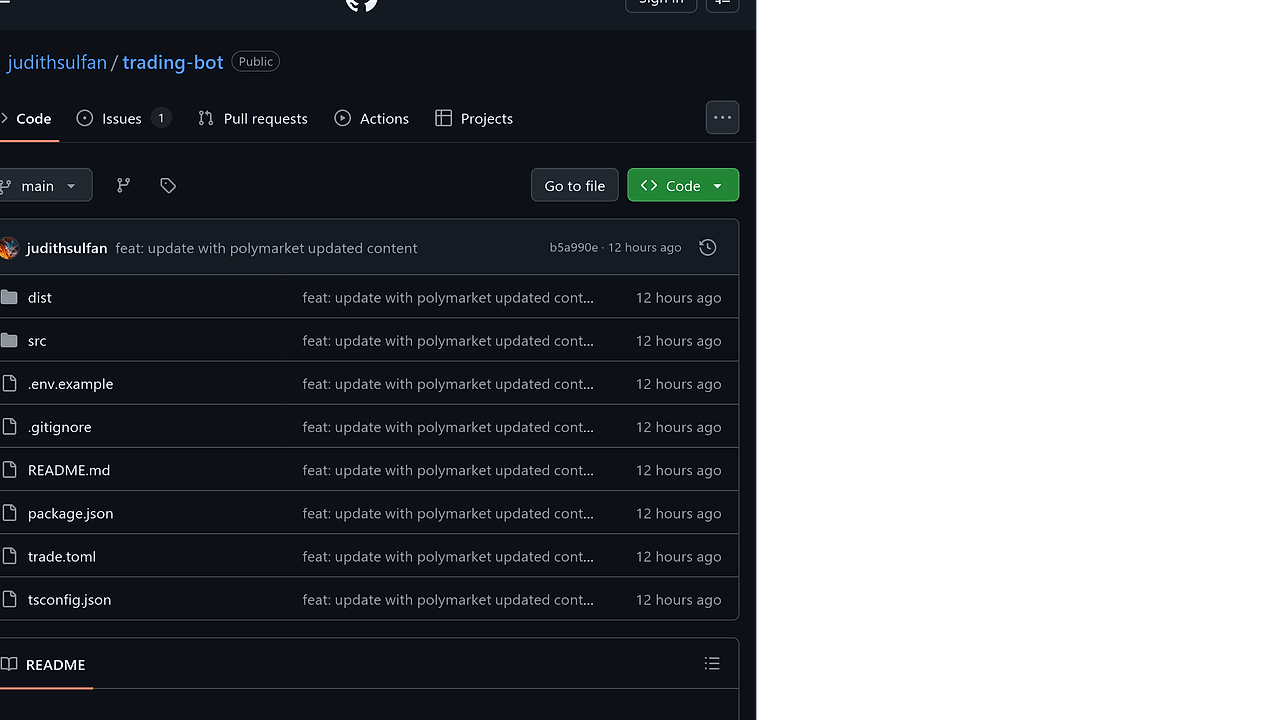
Polymarket Trading Bot is an open-source prediction market trading bot built in Judith Sulfan’s GitHub repo that automates entries, exits, and emergency swaps on Polymarket UP/DOWN markets for Polymarket traders and crypto quant operators. Polymarket Trading Bot is one of the best Prediction Market Trading Bots tools for Polymarket traders. It supports BTC, ETH, SOL, and XRP across 5m to 24h windows, polls live prices every second, and uses real on-chain balances instead of simulated PnL.
Quick Overview
| Attribute | Details |
|---|---|
| Type | Prediction Market Trading Bots |
| Best For | Polymarket traders, crypto arbitrageurs, and TypeScript developers |
| Language/Stack | Node.js 20+, TypeScript 5.3, Polymarket CLOB client, Polygon, Gnosis Safe |
| License | ISC |
| GitHub Stars | N/A as of Feb 2026 |
| Pricing | Open-Source |
| Last Release | N/A |
Who Should Use Polymarket Trading Bot?
- Polymarket power users running small live positions who want rule-based exits instead of manual chart watching.
- TypeScript developers who want a source-controlled trading loop they can audit, patch, and deploy without a SaaS dependency.
- Crypto arbitrageurs testing prediction-market microstructure where price distance from 0.50 drives the signal.
- Ops-minded traders who care about wallet separation, proxy funding, and order confirmation after each fill attempt.
Not ideal for:
- Backtest-first quants who need historical simulation, parameter sweeps, or walk-forward validation before any live order.
- Traders without Polygon USDC in a proxy wallet, because the bot requires live funds on chain to operate.
- Teams that want a GUI-only workflow, since the primary interface is
trade.toml,.env, and terminal output.
Key Features of Polymarket Trading Bot
- Live market discovery — The bot resolves the active Polymarket slug for the configured coin and time bucket, then locks onto the live UP/DOWN
clobTokenIdsuntil expiry. That means you do not have to hardcode market IDs for every window. - 1-second CLOB pricing — It polls bid and ask data from
https://clob.polymarket.com/pricesevery second, which is fast enough for simple momentum or mean-reversion rules without pretending to be a high-frequency engine. - On-chain balance checks — It reads
CONDITIONALandCOLLATERALbalances throughgetBalanceAllowance, so the decision loop reflects real wallet state. That matters when a partially filled order or failed settlement changes the next action. - Two rule sets with explicit triggers —
trade_1is exit-only, whiletrade_2handles entry, exit, and emergency swap logic. Signals are derived fromremaining_time_ratioandup_price_ratio, which makes the strategy readable in code review. - FAK order execution — Orders are sent as Fill-and-Kill attempts with retries, then balance confirmation happens before the next tick. This prevents the loop from assuming a fill that never happened.
- Strict config validation —
trade.tomland environment variables are validated with Zod at boot. Bad strategy shapes fail early instead of producing undefined behavior mid-session. - Operator-visible runtime logs — The engine prints market trend, spread, position, and portfolio state on a short cadence. If you want longer retention or trace correlation, pipe those logs into OpenTrace or archive them in DataHaven.
Polymarket Trading Bot vs Alternatives
| Tool | Best For | Key Differentiator | Pricing |
|---|---|---|---|
| Polymarket Trading Bot | Polymarket UP/DOWN automation | Native Polymarket CLOB flow, proxy wallet support, and market-slug resolution | Open-Source |
| Hummingbot | CEX market making and arbitrage | Broad exchange support and mature market-making primitives | Open-Source |
| Freqtrade | Crypto spot/futures systematic trading | Backtesting, hyperopt, and strategy research workflow | Open-Source |
| 3Commas | No-code bot management | GUI-driven execution with exchange integrations | Paid |
Pick Polymarket Trading Bot when the market is a Polymarket binary contract and you need code-level control over entry and exit rules. Pick Hummingbot when you want exchange-agnostic market making or cross-venue execution. Hummingbot is the better fit if your workflow spans spot books, websockets, and inventory management.
Pick Freqtrade when your priority is research throughput, backtesting, and parameter optimization on exchange data. It is the cleaner choice for systematic crypto spot or futures strategies, but it is not built around Polymarket market slugs, CLOB token IDs, or proxy-funder wallet semantics.
Pick 3Commas when a GUI matters more than source code and you want a managed interface instead of a repo you own. It removes setup friction, but you give up direct control over the strategy loop and the exact execution path.
If you are instrumenting a deployment pipeline around this bot, OpenSwarm is a good companion for repeatable ops tasks, while OpenTrace helps you keep a durable audit trail of every decision and order attempt.
How Polymarket Trading Bot Works
Polymarket Trading Bot uses a simple control loop: bootstrap config, resolve the live market, poll prices, evaluate strategy rules, then submit a FAK order if the thresholds fire. The design is stateful but narrow. It keeps the trade loop focused on a single active market, which is a good fit for a binary UP/DOWN contract where position drift is easy to reason about.
The core abstractions are remaining_time_ratio, up_price_ratio, hasBought, and on-chain position state. remaining_time_ratio measures how far the market has progressed toward expiry, while up_price_ratio measures how far the UP token price has moved away from 0.50. That makes the strategy logic easy to inspect in trade.toml without reverse-engineering a more opaque signal stack.
npm run dev
That command starts the TypeScript loop through tsx, validates the config, boots the Polymarket CLOB client, and begins the one-second market poll cycle. If the configured thresholds match the live market state, the bot posts a FAK order, waits for confirmation, and then resumes the loop with fresh balances.
The wallet model is important. Orders are signed by an EOA, but settlement funding comes from a proxy or Gnosis Safe wallet on Polygon chain id 137, and the bot uses signature type 2. That separation keeps signing authority and trading capital distinct, which is the sane setup for live automation. It also means the bot behaves like an execution engine, not like a custody layer.
Pros and Cons of Polymarket Trading Bot
Pros:
- Live-state execution — The bot reads actual balances and prices before acting, which avoids the false confidence you get from paper-only logic.
- Small, auditable codebase — The project structure is direct: config, services, trade logic, utilities, and bootstrapping. That makes code review and patching easier than a monolithic trading stack.
- Market-specific strategy model — Polymarket-specific concepts like slug discovery, token IDs, and binary outcomes are first-class citizens instead of adapter afterthoughts.
- Explicit order behavior — FAK orders plus retry logic reduce the risk of leaving stale orders hanging on the book.
- Clear runtime telemetry — Trend, position, spread, and portfolio lines are printed regularly, which helps during live testing and incident review.
- Low dependency surface — A Node.js runtime, a signer, a proxy wallet, and USDC are enough to run the bot.
Cons:
- No backtesting layer — There is no historical simulation, walk-forward testing, or parameter search in the repo text.
- Limited market coverage — The supported universe is BTC, ETH, SOL, and XRP, with the 5-minute bucket currently wired for BTC only.
- Polling instead of streaming — One-second polling is acceptable for simple strategies, but it is not the same as a websocket-driven execution stack.
- Strategy surface is narrow —
trade_1andtrade_2cover a small set of behaviors, so more complex alpha extraction needs additional code. - Live capital required — You need USDC in the proxy wallet on Polygon before the bot can do anything useful.
Getting Started with Polymarket Trading Bot
git clone https://github.com/judithsulfan/trading-bot.git
cd trading-bot
npm install
cp .env.example .env
npm run dev
After the first run, set POLYMARKET_PRIVATE_KEY and POLYMARKET_FUNDER_ADDRESS in .env, then edit trade.toml to choose the market coin, period, trade size, and strategy. The proxy wallet must hold USDC on Polygon, and the signer must match the execution setup expected by the repo.
If you want to validate the production path, run npm run build and then npm start. Start with a tiny trade_usd value and confirm the market and portfolio logs look sane before scaling size. That is the simplest way to catch wallet, slug, or strategy mistakes before they cost real money.
Verdict
Polymarket Trading Bot is the strongest option for Polymarket-specific automated execution when you want direct control over live entry and exit rules. Its main strength is state-aware trading against real balances; the caveat is the narrow market set and lack of backtesting. If you trade Polymarket regularly, this repo is worth adopting and hardening.