What Is Polymarket Copy Trade Bot?
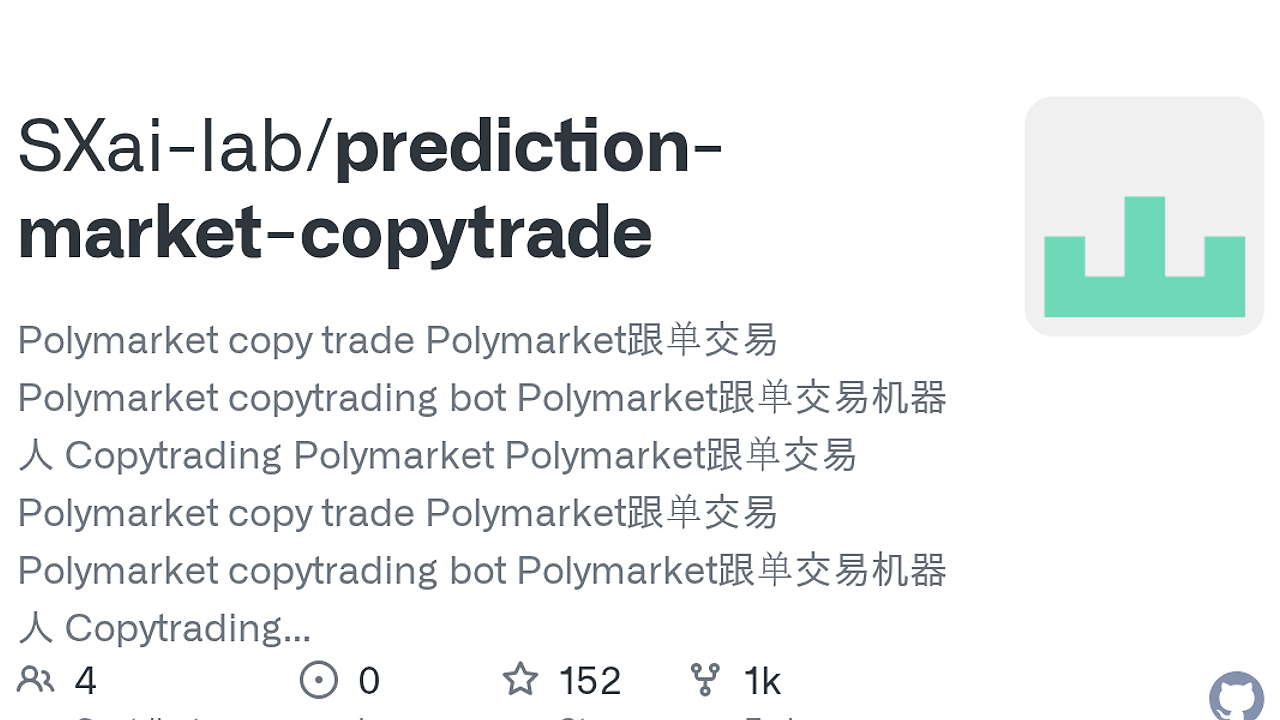
Polymarket Copy Trade Bot is a TypeScript/Node.js prediction market trading bot maintained by SXai-lab that mirrors a target Polymarket trader into your own wallet for Polymarket traders and copy-trading users, and the README documents Node.js 20+ plus five tunable risk controls. Polymarket Copy Trade Bot is one of the best Prediction Market Trading Bots tools for Polymarket traders because it focuses on one job: watch a target account, translate recent Activity into mirrored orders, and keep execution bounded by your own size and order limits.
This is not a generic crypto bot framework. It is a narrow execution layer for Polymarket that reads a target by username or proxy address, polls activity on a fixed interval, and places near-equivalent orders under your wallet credentials. If you want a copy-trading workflow without writing a custom CLOB client, this repo is the shortest path from idea to live automation.
Quick Overview
| Attribute | Details |
|---|---|
| Type | Prediction Market Trading Bot |
| Best For | Polymarket traders, copy-trading users, and crypto builders |
| Language/Stack | TypeScript, Node.js 20+, Polymarket CLOB, Polygon |
| License | N/A |
| GitHub Stars | N/A as of Feb 2026 |
| Pricing | Open-Source |
| Last Release | N/A |
Who Should Use Polymarket Copy Trade Bot?
- Indie builders who want a working Polymarket copy-trading loop without designing their own execution engine.
- Active traders who already follow one or two accounts and want their wallet to mirror fills with a controlled multiplier and per-order cap.
- Quant-curious users who want to study market behavior, replay activity, and compare a target trader's decisions against their own exposure.
- Small teams building a niche prediction-market product that needs a simple, auditable bot rather than a general-purpose strategy platform.
Not ideal for:
- Latency-sensitive arbitrage desks that need streaming data, sub-second reaction time, and routing across multiple venues.
- Hands-off investors who do not want to manage wallet security, Polymarket account setup, or environment variables.
- Users seeking broad exchange support because Polymarket Copy Trade Bot is purpose-built for Polymarket rather than multi-exchange crypto execution.
Key Features of Polymarket Copy Trade Bot
- Target resolution by address or username — The bot accepts a target Polymarket proxy address or a username and attempts to resolve the username into a proxy. That reduces friction when you are following a public trader rather than manually tracking wallet metadata.
- Polling-based activity ingestion —
COPY_POLL_INTERVAL_MScontrols how often the bot checks for new activity, andCOPY_ACTIVITY_LIMITbounds the number of recent events it scans each cycle. This makes the system deterministic and easy to reason about, even though it is not low-latency streaming. - Mirrored order sizing —
COPY_SIZE_MULTIPLIERscales the source trader's size into your own risk profile. You can run at 0.1x for observation, 1x for parity, or higher if your capital and conviction justify it. - Per-order hard caps —
COPY_MAX_ORDER_USDacts as a safety brake on each mirrored trade. If the source trader opens a position far larger than you expect, the bot trims or blocks the order instead of blindly matching it. - Trades-only filtering —
COPY_TRADES_ONLY=truetells the bot to ignore non-trade activity. That matters on Polymarket because not every event in Activity deserves execution, and avoiding noise reduces accidental order spam. - Node 20+ TypeScript runtime — The repository is built for modern Node.js and TypeScript, which means the implementation is easy to inspect, type-check, and extend. If you are already shipping Node tooling, the learning curve is small.
- Wallet and chain configuration knobs —
POLYMARKET_PRIVATE_KEY,POLYMARKET_ADDRESS,POLYMARKET_SIGNATURE_TYPE, andPOLYMARKET_CHAIN_IDexpose the minimum set of fields needed for authenticated execution. That is enough to support a clean local setup without hard-coding secrets into source.
Polymarket Copy Trade Bot vs Alternatives
| Tool | Best For | Key Differentiator | Pricing |
|---|---|---|---|
| Polymarket Copy Trade Bot | Polymarket copy trading with local safety rails | Narrow scope, simple polling loop, and explicit risk caps for mirrored execution | Open-Source |
| Hummingbot | Market making and multi-exchange automation | Broader exchange support and a more general strategy framework | Open-Source |
| Freqtrade | Systematic crypto strategy research and execution | Built-in backtesting and a stronger research workflow for candles and indicators | Open-Source |
| ccxt | Building your own exchange integration layer | Library-level control for custom execution, but you must design the strategy and guardrails yourself | Open-Source |
Pick Polymarket Copy Trade Bot when your problem is specifically Polymarket mirroring and you want a working path with minimal code. Pick OpenSwarm if this bot becomes one step inside a larger multi-agent workflow that needs orchestration, retries, and task handoff. Pick OpenTrace when you need request-level visibility into API latency, failed fills, or malformed responses while debugging a live copy-trading loop.
Choose Hummingbot when you need broader market coverage or maker/taker logic across multiple venues. Choose Freqtrade when your real edge comes from backtests, indicators, and deterministic strategy research rather than following another trader in real time. Choose ccxt when you want total control over exchange I/O and are willing to build the risk layer yourself.
How Polymarket Copy Trade Bot Works
Polymarket Copy Trade Bot is built around a simple architecture: observe a target account, normalize activity into actionable trade intent, then place mirrored orders through your wallet with safety checks applied before execution. The design choice here is important. Instead of maintaining an orderbook model or market-making state machine, the bot uses a polling loop against Polymarket activity, which keeps the implementation small and easier to audit.
The bot's core abstractions are the target trader, the polling window, and the execution envelope. The target can be a username or a proxy address, the polling loop runs at COPY_POLL_INTERVAL_MS, and the execution envelope is constrained by COPY_SIZE_MULTIPLIER, COPY_MAX_ORDER_USD, and COPY_TRADES_ONLY. That combination turns a public activity feed into a bounded local trading policy rather than a blind mirror.
Because this is Node.js and TypeScript, the runtime model stays familiar to anyone who has shipped server-side automation. Secrets live in .env, the wallet signs actions using your private key and Polymarket address, and the bot can run either in watch mode or as a built artifact. The practical trade-off is obvious: you get a short feedback loop and easy local control, but you do not get ultra-low-latency execution or stream-driven arbitrage.
npm install
cp .env.example .env
npm run dev
The first command installs the TypeScript and Node dependencies. The second copies the example environment file into a local secret store, and the third starts the polling loop in development mode. Expect the bot to keep running until you stop it with Ctrl+C, and expect the first failure mode to be bad configuration rather than runtime complexity.
Pros and Cons of Polymarket Copy Trade Bot
Pros:
- Small, auditable scope — The codebase solves one execution pattern instead of pretending to be a full trading platform.
- Explicit risk controls —
COPY_SIZE_MULTIPLIERandCOPY_MAX_ORDER_USDreduce the chance of accidental oversized orders. - Low setup friction — Node.js 20+, npm, and a
.envfile are enough to get moving. - Username or proxy support — Following a target is easier when you do not need to manually resolve every identity mapping.
- TypeScript implementation — Strong typing improves maintainability when you extend order logic or add new validation.
- Local-first secrets handling — The README keeps private keys on disk and warns against committing them, which is the right default for wallet automation.
Cons:
- Polling is not streaming — Reaction time depends on
COPY_POLL_INTERVAL_MS, so this is not ideal for latency wars. - Polymarket-only scope — There is no built-in support for other exchanges or generic market data feeds.
- Copy trading is not alpha by itself — If the target trader changes behavior, the bot will faithfully mirror that change, including bad entries.
- Operational risk remains on the user — You still manage the wallet, key safety, and funding level.
- No built-in backtesting layer — There is no evidence in the README of historical simulation, performance attribution, or strategy scoring.
Getting Started with Polymarket Copy Trade Bot
git clone https://github.com/SXai-lab/prediction-market-copytrade.git
cd prediction-market-copytrade
npm install
cp .env.example .env
npm run dev
That sequence clones the repository, installs dependencies, creates a local environment file, and starts the bot in development mode. Before you run it for real, set COPY_TARGET_USER, POLYMARKET_PRIVATE_KEY, and POLYMARKET_ADDRESS, then verify that COPY_SIZE_MULTIPLIER and COPY_MAX_ORDER_USD are conservative enough for a first session.
If you prefer a compiled run, use npm start after a successful build. The README also notes that COPY_TARGET_USER can be a proxy address or a username, so the main configuration decision is whether you want direct addressing or human-friendly lookup.
Verdict
Polymarket Copy Trade Bot is the strongest option for Polymarket copy trading when you want a minimal TypeScript execution layer with hard risk caps and local control. Its biggest strength is the small, inspectable polling architecture; its main caveat is that polling will always lag behind streaming systems. Choose it if Polymarket mirroring is the job; do not use it if you need low-latency multi-market automation.