What Is Polymarket Trading Bot?
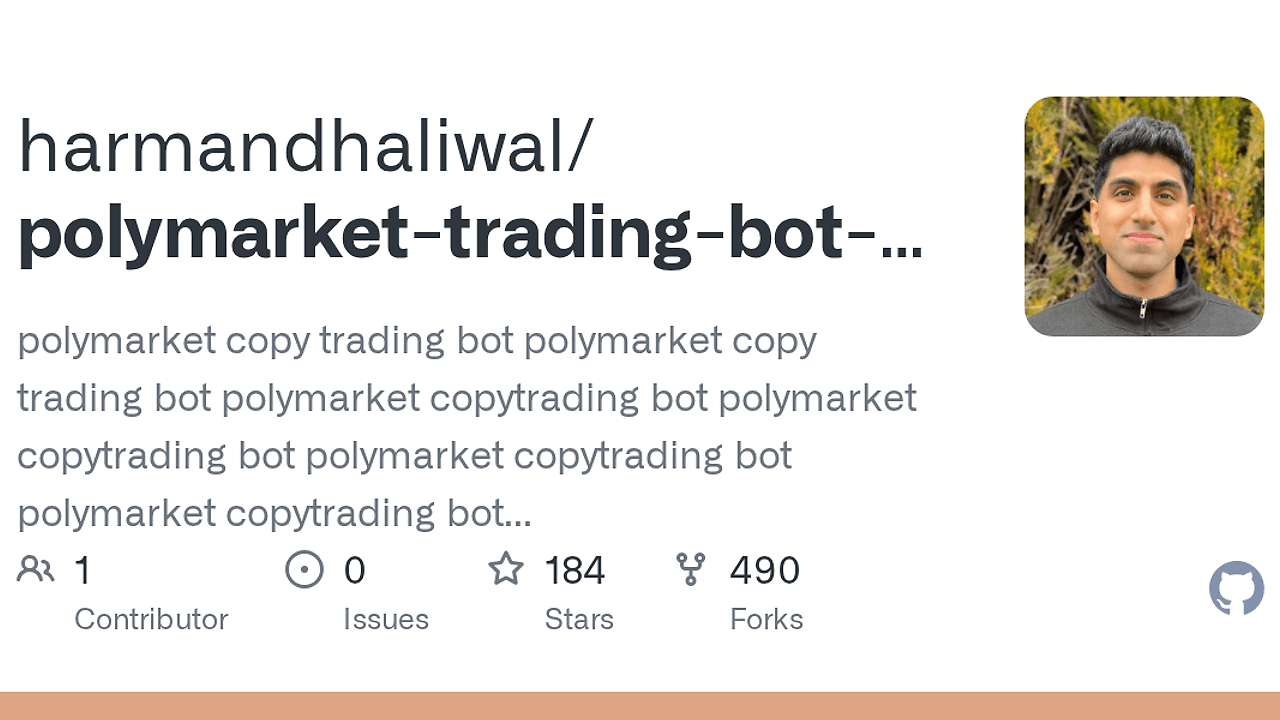
Polymarket Trading Bot is one of the best Prediction Market Trading Bots for Polymarket traders who want to mirror top wallets automatically. Built by Harman Dhaliwal in TypeScript and Node.js, it watches Polymarket’s CLOB through live WebSockets, copies selected wallet activity, and size-adjusts orders to your account; the published backtest shows +1938 USDC across 177 markets with 68 low-confidence signals skipped.
This is not a discretionary trading dashboard. It is an execution bot for people who want to follow wallets that already proved they can stay ahead of market narratives, from crypto to politics to sports, without manually clicking orders at 2am.
Quick Overview
| Attribute | Details |
|---|---|
| Type | Prediction Market Trading Bots |
| Best For | Polymarket traders who copy top wallets |
| Language/Stack | TypeScript, Node.js, ethers.js, Polymarket CLOB API, Polygon |
| License | ISC |
| GitHub Stars | N/A as of Mar 2026 |
| Pricing | Open-Source |
| Last Release | N/A |
Who Should Use Polymarket Trading Bot?
- Wallet-following traders who already watch Polymarket leaderboards and want execution automation instead of manual order entry.
- Indie hackers building a side system around prediction markets and needing a small, inspectable codebase in Node.js.
- Quant-minded bettors who prefer rule-based entry, balance-aware sizing, and signal filtering over gut feel.
- Small accounts that need position sizing tied to available USDC instead of copying whale size one-for-one.
Not ideal for:
- Traders who want a polished web UI, portfolio analytics, and risk dashboards out of the box.
- Anyone unwilling to manage a private key, RPC access, and Polygon USDC balances.
- Users who expect this bot to generate edge by itself; it mirrors execution quality, not alpha discovery.
Key Features of Polymarket Trading Bot
- Live wallet monitoring — The bot tracks target wallets through Polymarket’s live market infrastructure instead of polling on a timer. That matters because prediction markets move fast, and stale signals are usually dead signals.
- Multi-market coverage — It is built for crypto, politics, sports, world events, and economics, not one narrow market class. You can scope
COPYTRADE_MARKETSto a short list or run a broader watch set when your wallet list is well curated. - Balance-aware sizing —
COPYTRADE_SHARESandBOT_MIN_USDC_BALANCEkeep order size aligned to your account rather than the followed wallet’s bankroll. That avoids the common copy-trading mistake where a whale-sized thesis gets applied to an undersized account. - Confidence gating —
pricePredictorclassifies each signal and only allowsBUY_UPorBUY_DOWNwhen confidence clears the threshold. The repo’s own backtest skipped 68 low-confidence entries, which is exactly what you want if you care about signal quality over trade count. - Execution buffering —
COPYTRADE_PRICE_BUFFERgives the bot room for price drift between signal detection and order submission. That is important on a live CLOB where a few basis points can flip a fill from acceptable to expensive. - Per-side trade caps —
COPYTRADE_MAX_BUY_COUNTS_PER_SIDEprevents over-concentration when a wallet keeps nudging the same market. This is a simple control, but it stops copy trading from turning into accidental martingale behavior. - Polygon-native settlement flow — The bot uses Polygon wallets, USDC, and approval flows that match Polymarket’s settlement model. That means the code path is closer to production behavior than a simulation wrapped in fake exchange abstractions.
Polymarket Trading Bot vs Alternatives
| Tool | Best For | Key Differentiator | Pricing |
|---|---|---|---|
| Polymarket Trading Bot | Automated Polymarket copy trading | Live wallet mirroring with confidence filtering and balance-aware sizing | Open-Source |
| Manual Polymarket Trading | Discretionary traders | Full human judgment, no automation risk, no private-key automation layer | Free |
| OpenSwarm | Multi-step automation workflows | Better if you want to orchestrate broader agent tasks around a trading pipeline | Open-Source |
| OpenTrace | Event tracing and auditability | Better if you need to inspect order flow, latency, and failure points around the bot | Open-Source |
Pick manual trading if you still want to make every entry yourself and you trade only a few markets per week. Pick OpenSwarm if this bot becomes one step in a larger automation chain, such as signal routing, alerts, and post-fill tasks. Pick OpenTrace if you need observability around execution timing, rejected orders, or wallet-level decision logs.
If you are wiring this into a larger deployment workflow, djevops is the internal fit for deployment automation, while browse all DevOps Automation tools is the broader directory when you want adjacent tooling.
How Polymarket Trading Bot Works
The bot is built around a small set of core abstractions: watched wallets, market slugs, token IDs, a live order-book feed, and a signal classifier. It opens a persistent connection to Polymarket’s CLOB through websocketOrderbook, keeps best bid and ask data fresh, and then maps wallet activity to executable trade candidates before the order is sent.
The design choice here is simple. It does not try to predict the market from scratch, and it does not need a complex model to operate. It watches wallets that already have a track record, converts their behavior into buy or sell signals, and applies guardrails like minimum balance, confidence threshold, and per-side limits before touching funds.
COPYTRADE_MARKETS=btc-usd,us-election-2026,premier-league-winner
COPYTRADE_SHARES=10
COPYTRADE_PRICE_BUFFER=0.02
COPYTRADE_MAX_BUY_COUNTS_PER_SIDE=2
BOT_MIN_USDC_BALANCE=50
npm start
That example starts the bot with three market slugs, a fixed share size, a 2% execution buffer, and a minimum cash floor. In practice, the bot will listen for wallet movement, score the signal through pricePredictor, and only place an order when the confidence gate and size rules both pass.
The important architectural detail is that execution and signal selection are separated. That keeps the system easier to reason about than a monolithic script that conflates discovery, classification, and order placement in one loop. It also makes the bot easier to audit when you want to answer the exact question every trader asks after a bad trade: why did it enter here and not elsewhere?
Pros and Cons of Polymarket Trading Bot
Pros:
- Real-time execution path — WebSocket-based market tracking is a better fit than polling for fast-moving prediction markets.
- Clear risk controls — Balance floors, price buffers, and per-side caps keep the bot from spraying orders blindly.
- Open source and inspectable — The code path is small enough for a serious developer to audit, fork, and modify.
- Works across many market types — It is not locked to a single narrative like crypto or politics.
- Backtest evidence is included — The repo ships with dated results from Mar 23-24 2026, including 177 replayed markets and a documented PnL run.
- Private-key driven by design — Orders are signed locally, which is the right model for direct exchange interaction.
Cons:
- No polished UI — You are working in the terminal and
.env, not a dashboard. - Operational risk is on you — If your private key, RPC, or wallet setup is wrong, the bot cannot save you.
- Signal quality depends on wallet selection — Copying bad wallets is still bad trading, just faster.
- Limited built-in analytics — The repo shows backtest output, but not a full reporting stack.
- Requires active maintenance — API changes, market slug changes, and Polymarket execution quirks can break a bot like this.
Getting Started with Polymarket Trading Bot
A realistic Polymarket Trading Bot tutorial starts with Node 18+, a Polygon wallet with USDC, and a working RPC URL. The repo expects you to clone the code, install dependencies, copy the sample environment file, and fill in your wallet and market settings before running the process.
git clone https://github.com/harmandhaliwal/polymarket-trading-bot-copytrading.git
cd polymarket-trading-bot-copytrading
npm install
cp .env.example .env
# set PRIVATE_KEY, RPC_URL, COPYTRADE_MARKETS, and any sizing limits
npm start
After the first run, the bot should connect to Polymarket, load your configured watchlist, and begin evaluating wallet moves against the confidence gate. The initial configuration that matters most is the market list, the private key, and the sizing controls, because those determine whether the bot is actually tradable or just connected.
Verdict
Polymarket Trading Bot is the strongest option for Polymarket wallet copy trading when you want low-latency execution and simple risk controls. Its best strength is the combination of live CLOB tracking and confidence filtering, while the main caveat is that you still need to choose wallets well and operate it like production software. Recommended for developers who want direct control.