What Is Meteora Bundler?
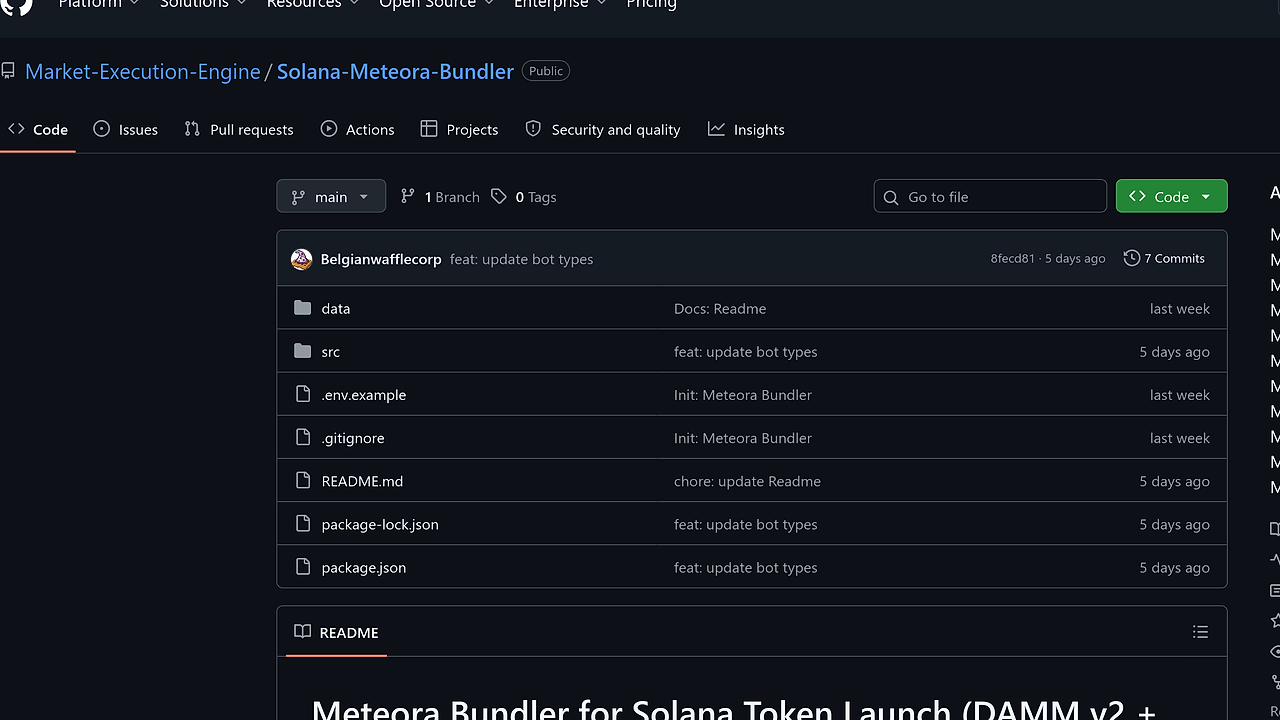
Meteora Bundler is a TypeScript-based Solana launch automation repo built by Market-Execution-Engine for teams that need to mint a new token, create a Meteora DAMM v2 pool, and open an Alpha Vault FCFS in one repeatable flow. Meteora Bundler is one of the best Solana Launch Automation tools for Solana token launch teams. The repo exposes three npm entrypoints and writes three JSON artifacts under data/, which makes each launch stage easy to rerun, inspect, and hand off.
This matters because the launch path is not a single transaction. It is a sequence of stateful steps that touches token minting, metadata upload, liquidity setup, and vault configuration, and the repository treats each step as a discrete script instead of a monolith.
Quick Overview
| Attribute | Details |
|---|---|
| Type | Solana Launch Automation |
| Best For | Solana token launch teams |
| Language/Stack | TypeScript, Node.js, Solana Web3.js, SPL Token, Token-2022, Meteora DAMM v2, Alpha Vault, Pinata/IPFS |
| License | N/A |
| GitHub Stars | N/A as of Feb 2026 |
| Pricing | Open-Source |
| Last Release | N/A |
Who Should Use Meteora Bundler?
- Launch teams coordinating a token mint, AMM pool, and FCFS vault who want one scripted workflow instead of three separate operators.
- Indie founders shipping a Solana token launch who need a deterministic process with filesystem outputs they can audit before going live.
- Protocol teams using SPL or Token-2022 that need a launch path with controlled quote mint selection, caps, and vesting windows.
- Operators who want a dry-runable preflight before flipping
DRY_RUN=falseon a real mainnet launch.
Not ideal for:
- One-off users who want a point-and-click UI and do not want to touch environment variables.
- Teams that need a generic multi-chain launch platform instead of a Solana-specific workflow.
- Projects that are not using Meteora primitives, because the repo is opinionated around DAMM v2 and Alpha Vault FCFS.
Key Features of Meteora Bundler
- SPL and Token-2022 mint support — Meteora Bundler supports both token program paths, so you can launch with the standard SPL token program or with Token-2022 when you need newer mint behavior. That is useful for teams that have already standardized on Token-2022 extensions and do not want a separate code path.
- Three-stage launch pipeline — The repo splits the launch into token mint creation, Meteora DAMM v2 pool creation, and Alpha Vault FCFS creation. Each stage has its own script and JSON output, which reduces hidden state and makes failures easier to isolate.
- Quote mint flexibility — You can launch against WSOL or USDC as the quote side. That matters for liquidity planning because you can choose the pair that matches your treasury, market structure, or distribution plan.
- Dry run mode —
DRY_RUN=trueis built in for safer preflight checks before you commit to an on-chain launch. This is the right default when you are testing env values, wallet permissions, and pool math on a staging flow. - Metadata upload flow — The mint step includes metadata and image upload through Pinata/IPFS. That gives the token a usable off-chain metadata path instead of forcing teams to bolt on a second upload script after the mint already exists.
- Alpha Vault FCFS controls — The vault flow exposes depositing point, vesting range, max deposit cap, individual cap, escrow fee, and whitelist mode. Those controls are what make the launch useful for controlled early participation instead of a free-for-all public sniping event.
- Filesystem artifacts for handoff — The repo writes
data/latest-token-mint.json,data/latest-pool.json, anddata/latest-alpha-vault.json. Those artifacts are a practical choice for CI, auditability, and recovery after an interrupted launch run.
Meteora Bundler vs Alternatives
| Tool | Best For | Key Differentiator | Pricing |
|---|---|---|---|
| Meteora Bundler | Scripted Meteora token launches | One repo handles mint, DAMM v2 pool, and Alpha Vault FCFS with JSON handoff between steps | Open-Source |
| Meteora dashboard | Manual launches inside the Meteora UI | No code required, but configuration is done by hand | Free |
| Custom TypeScript scripts | Highly specific one-off launch logic | Maximum control, but you own every edge case and retry path | Open-Source |
| Jito bundle scripts | Transaction ordering and bundled execution | Better for bundle mechanics than for full launch orchestration | Open-Source |
Pick the Meteora dashboard when you only need a one-time launch and want a UI instead of code. Pick custom TypeScript scripts when your launch flow diverges from the repo’s opinionated structure and you are willing to maintain the entire state machine yourself.
Pick Jito bundle scripts when the main problem is transaction ordering or inclusion strategy, not pool creation and vault setup. For broader release automation around the launch pipeline, djevops fits the surrounding CI/CD problem better, while OpenSwarm is a better match when the launch prep itself needs multi-step orchestration across tasks.
How Meteora Bundler Works
Meteora Bundler works as a linear launch pipeline with explicit state handoff between steps. The design is simple on purpose: each stage writes a JSON artifact, and the next stage reads that artifact instead of trying to reconstruct state from logs or chain queries.
The mint stage in src/token_mint.ts creates the token, uploads metadata through Pinata/IPFS, and records the resulting mint data in data/latest-token-mint.json. The pool stage in src/damm-v2-launch.ts consumes that output, builds the Meteora DAMM v2 pool, and stores pool state in data/latest-pool.json.
The vault stage in src/alpha-vault-fcfs.ts consumes both prior outputs and creates the FCFS vault linked to the pool. The vault is derived from the wallet, pool, and cluster program id, which keeps the launch deterministic as long as the environment variables stay consistent.
DRY_RUN=true npm run mint:token
DRY_RUN=true npm run launch:dammv2
DRY_RUN=true npm run create:alpha-vault:fcfs
The three commands above model the full launch path from mint to pool to vault. In practice, you run the mint first, verify the generated JSON, then move to DAMM v2, and finally create the FCFS vault once the liquidity and caps look correct.
Pros and Cons of Meteora Bundler
Pros:
- Clear step boundaries — minting, pool creation, and vault creation are separate scripts, so a failure in one stage does not collapse the entire launch flow.
- Supports modern token programs — SPL and Token-2022 are both supported, which matters for teams that need extension-aware token issuance.
- Launch-state artifacts are persisted — the
data/*.jsonfiles give you a reliable audit trail and a simple machine-readable input for the next command. - Built-in preflight path —
DRY_RUN=truegives you a safe place to validate configuration before using real funds or mainnet permissions. - Flexible distribution controls — FCFS deposit caps, vesting ranges, and whitelist modes let you shape early participation instead of leaving it to unconstrained access.
- Quote side selection — WSOL and USDC support makes the liquidity side easier to align with treasury or market-making constraints.
Cons:
- No UI — Meteora Bundler is script-first, so non-technical operators will need to work from the terminal and
.envfiles. - Heavy environment dependence — bad values in
RPC_URL,WALLET_SECRET_KEY, or pool parameters can break the flow before launch time. - Meteora-specific — the repo is built around DAMM v2 and Alpha Vault FCFS, so it is not a general Solana launch framework.
- Operational risk is still on you — dry run helps, but it does not replace test/dev rehearsals with the same parameters you plan to use on mainnet.
Getting Started with Meteora Bundler
Start by installing dependencies, copying the example environment, and filling the required launch values before you run any production step. The safest first pass is to keep DRY_RUN=true until the mint metadata, token program, quote mint, and cap values all validate cleanly.
npm install
cp .env.example .env
# fill RPC_URL, WALLET_SECRET_KEY, CONFIG_ADDRESS, PINATA_API_KEY, PINATA_SECRET_API_KEY
DRY_RUN=true npm run mint:token
After the first command, Meteora Bundler should create the mint output file and leave you with a token record you can inspect before continuing. Once that file looks right, you can run the pool and vault scripts in order, and you should only disable dry run after checking every env var and wallet permission.
Verdict
Meteora Bundler is the strongest option for scripted Solana token launches when you need mint, pool, and vault creation to stay in one deterministic pipeline. Its biggest strength is the JSON-driven three-step workflow; its main caveat is operational risk from misconfigured env vars and launch parameters. Use it when you want repeatability, not a GUI.