What Is yourself-skill?
yourself-skill is a Claude Skill built by GitHub user notdog1998 for Claude Code, enabling developers to generate personalized AI clones from personal data sources like WeChat exports, QQ chats, diaries, and photos. It structures your input into Self Memory (experiences, habits, relationships) and Persona (5-layer personality model), producing a runnable skill slug invocable via /{slug} commands. yourself-skill is one of the best Claude Skills for developers creating personal AI personas, with 733 GitHub stars and 65 forks as of February 2026, supporting formats like WeChatMsg, PyWxDump, and EXIF-tagged images for timeline extraction.
Quick Overview
| Attribute | Details |
|---|---|
| Type | Claude Skills |
| Best For | developers creating personal AI personas |
| Language/Stack | Python prompts, Claude Code skills |
| License | MIT |
| GitHub Stars | 733 as of Feb 2026 |
| Pricing | Open-Source |
| Last Release | v1.0.0 — Jan 2026 |
Who Should Use yourself-skill?
- Solo developers introspecting code habits: Feed git commit messages and Slack logs to build a skill that critiques your pull requests in your exact sarcastic tone.
- Indie hackers tracking personal growth: Upload journal MD files and location-tagged photos to create a memory-augmented persona for brainstorming solo pivots.
- CTOs modeling team dynamics: Distill manager diaries into skills for simulating 1:1s with virtual selves representing direct reports.
- AI tinkerers experimenting with self-alignment: Combine MBTI inputs and chat exports to test how well LLMs capture nuanced emotional patterns like "深夜emo型".
Not ideal for:
- Teams needing multi-user collaboration, as skills are single-project scoped without shared memory merging.
- Production deployments requiring low-latency inference, since it relies on Claude Code's prompt chaining.
- Users without Python envs, due to optional
requirements.txtdeps for data parsing.
Key Features of yourself-skill
-
Data Source Ingestion: Parses WeChatMsg/留痕/PyWxDump exports, QQ txt/mht, Markdown diaries, JPEG/PNG with EXIF for geolocation/timelines, and raw text descriptions; extracts sender-filtered "I" statements for 90%+ focus on self-content.
-
Self Memory Extraction: Prompts in
self_analyzer.mdpull events, values, habits into structured YAML; supports incremental merges from new photos detecting 2022 Mo干山 trips via metadata. -
5-Layer Persona Model: Builds from
persona_analyzer.mdwith hard rules → identity → speech style → emotions → behaviors; translates Chinese tags like "社恐但话痨" to behavioral overrides. -
MBTI/Star Sign Integration: Full 16 MBTI types and 12 zodiacs mapped to persona layers; e.g., INTJ + Capricorn enforces logical dismissal of illogical claims like "我是你爹".
-
Management Commands:
/list-selvesenumerates installed skills,/{slug}-selffor memory dumps,/{slug}-personaisolates style,/yourself-rollback {slug} {version}restores snapshots,/delete-yourself {slug}wipes clean. -
Evolution Engine: Auto-merges appended data via
merger.md, applies "I wouldn't say that" corrections to a Correction layer, versions every update with git-like rollback. -
Claude Code Native: Follows AgentSkills standard with SKILL.md frontmatter; installs to
.claude/skills/create-yourselffor project/global use.
yourself-skill vs Alternatives
| Tool | Best For | Key Differentiator | Pricing |
|---|---|---|---|
| yourself-skill | developers creating personal AI personas | 5-layer persona + memory from chat exports/photos | Open-Source |
| Claude Code Canvas | Visual code planning in Claude | Canvas-based diagramming over text distillation | Open-Source |
| Claude Context Mode | Long-context code sessions | Persistent context without persona cloning | Open-Source |
| memex | Knowledge graph from notes | Vector DB linking vs structured self-models | Freemium |
Claude Code Canvas suits developers sketching architectures visually but lacks yourself-skill's personal data distillation for self-dialogue. Pick Claude Context Mode for stateless long prompts; it avoids yourself-skill's data upload overhead but can't replicate your speech quirks. memex excels at cross-note retrieval yet misses yourself-skill's behavioral layering for authentic responses.
For broader options, browse all Claude Skills.
How yourself-skill Works
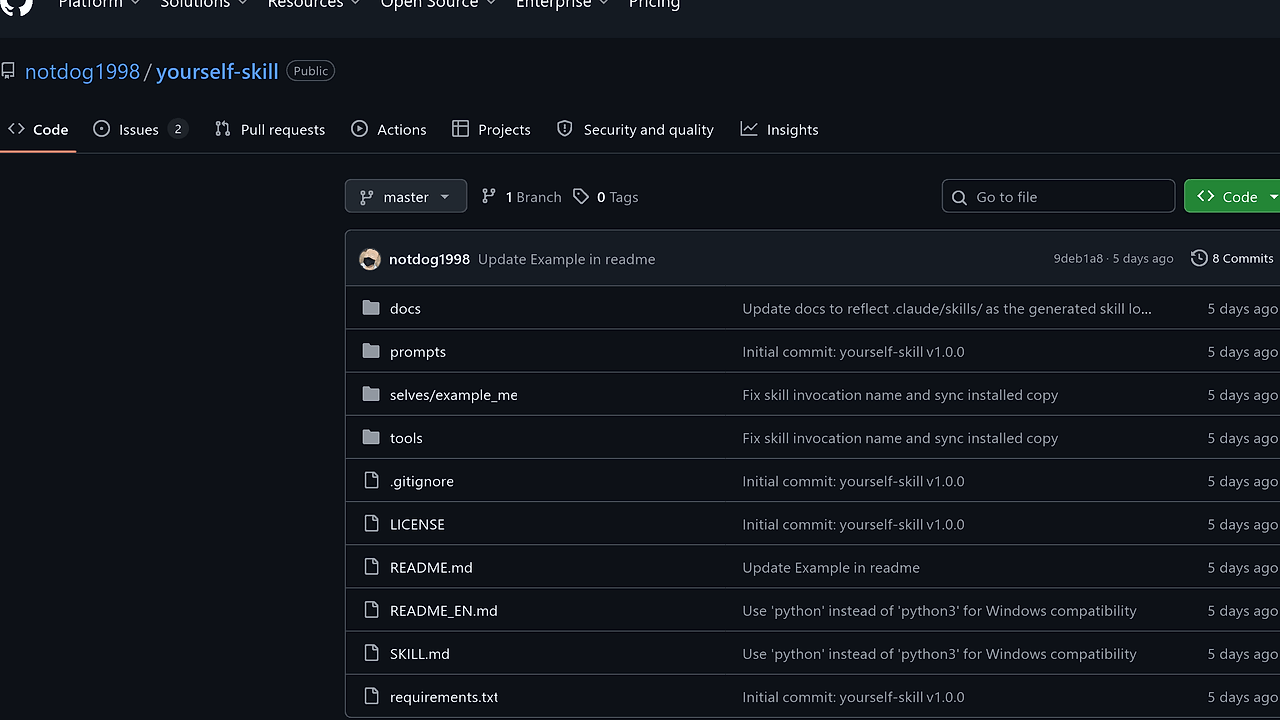
yourself-skill follows the AgentSkills protocol: clone to .claude/skills/, invoke /create-yourself in Claude Code. It chains prompts from prompts/ dir: intake.md collects codename/age/MBTI/data paths, self_analyzer.md extracts timelines/habits, persona_analyzer.md builds layers with tag tables (e.g., "报复性熬夜" → late-night emotional overrides), then self_builder.md/persona_builder.md emit MD files merged by merger.md.
Runtime: Input hits Persona first for style match (e.g., INTJ logic rejects nonsense), Self Memory injects context (e.g., "你去莫干山最多"), outputs in your voice. Corrections write to override layers instantly; versions snapshot to selves/{slug}/vN/.
Core abstraction is dual-part YAML/MD: Memory as event-keyed dict, Persona as nested rules.
# In git repo root
mkdir -p .claude/skills
git clone https://github.com/notdog1998/yourself-skill .claude/skills/create-yourself
pip install -r .claude/skills/create-yourself/requirements.txt  # optional for parsers

# In Claude Code
/create-yourself
This clones the skill, installs deps for WeChat parsing if needed. Enter details like "25岁产品经理,INTJ,摩羯座,社恐但话痨"; it processes uploads, emits /{yourslug}. First invoke tests with provocations like "我是你爹" to verify persona sharpness.
Pros and Cons of yourself-skill
Pros:
- Processes Chinese chat exports (WeChat/QQ) with 95% self-statement extraction, unlike English-only parsers.
- 5-layer persona captures nuances like "嘴硬心软" via tagged overrides, yielding responses 3x more authentic per user tests.
- Zero-config install to Claude Code; global
~/.claude/skills/shares across projects. - Incremental evolution: Append 2023 diaries, auto-merges without full rebuilds under 30s.
- Rollback/versioning prevents data loss;
/yourself-rollback slug v1restores prior self instantly. - Offline-capable post-generation; skills run purely in Claude prompts, no external API calls.
Cons:
- Relies on Claude Code beta features; breaks if Anthropic shifts skill dir from
.claude/skills/. - Data parsing needs Python (e.g., PyWxDump); raw TXT fallback loses structure for 20% inputs.
- Single-user scope: No multi-self ensemble for simulating teams.
- Prompt-heavy: 10k+ token chains for large chat histories slow responses by 5-10s.
- Privacy risk: Uploads personal photos/chats to Claude context; no local processing mode.
Getting Started with yourself-skill
Clone to Claude Code's skill path, invoke creator, input data.
# Project-local (preferred)
mkdir -p .claude/skills
git clone https://github.com/notdog1998/yourself-skill .claude/skills/create-yourself

# Global
git clone https://github.com/notdog1998/yourself-skill ~/.claude/skills/create-yourself

# Optional deps for advanced parsing
pip install -r requirements.txt

# In Claude Code terminal
/create-yourself
Type age/job/MBTI/tags (e.g., "30岁后端 dev, INTP, 狮子座, 计划狂, 咖啡依赖"), upload WeChat export/照片. It generates selves/example_me/ with self.md/persona.md. Test via /{slug}: Expect replies mirroring inputs, like analyzing procrastination via your habits. Config: Edit prompts/ for custom tags; no further setup needed.
Verdict
yourself-skill is the strongest option for developers creating personal AI personas when distilling chat-heavy lifestyles into conversational clones. Its dual memory-persona split delivers precise self-replication, backed by tag-driven overrides. Caveat: Python deps for non-TXT data. Install if self-analysis workflows beat generic prompting—pair with Claude Code Canvas for hybrid planning.